




Dental Clinic on Google Maps: Visibility and Errors
Many owners dentistry people think that if a clinic's profile is on Google, it's already working. In practice, this isn't true. Google clearly explains that local visibility is based on three factors: how relevant the profile is to a search query, how close the business is to the user, and how visible and trustworthy it appears. Of the factors a clinic can actually influence, Google specifically highlights profile completeness, data accuracy, current hours, responses to reviews, and the availability of photos and videos.
Therefore, the problem often isn't that you have "bad SEO" overall. More often, the profile is simply underperforming in several places at once. Each individual detail seems insignificant. But together, they reduce impressions, clicks, calls, and routes.
Below are five reasons to check first.

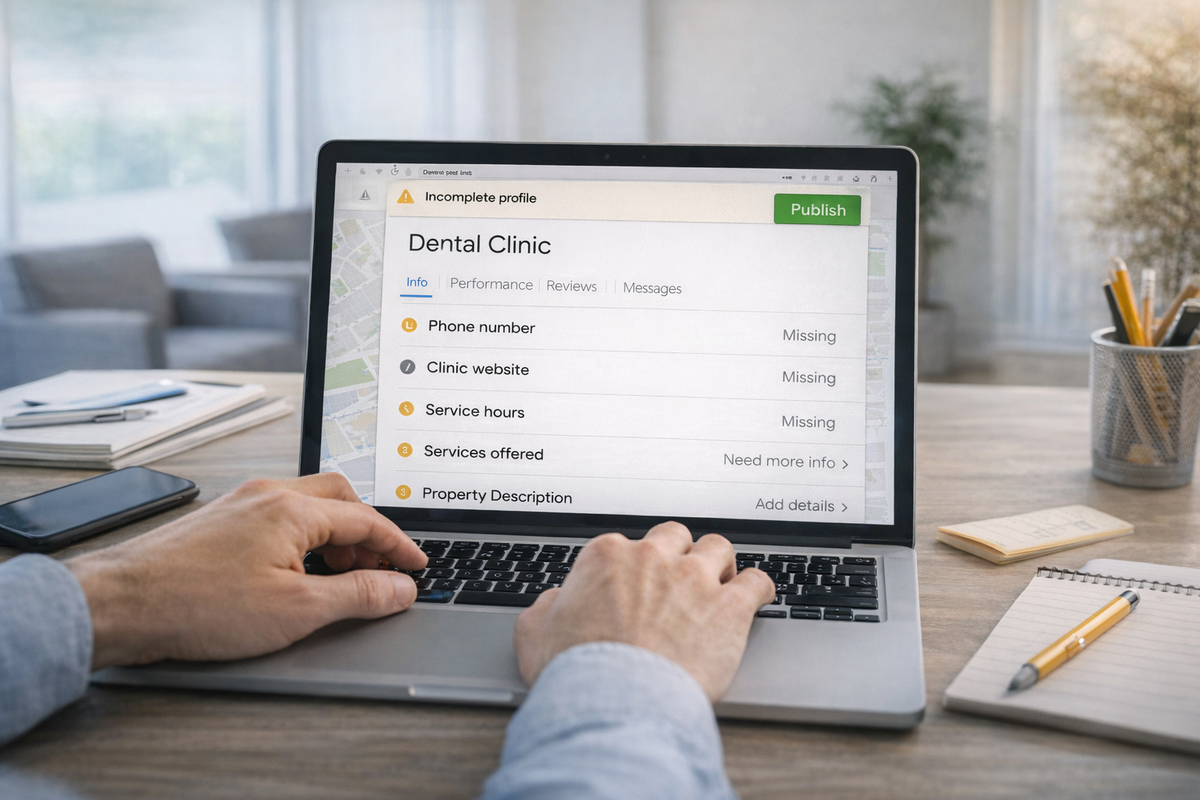
1. The card is not completely filled out.
This is the most common problem. The clinic has a name, address, and phone number—and that's it. But Google recommends keep your profile as complete and accurate as possible, as this helps your business better understand what it does, where it's located, and what search queries it should be shown for. If the information is incomplete or inaccurate, your profile may simply not show up for relevant local searches.
What dental practices often miss:
- Outdated opening hours;
- Empty or limited list of services;
- Overly general descriptions;
- Unspecified categories;
- Lack of local details such as appointments, a specific branch's website, or appointment details.
If you have several specialties—implantology, orthodontics, aesthetic dentistry, surgery—and these are barely reflected in your profile, Google receives too few signals to confidently show you in these areas. How this is checked, step by step, is shown in our breakdown of map visibility.
2. Google doesn't fully understand who you are and what makes you different
Google recommends choosing a minimum number of categories that accurately describes your core business and presenting your company as it actually appears offline and on your website.Separately Google indicates, the address must be accurate, and the profile must be unique to each business, otherwise there will be problems displaying information.
This is especially important for dentistry, as clinics often try to "shove everything in at once":
- Add unnecessary wording to the title;
- Mix brand, branch, and services into one line;
- Create unnecessary cards;
- Choose a category that's too broad or too strange.
The result is simple: your profile becomes less clear to both Google and humans. And when your profile is unclear, it ranks worse and converts worse.
The rule of thumb here is: your profile should explain who you are, where you are, and what you offer in 10 seconds.
3. The card has weak trust signals
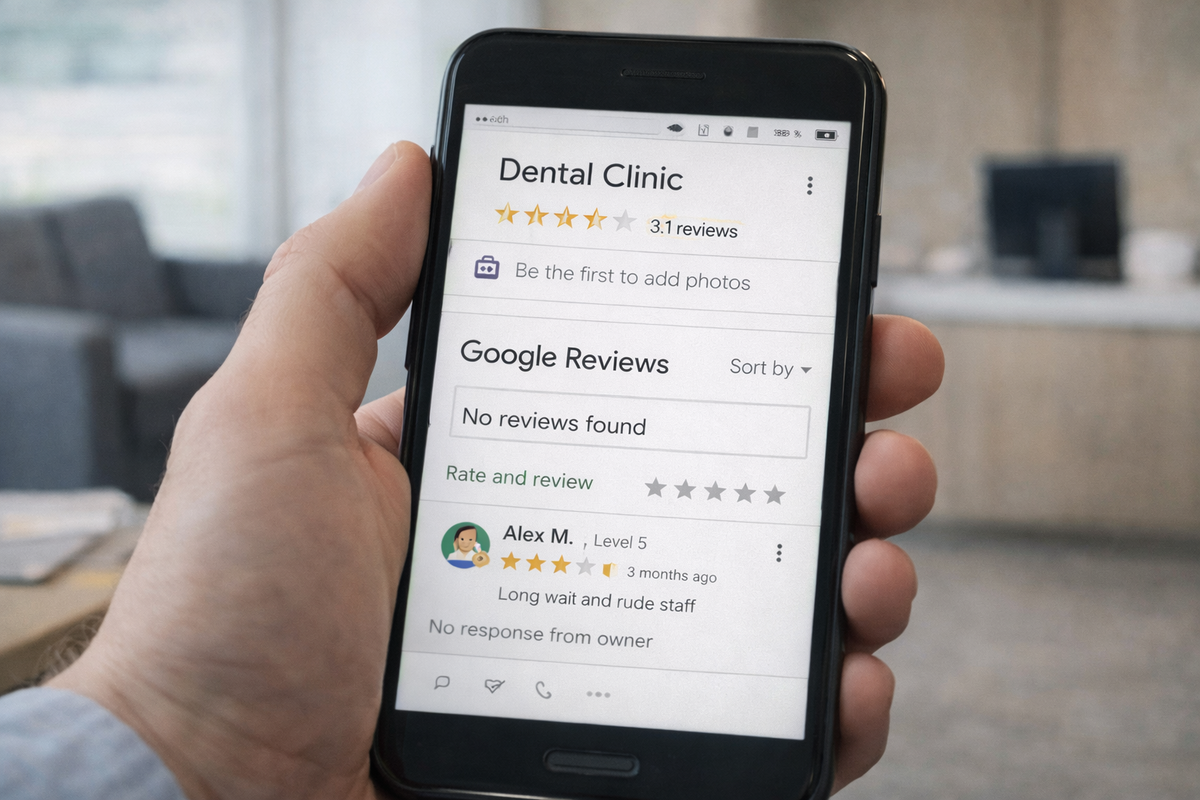
Even if a profile is technically correct, it may appear "empty." And for dentistry, this is critical. People rarely choose a clinic based on its name alone. They look at photos, how recent the profile is, reviews, and how the clinic responds to people.
Google explicitly states that positive reviews and helpful responses help businesses stand out.,The number of websites linking to a business and the number of reviews are considered prominence signals. More good reviews and positive ratings can help local rankings.
What I often see with dental practices:
- The last photos were uploaded six months ago;
- There are no photos of the team, offices, equipment, or process;
- No one responds to reviews;
- Negative comments are posted without response;
- There is a rating, but few recent reviews.
And it's important not to stray into a gray area here. Google specifically prohibits fake engagement: reviews without real experience, reviews for discounts, and content from multiple accounts to manipulate ratings. For this, the profile may receive restrictions. — This can include blocking new reviews for a period, removing existing reviews, and issuing warnings to users.
Therefore, a strong card isn't a quick fix. A strong card is when trust grows naturally and systematically.
4. You have duplicates or inconsistencies in your data
This is a subtle problem that goes unnoticed for a long time. For example:
- an old phone number somewhere;
- an old website link somewhere;
- the same branch appears in two versions;
- one address is written differently;
- someone once created a second profile "just in case."
Google clearly states that a business should have one profile per business, and duplicates can cause problems displaying information. Moreover, if a profile is considered a duplicate, It may not show up in Google Search or Maps at all.
For networks and clinics with multiple doctors, this issue is even more sensitive, as they often mix up the following:
- organization profile;
- doctor profile;
- branch profile;
- old traces from previous contractors.
If these things aren't sorted out, you could spend months improving photos, reviews, and posts, while some of the impact will be lost in the chaos of the structure.
5. The card is not supported by the site and local logic
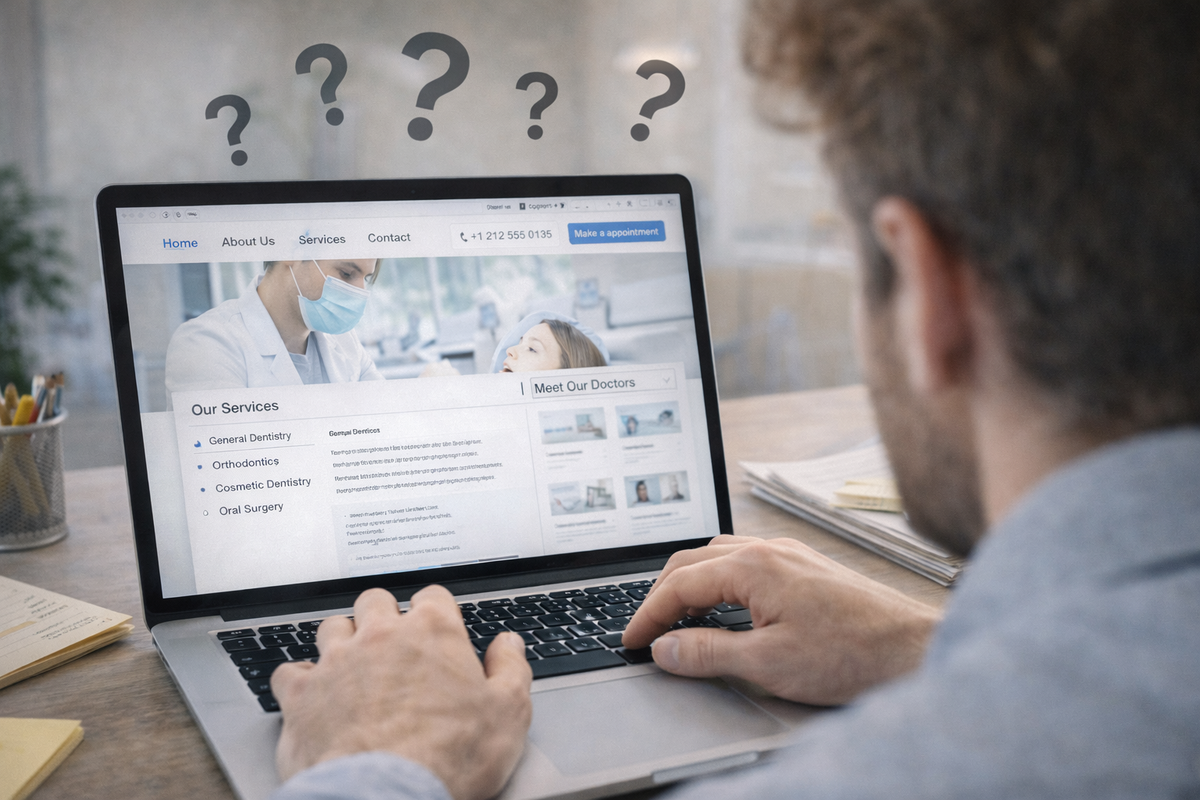
Google evaluates not only the profile itself but also the overall context of the business. If the website is weak, not localized, or doesn't correspond to a specific branch, the card has a harder time converting interest into a booking.
This doesn't mean that without a perfect website, the card won't work. But it does mean something else: when a clinic has a clear page specific to a city, branch, or specific area, it's easier for people to make a decision. But when everything leads to a generic website without a local landing page, some traffic is lost after the click.
At a visceral level, it looks like this:
- they saw the card;
- they accessed the card;
- they went to the website;
- and then it's not very clear who exactly is seeing patients,
- where the branch is, what services you specialize in, or how to make an appointment.
This is especially dangerous for dental practices because patients have a high threshold of trust. A "pretty card" isn't enough for them. They need to quickly understand that the clinic is real, understandable, and professional.
Why do large clinics often outperform small ones?
More often than not, it's because large clinics have established processes:
- who updates the profile;
- who monitors photos;
- who collects real reviews;
- who responds to negative reviews;
- who checks hours and services;
- who ensures consistency of information across branches.
In other words, large clinics grow not by magic, but by discipline. Small clinics often fail not because of size, but because of a lack of system. And that's the good news: a system can be built without a large marketing department.
Quick profile check: what to review first
What to do next
Clinic owners typically don't have the time to analyze everything layer by layer: what impacts visibility, what impacts trust, and what puts their profile at risk.
At this stage, a short, external review of the profile is more effective than a "call for the sake of a call."
At Madloba Consult a free format has been created for this purpose: simply send a link to a Google Maps listing, without account access or login. In response, you'll receive an audit with prioritized recommendations on what to fix first to increase visibility and engagement on your card.
You don’t need to buy anything or share access right away.
Start by identifying exactly where your profile is losing impressions, calls, and directions.
If you need an external review, you can send a link to your profile for a free audit — it will quickly show what needs to be fixed first.

1 comment
Log in to leave a comment