




Dental Reviews: Fake Review Risks and Google Policy
In dentistry, reviews aren't just cosmetic; they're a key factor in trust and visibility in local search. The problem is that quick "add 20 reviews in a week" schemes often fall under Google's definitions of "fake engagement" and "rating manipulation" and can result in review deletion and profile restrictions (including a temporary ban on receiving new reviews and user warnings).. [1] This article covers what Google considers to be fraud, why it's dangerous for dental practices, and how to build a system of honest reviews that supports growth without hidden risks.. [2]
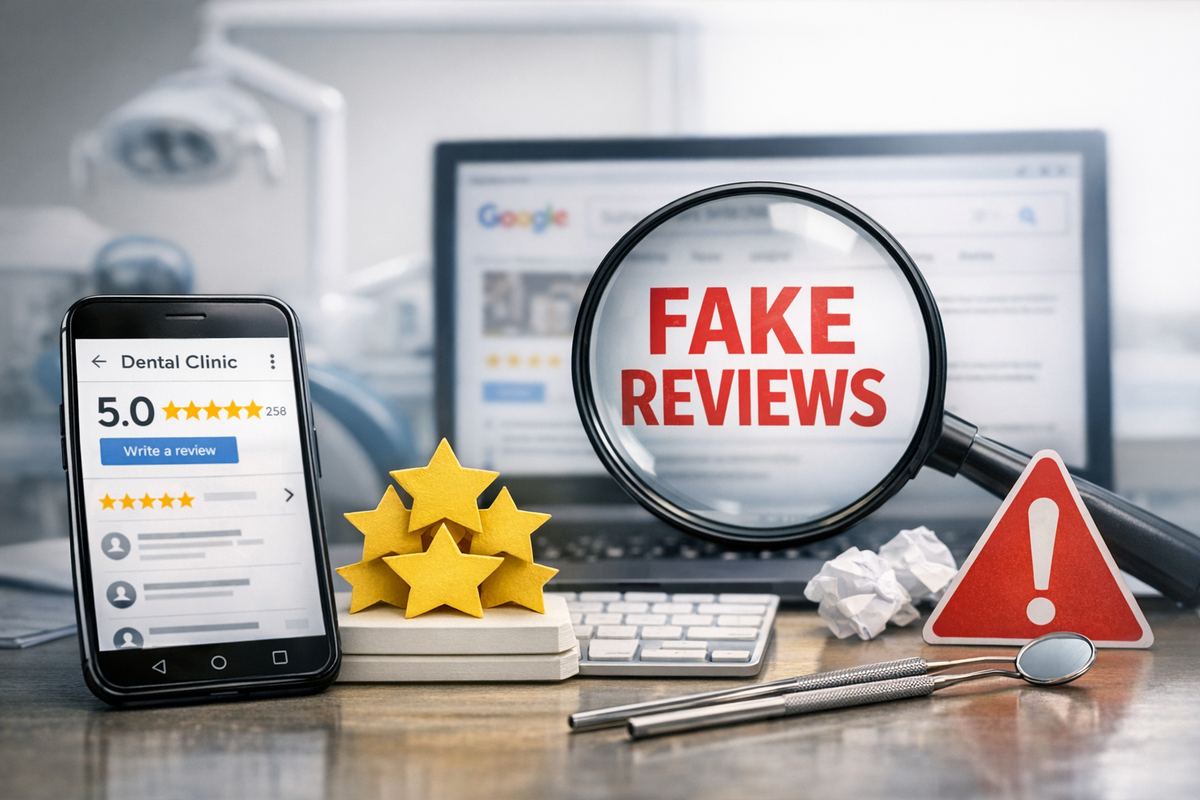
Dental clinics inflate reviews not because they are "bad people," but because the market is tough: patients choose carefully, and a Google profile is often the first thing they see (stars, number of reviews, freshness, clinic responses).. [3] But it's precisely here that the cost of error is highest: Google openly describes prohibitions on fake and incentivized reviews and explicitly lists the restrictions it can impose on a profile in the event of violations. [4]
It's important to set the right expectations from the start. Google explains that local results are mainly based on relevance, distance, prominence, and that there is no way to “request or pay for” a better position. [5] Reviews are part of prominence signals, so the temptation to "speed things up" is understandable—but speeding things up through cheating often turns into a risk for the entire digital channel (card + website + reputation). [6]
Why dentistry is tempted to overcharge and why it's almost always a bad rate
One reason is consumer behavior. According to BrightLocal’s Local Consumer Review Survey 2026, 97% of consumers read reviews, and 41% “always” read reviews when choosing a business. On top of that, people increasingly care about freshness: BrightLocal also shows that recency has become more important, and a meaningful share of consumers pay attention to reviews from recent weeks. [7]
The second reason is the mistaken belief that “you only need a 5.0 rating and lots of reviews.” In the same study, BrightLocal shows that although stars matter, only a small share of consumers insist on a strict 5-star rating, while the main expectation threshold is “high, but realistic” — for example, 4.0–4.5+. That reduces the value of manipulation: you do not need to “paint a perfect picture” to win a patient’s choice. [7]
The third reason is pressure from competitors and agencies. Google explicitly states in "Fake & Misleading Content & Reviews" that it will remove fake engagement, and "Rating Manipulation" includes, for example, unusual review volumes/patterns that indicate attempts at rating manipulation. [8] That is, a “surge in reviews over a short period of time” is not just a marketing activity, but a potential trigger for quality control systems.. [8]
Why Fake Reviews Seem Attractive
This diagram works best at the beginning of the article or right after the section explaining why dental clinics feel tempted to speed up review growth.
What Google considers fake engagement and rating manipulation
Google’s rules are quite direct: reviews on Google Maps must reflect real experience. Fake engagement is not permitted and will be removed. [8] Fake engagement is not allowed and will be removed. Among other things, Google includes the following under fake engagement:
- content not based on real experience; [8]
- reviews/ratings that are paid for (with money or “in kind” — discounts, bonuses, or services); [8]
- reviews posted from multiple accounts at one person’s request; [8]
- reviews submitted using emulators/device spoofing/modified operating systems and any techniques that imitate “real activity.” [8]
A separate category is Rating manipulation. Google explicitly includes Incentivized or Biased Reviews here and describes the following as violations:
- reviews left because of a promised incentive (payment, discount, free goods/services), including incentives for “editing” or “removing” a negative review; [8]
- unusual review volumes or patterns indicating rating manipulation; [8]
- conflicts of interest (for example, an employee, contractor, competitor, relative, or other professional/personal relationships that create bias). [8]
The key part that dentists often skim read is that Google states that merchants are not allowed to: - offer incentives for reviewing or editing/removing a negative review; [8]
-prohibit/discourage negative reviews or selectively request only positive ones; [8]
- Require or pressure users to leave a review on-site, and request specific text (including requests to mention an employee by name); [8]
- set employees a KPI of “collect N reviews” or require specific content. [8]
These are important formulations specifically for dental practices, because the typical scenario of “reception desk + iPad + “give 5 stars to Dr. X” can come across as pressure and as a request for “specific content.”. [8]

What are the consequences of violations and why is this a risk not only to reputation but also to traffic?
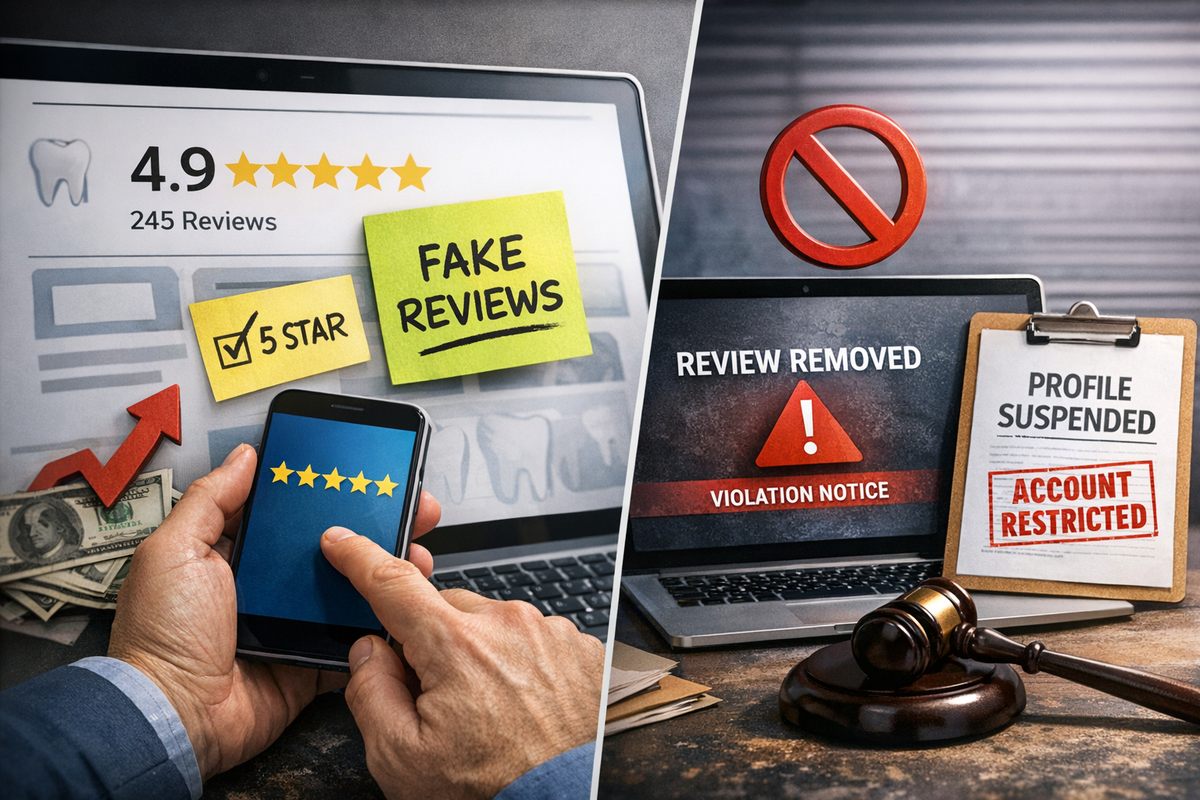
Google has a separate page for “Business Profile restrictions for policy violations” and clearly states: if a profile owner violates the fake engagement policy, Google may impose restrictions on the profile in addition to removing violating reviews.. [9] Examples of restrictions (important: these are officially listed as possible measures):
● the profile may be unable to receive new reviews/ratings for a set period; [10]
● existing reviews/ratings may be taken down from publication for a set period; [10]
● the profile may display a warning telling users that fake reviews were removed. . [10]
Google also says it will notify the owner by email and that the business has the option to appeal.. [10]
Why this affects traffic, not just image. Google emphasizes that prominence takes into account, among other things, the number of reviews and that more reviews and positive ratings may help local ranking. [5] If your reviews are removed or you temporarily lose the ability to receive new ones, you lose one of the important controllable prominence signals — and at the same time, you lose patient trust, especially if a public warning appears. . [11] We wrote separately about what happens after you buy reviews and why it cannot be undone.
Risk ladder: from a safe request to explicit manipulation
The higher the level, the closer the practice is to violating Google’s policies and the higher the risk of restrictions on the listing.
This classification is based on Google’s wording about prohibited practices. [8]
The gray zone: common review manipulation scenarios in dentistry and what to replace them with
Below are practical situations that most often “accidentally” turn into violations.
Risky review practices
Scenario “Discount for a review”
Scenario “Ask only happy clients”
Scenario “Leave a review now”
Scenario “Write that the doctor is the best”
Scenario “Agency provides reviews”
Scenario “Using reviews in ads without compliance”
What to do instead of manipulation: an honest review system and checklist
If the goal is growth without the risk of restrictions, the logic should not be “more at any cost,” but rather “a steady flow of real reviews + freshness + replies + service recovery.”
Below is a checklist of “what to do instead of manipulation,” aligned with Google’s principles: no incentives, no selectivity, no pressure on-site, and no prompts about “what to write.” [8]
Checklist: What to do instead of review manipulation
If your goal is stable growth without the risk of restrictions, the process should not be aggressive, but calm, clear, and systematic.
Make the process simple but neutral
- Use one standard review request for all patients. Do not ask for “5 stars”, suggest wording, or ask to mention staff. [8]
- No incentives: no discounts, gifts, or “free consultation for a review”. [8]
- Do not set KPIs like “collect N reviews” — Google warns about pressure and manipulative patterns. [8]
Separate public reviews and service recovery
- Public review: “If you’re willing, share your experience on Google.”
- Private feedback: “If something wasn’t right — reply and we’ll fix it.”
Focus on recency
- BrightLocal shows increasing importance of recency — better “2–4 reviews monthly” than “30 in a week and silence”. [7]
Respond to reviews consistently
- Google includes reviews in prominence signals; responses improve trust and conversion. [14]
Reduce temptation to manipulate reviews
- Customers rarely expect a perfect 5.0 — being real and trustworthy matters more. [7]
One safe review request template
The tone should be neutral, without pressure and without influencing the content:
“Thank you for visiting us today. If you have a minute, please share your experience on Google — it helps other patients make a decision. If anything was not right, reply to this message and we will look into it.”
(Add the link to the listing as a convenience, not as “do it right now.”)
A soft CTA for a free audit, without a hard sell
If you are not sure where your listing is weak — reviews, replies, “gray” tactics risks, duplicates, or profile completeness — the best place to start is with a diagnostic step that comes with no obligation. The same check from a single link is done at Madloba Consult.
MapsAudit offers a free listing audit: all you need is a public Google Maps listing link, with no login, the audit is promised within 48 hours, and it includes 10 prioritized recommendations, examples of “how to fix it,” and a block covering reviews and risks/duplicates. One more trust point: the site clearly states that the resource is not affiliated with Google. [15]
Legal and ethical risks and materials for publication
Legal and ethical risks
Below is a short guide to three jurisdictional “packages.” This is not legal advice, but it is a useful risk map to help you avoid problems when you use reviews/photos/cases later in advertising, on your site, or on social media.
US (HIPAA + FTC)
- HHS explains that the HIPAA Privacy Rule, with limited exceptions, requires written authorization from the patient before using or disclosing protected health information for marketing purposes. [16]
- ADA practical guidance emphasizes: use photos of real patients only with written permission, and for identifying photos, including full-face images, where HIPAA applies, a valid written authorization is required. [17]
- For “testimonials” and unusual results, the FTC explains the principle that if advertising contains endorsements with exceptional results, and the advertiser has no evidence that this is a typical result, it must clearly disclose the “generally expected results.” [18]
UK (GDC + ASA)
- GDC requires public information, including marketing, to be current and accurate, understandable for patients, supported by facts, and not create unjustified expectations; it must also clearly indicate NHS/mixed/private. [19]
- ASA emphasizes that “before/after” materials in dentistry must be genuine and representative, and advertisers must have signed and dated proof; in separate guidance, ASA says that “before/after” is often treated as testimonials, and permission plus contact details of the provider must be available. [20]
EU/EEA (GDPR)
- The European Commission describes the transparency rule: when collecting data, including personal data, you must clearly inform people who is collecting it, why, on what legal basis, how long it will be stored, who the recipients are, what the data subject’s rights are, and so on. [21]
- ICO, under UK GDPR, though the definition matches in substance, states that personal data is any information about an identified or identifiable person. If you take a review and publish it on your site with a screenshot of the name/avatar, you are potentially processing personal data. [22]
In practice, for directories and “case studies without names,” it is safer to anonymize by removing names/profile photos, or to have a legally valid basis and properly prepared privacy information. [23]
Sources
Google contribution policy
Google Business Profile help
Google Business Profile policy page
MapsAudit

1 comment
Log in to leave a comment