




Small Dental Clinics on Google Maps: Visibility and Reviews
On Google Maps, clinic size and budget do not automatically provide an “automatic advantage”: local results rely on relevance, distance, and prominence, and there is no way to “request or pay for” a better position. [1] Small practices often win through discipline: they have less data chaos, faster updates, more “human” review responses, and a profile that is clearer to the patient. [2] In this article, I break down the mechanics and provide a “first-week plan” so that a small dental clinic can catch up with and overtake larger players without gray-hat tactics. [1]
In dentistry, choice is always about trust. A patient rarely “buys a service” — they choose safety, predictability, and confidence that they will be understood and not harmed. That is why small clinics sometimes look stronger in local search, even if a network has more branches and a larger marketing budget. [3]
How Google ranks dental clinics in local search
Local ranking in Google Maps is typically based on three factors: relevance, distance, and prominence. For a small dental practice, the key is not to “beat distance”, but to maximize the signals that can actually be improved systematically. [1]
Relevance
How accurately the clinic profile matches a patient’s query. The more complete and clear the profile is, the easier it is for Google to understand when and to whom to show it. [1]
Highly controllableDistance
How close the clinic is to the user or to the location Google associates with them. This is the factor business owners have the least control over. [1]
Hard to controlProminence
How well-known and visible the clinic is online and to patients. This includes reviews, mentions, links, activity, and overall trust signals. [1]
Partially controllableWhat this means for a small clinic
A small dental practice can outrank a large one not because of budget, but because it sends a clearer and more consistent signal to both Google and patients. When the profile is structured, data is accurate, photos are fresh, and reviews receive real human responses, the listing becomes more understandable, trustworthy, and relevant. [1]
What clinic owners can control
Speed and discipline: it is easier for small clinics to keep a profile “alive”
Google recommends a simple thing that in practice separates “growing” from “stagnant” listings: keep information complete and up to date — such profiles “are more likely to show up” in local search. [1] If the data is inaccurate, the profile may fail to appear for relevant queries. [1]
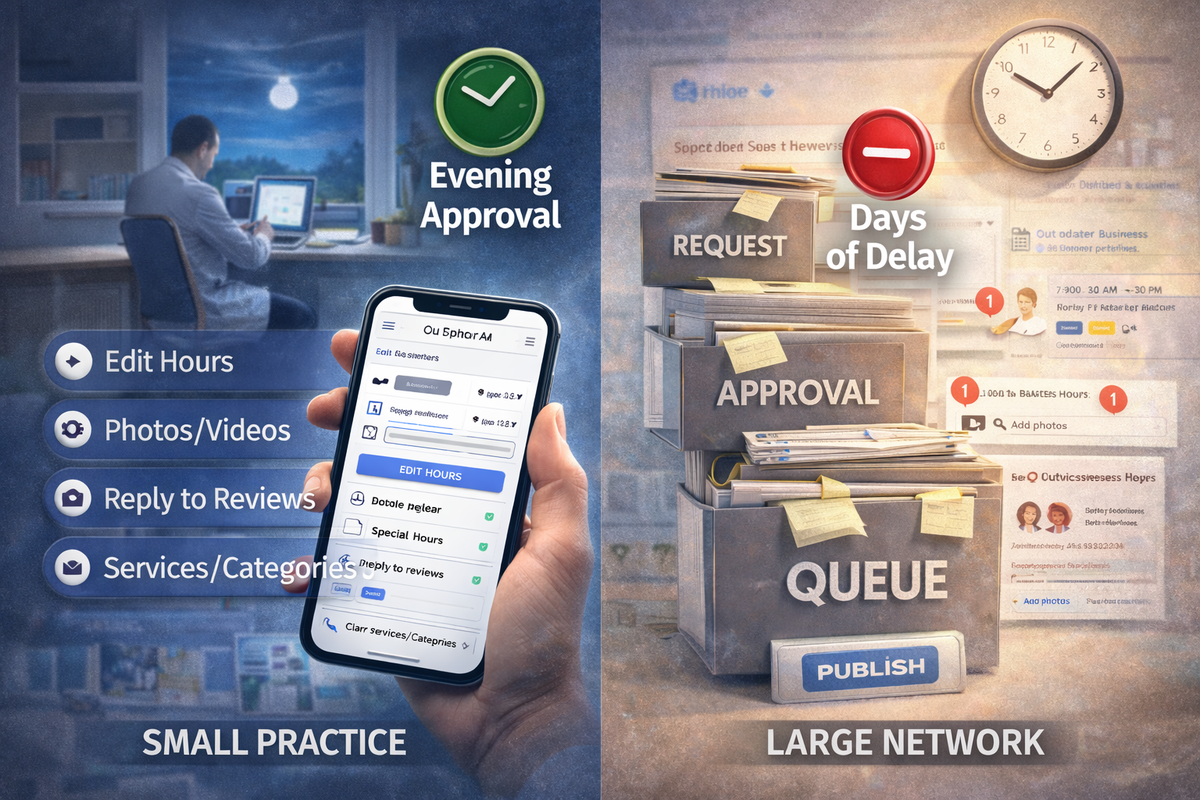
The problem for large clinics and networks is not competence, but the speed of internal approvals. In a small practice, the owner/manager can in one evening:
- update regular hours and special hours;
- add fresh photos/videos;
- reply to new reviews;
- clarify services and categories. [1]
In a large structure, this often turns into “request → approval → queue → publication.” And the listing looks less current. Google directly highlights regularly updating hours, replying to reviews, and adding photos/videos as practices that “improve local presence.” [1]
Mini-case (anonymized). A network with several branches could have a strong brand, but one branch “underperformed” because special hours were not updated, reviews were left unanswered, and photos had not been refreshed for months, a typical “no one was assigned responsibility” effect. A nearby small clinic won because its profile looked more active and clearer to the patient. This case is about discipline, not a “secret trick.” [1]
Less organizational chaos: networks more often have duplicates and conflicting data
As a business grows, so does the probability of “entity chaos”: duplicate listings, an old phone number, different versions of the address, different names, “mixed brands.” In its business representation guidelines, Google directly says: if several brands operate in one location, do not combine brand names in one profile — choose one brand, and if the brands are independent, create separate profiles. [4]
Google also has separate guidance on resolving duplicate issues: if you created a duplicate profile by mistake, it can be removed/resolved so it does not break the main verified listing. [5] In practice, this is critical for networks: a duplicate can “spread out” signals such as reviews, photos, and clicks, and it creates confusion for the patient.
Another nuance: Google directly warns that outdated information can lead to the profile not showing for relevant queries. [1 In a large structure, the risk of outdated information is simply higher because of the number of locations and people involved.
Mini-case (anonymized). A network branch had two profiles: one old one, with some of the reviews, and one new one, with correct hours. Patients ended up on one or the other. As a result, conversion dropped, and the team could not understand “why there is more advertising but no calls.” After resolving the duplicate and standardizing the data, the situation stabilized. [6]
“Hyperlocality”: small clinics win on the distance factor and specificity
Distance is a factor you cannot “outsmart”: Google explains that distance is how far the business is from the person, and if the user does not share location, Google uses what it knows about the location. [1]
Why this helps small clinics:
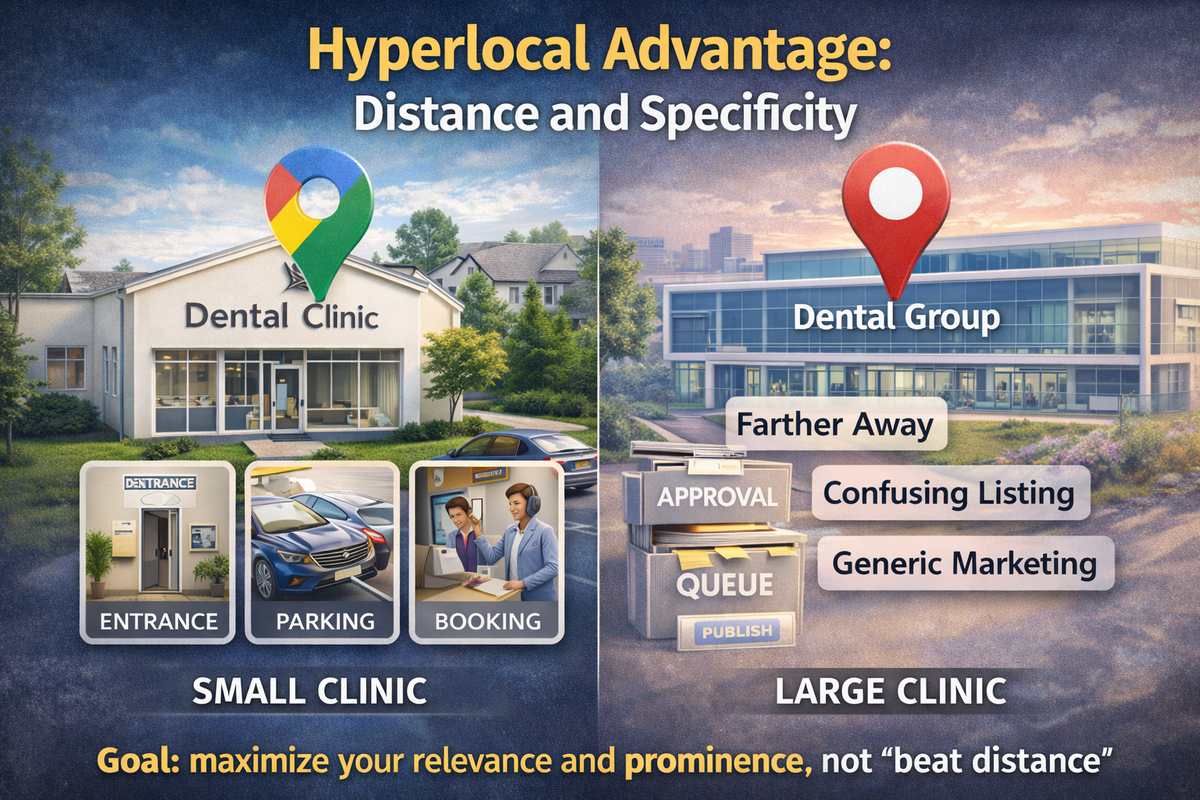
- they are often located inside a residential neighborhood;
- they offer a clear set of services “nearby and now”;
- in the listing, it is easier to show specifics: “where the entrance is,” “where parking is,” “how to book.” [1]
Why this hurts large clinics:
- a large brand may be “strong,” but physically farther away;
- a network may be closer, but the specific branch listing is weak/confusing;
- centralized marketing sometimes uses “general wording,” lowering the relevance of a specific location. [1]
Practical conclusion: your task is not to “beat distance,” but to get the maximum out of relevance and prominence at your specific location. [1]
Reputation as a process: stable reviews and replies are often stronger than budget
Google directly says that replies to reviews show that you care about feedback, and that “positive reviews and helpful responses” help a business stand out. [1] The same guidance explains that prominence relies, among other things, on how many websites link to the business and how many reviews it has; “more reviews and positive ratings can help local ranking.” [1]
From the human behavior side, BrightLocal shows the scale: 97% of consumers read reviews, and 41% “always” read reviews when choosing a business. [7] For dentistry, this is especially sensitive: one patient’s bad experience can stay visible in the listing for a long time, and ignoring reviews becomes self-sabotage.
Why it is easier for small clinics:
- the owner/administrator knows the real context and can reply in a human way;
- it is easier to implement a routine: “every Tuesday and Friday we go through reviews”;
- there are fewer internal barriers around “who is allowed to reply.” [2]
Why it is harder for larger clinics:
- replies often turn into templates;
- “legal fear” appears and replies disappear entirely;
- the feedback collection process becomes desynchronized across branches.
What matters here is this: I am not saying “the more reviews the better at any cost.” Google separately warns that you cannot buy better ranking and keeps algorithm details closed “for fairness.” [1] That means the bet should be on system and interaction quality, not on a “one-week campaign.” [2]
Recognition and online presence: small clinics are often stronger in local connections
Prominence is about “how well-known the business is,” and Google directly states that it relies on signals such as how many websites link to your business and how many reviews you have. [1]
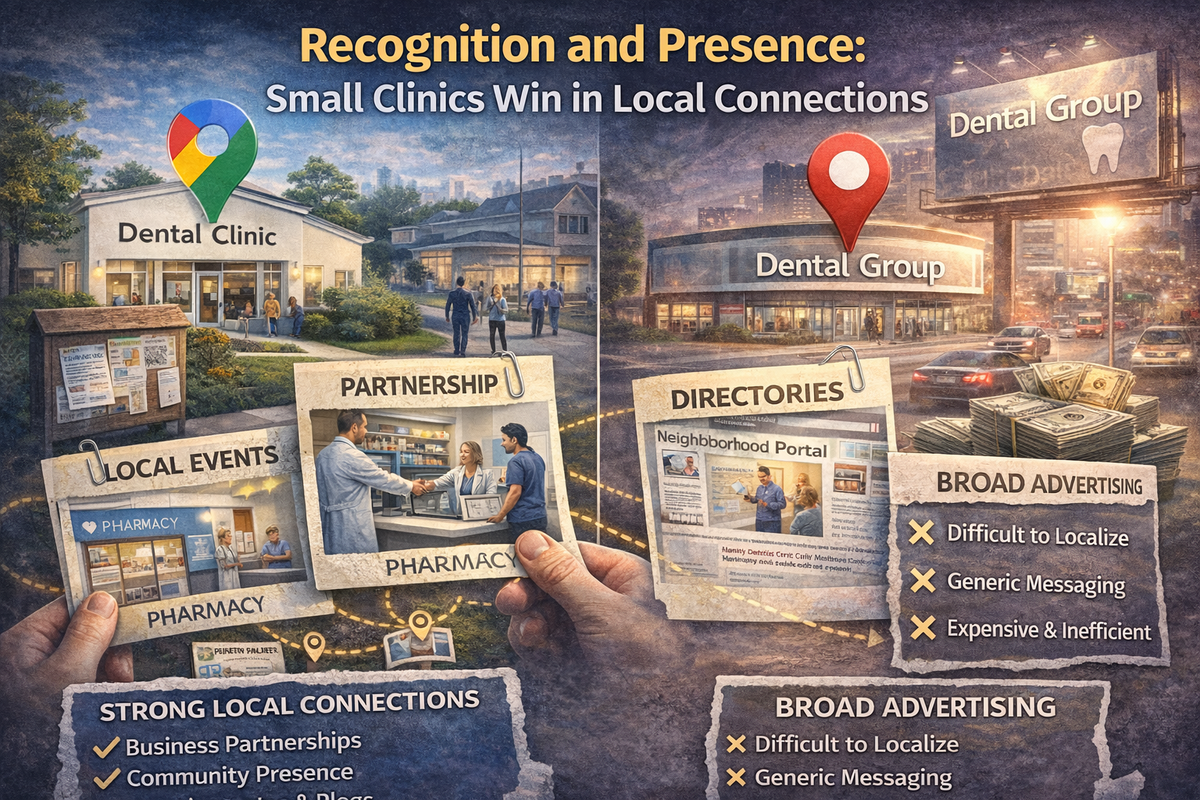
This means a small dental clinic does not need to beat a network with budget. It is more useful to build local connections that create natural “recognition”:
- partnerships with local businesses (pharmacy/optics/orthopedics);
- publications in city directories and communities;
- participation in local events and charity with mentions. [1]
It is harder for networks to do this carefully in every neighborhood: they often go with “broad advertising,” while the local recognition of a specific branch stays weak. A small clinic wins because “people know it in the neighborhood,” and that turns into mentions and links, which Google treats as part of prominence. [1]
Mini-case (anonymized). A small clinic in a residential district did not run an “SEO campaign,” but a local one: a partner page on the neighborhood fitness center’s site + participation in a residents’ meeting, after which a district portal published an article mentioning the clinic. Over time, this can often be equivalent to a large advertising budget in its effect on visibility in a specific location, because the signal is locally relevant. [1]
Country differences and the first-week plan
Below are two things in one section: (a) what changes in the rules and expectations across markets, and (b) what to do in the first week so a small dental clinic can “catch up” with larger clinics through system, not through chaotic actions.
Differences by country and market
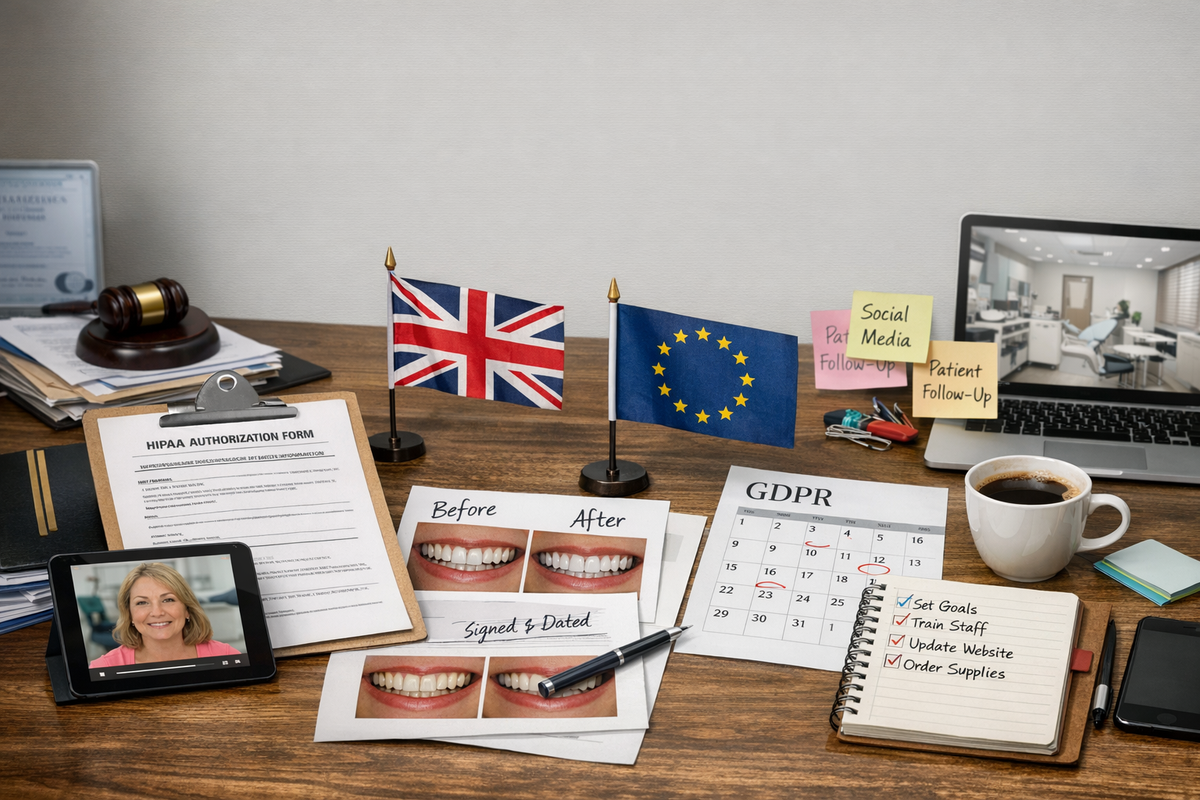
US. If you use patient materials in marketing — photos, videos, treatment stories — it is important to remember the HIPAA context. HHS explains that the HIPAA Privacy Rule requires individual authorization for the use/disclosure of protected health information for marketing purposes, with limited exceptions. [8] In practice, this means: beautiful cases and “before/after” are powerful levers, but without proper consent they are a risk. The American Dental Association recommends having written patient permission to use an image; ADA provides a sample HIPAA authorization form for using a patient photo in a marketing campaign. [9] If you publish testimonials/results, remember FTC requirements: if you do not have evidence of “typicality,” you cannot create the impression that everyone will get those results; you must disclose “generally expected performance” clearly and truthfully. [10]
UK. The regulatory framework noticeably affects dental marketing. GDC requires that advertising and public-facing practice materials clearly state whether the practice is NHS, mixed, or wholly private. [11] On “before/after,” ASA directly says such photos must be genuine and representative, and the advertiser must have signed and dated proof. [12] This is especially important for large networks: the scale of mistakes is bigger, and complaints/reviews are “more expensive.”
EU. In the EU context, when you use patient photos/videos or publish reviews with profile screenshots, you are often processing personal data. The European Commission emphasizes that, when collecting data, you must clearly tell people who you are, why you use the data, the legal basis, storage period, recipients, and so on. [13 ICO, under UK GDPR, though the definition is essentially aligned with GDPR logic, states that personal data is any information about an identifiable person. [14] The practical conclusion for a small clinic is: it is safer to publish “clean” content — team, interior, process — and be more cautious with patient content if you are not sure about consent and legal basis.
Without specific restrictions (if the country is not specified). The safest actions are universal: keep the profile complete and current, reply to reviews, add photos/videos, maintain data consistency, and eliminate duplicates — Google directly lists these as a basic strategy for improving local presence. [15]
What to do in the first week so a small clinic starts outperforming larger ones
I recommend a “one-week sprint” that strengthens relevance and prominence without entering gray areas.
7-day plan: how a small dental practice can quickly strengthen its Google Maps presence
This weekly sprint helps cover the core tasks tied to relevance and prominence without chaos and without grey-hat tactics. The idea is simple: focus on one specific block each day so that within the first week the listing becomes more accurate, clearer, and more alive for both patients and Google. [15]
Data and categories
Check the address, phone number, primary category, additional categories, and key profile details. [1]
Photos and videos
Add fresh photos of the clinic, treatment rooms, team, and short videos so the profile looks current. [1]
Reviews and responses
Work through the review backlog from the last 30–60 days and set up a consistent response routine. [2]
Duplicates and hours
Check regular hours, special hours, and make sure there are no duplicate listings or ownership conflicts. [1] [5]
Description and services
Refine the clinic description, service list, and overall profile presentation to improve relevance. [1]
Local mentions
Secure at least one local mention: a partner feature, a publication, or a link from a relevant local site. [1]
Review and report
Summarize everything in a short review: what was updated, what was found, and what still needs to be fixed next week. [15]
First-week sprint checklist
- Bring the profile to full completeness and accuracy: address, phone number, business type, and details so Google can better understand relevance. [1]
- Check verification: a verified business действительно has a better chance of appearing correctly in results. [1]
- Update regular and special hours so the listing does not look abandoned or inaccurate. [1]
- Reply to recent reviews and set up a routine so feedback does not sit unanswered for months. [2]
- Add fresh photos and videos: this helps make the profile more alive and convincing. [1]
- Check for duplicates and ownership or management conflicts so signals are not diluted. [5]
- Make sure the brand name is not merged from multiple brands in one location — a common mistake for chains and franchises. [4]
- Lock in at least one local visibility step: a partner mention or a local publication. [1]
What the result depends on
A small dental practice usually does not have extra time or a large team. That is why the best scenario is not to do everything at once, but to go through a short weekly cycle that consistently improves data accuracy, listing freshness, reputation, and local visibility.
If you want to understand why exactly your small dental clinic is losing to nearby larger clinics, and where relevance/prominence is “leaking” — categories, completeness, photos, hours, reviews, duplicates, and risks — start with diagnostics without obligation.
On MapsAudit, you can request a free listing audit: all that is needed is the public link to your Google Maps/Business Profile listing, login is not required, the audit arrives within 48 hours, and includes 10 prioritized recommendations, an NAP check, a review block, and a separate “risks and duplicates” block. [16]
Priority sources for the article
Click to expand the list of sources cited in the article, including link numbers and original pages.
+
Priority sources for the article
Click to expand the list of sources cited in the article, including link numbers and original pages.
Below are the main sources used in the article. The numbers in square brackets match the references inside the text.
-
[1] [2] [15]
Google Business Profile Help — Tips to improve your local ranking on Google
Relevance, distance, prominence; no way to pay for local ranking; the impact of reviews, links, profile freshness, photos, and videos.
https://support.google.com/business/answer/7091?hl=en -
[3] [7]
BrightLocal — Local Consumer Review Survey
Research on how reviews affect business choice and how users behave when reading reviews.
https://brightlocal.com/research/local-consumer-review-survey/ -
[4]
Google Business Profile Help — Guidelines for representing your business on Google
Rules for representing a business on Google, including naming, brands, and proper profile setup.
https://support.google.com/business/answer/3038177?hl=en -
[5] [6]
Google Business Profile Help — Resolve duplicate profiles & ownership issues
How to resolve duplicates, ownership conflicts, and management issues without damaging the main verified listing.
https://support.google.com/business/answer/12756178?hl=en -
[8]
HHS — HIPAA guidance on marketing
Guidance on the HIPAA Privacy Rule and the use of protected health information for marketing purposes.
https://www.hhs.gov/hipaa/for-professionals/privacy/guidance/marketing/index.html -
[9] [17]
American Dental Association — Advertising and patient image permissions
The need for written consent to use patient images and examples of release / authorization forms.
https://www.ada.org/resources/practice/practice-management/38_otheradvertising_traditional -
[10] [18]
FTC / Cornell Law School — Guides Concerning Use of Endorsements and Testimonials
Requirements for testimonials, endorsements, and disclosure of generally expected performance.
https://www.law.cornell.edu/cfr/text/16/255.2 -
[11]
General Dental Council (UK) — Guidance on advertising
UK requirements for dental practice advertising, including whether a practice is NHS, mixed, or wholly private.
https://www.gdc-uk.org/standards-guidance/standards-and-guidance/gdc-guidance-for-dental-professionals/guidance-on-advertising -
[12]
ASA (UK) — Dental advertising guidance
Rules for before/after images in dental advertising: genuine, representative, signed, and dated proof.
https://www.asa.org.uk/advice-online/dental-general.html -
[13] [19]
European Commission — GDPR transparency requirements
What information must be given to people when their personal data is collected and processed.
https://commission.europa.eu/law/law-topic/data-protection/rules-business-and-organisations/principles-gdpr/what-information-must-be-given-individuals-whose-data-collected_en -
[14]
ICO — What is personal data?
A definition of personal data and explanations of identifiable information within GDPR / UK GDPR logic.
https://ico.org.uk/for-organisations/uk-gdpr-guidance-and-resources/personal-information-what-is-it/what-is-personal-data/what-is-personal-data/ -
[16]
MapsAudit
A free Google Maps / Google Business Profile audit service referenced in the article’s CTA.
https://mapsaudit.com/

3 comments
Log in to leave a comment