




How to Collect Feedback Correctly: Mistakes to Avoid
How to Collect Reviews and Not Lose Clients: My Personal Experience
I remember making typical mistakes when I first started working with reviews: asking clients to leave comments incorrectly, underestimating the impact of negativity, not knowing how to respond to criticism. At the time, it seemed to me that reviews would appear by themselves, but in practice, everything turned out to be more complicated.
Reviews are not just a “nice addition”, but a tool that affects trust and sales, and working with reviews correctly is a system that requires a careful approach. I have tested dozens of methods and now I know exactly what works and what does not. In this article, I will tell you about all the nuances, which methods work best, and how to collect reviews so that they really benefit your business.

📢 Do you want to improve your company's reputation and get more reviews?
We will help develop a strategy for collecting reviews, teach staff how to properly interact with clients, and advise on how to improve the company's rating.
Leave a request and get a personal consultation 💬
👉 Is it possible to offer bonuses for reviews?
I often see companies promising discounts, gifts, or free drinks for leaving a review. This is a gross mistake that can lead to sanctions from Google and Yandex. Yes, it used to be popular to give out bonuses for comments, but now algorithms have learned to identify such schemes. If you are caught, they can delete reviews, lower your card in search results, and in some cases even block your profile.
📌 Why is this prohibited?
- Reviews must be honest and unbiased. When a client writes a comment for the sake of a bonus, he is biased.
- Competitors can complain about the violation of the rules - and the platform will simply delete all your reviews.
- The account can be subject to sanctions, and the business card can be lowered in the search results.
✅ What to do instead of bonuses?
Turn collecting reviews into a natural process. For example, if a client is satisfied with the service, politely invite them to share their opinion. No pressure, no pressure.

👉 What is the correct way to ask a client to leave a review?
I had some difficulties with this. It turned out that clients don't like being asked directly, but they are happy to respond if you do it unobtrusively.
Here are the methods that work best:
✔ Personal request
Instead of a dry "Leave a review," try saying:
"Your opinion is very important to us! We'd be glad if you shared your impressions. Your feedback will help us become better."
✔ Placement of QR codes
They should be on the menu, at the reception desk, on the product packaging - the simpler the process, the more likely the client will respond.
✔ Soft reminders via messengers: for example, a message on WhatsApp a day after the visit: “Thank you for visiting our salon! We would be grateful if you shared your impressions” [link].
💡 The main thing is not to put pressure and not to create a situation in which the client feels obligated.
📢 Collecting feedback can be easier!
We will set up the process so that clients themselves want to share their impressions. We will train the staff, advise what tools to use, and develop a system that will work without your participation.
👉 Sign up for a consultation and learn how to automate comment collection.
👉 What to do with negative reviews?
I used to take negativity very seriously. It seemed that any negative comment was a death sentence. But over time I realized that negativity is not a disaster, but a chance for growth. Such comments show weaknesses, help identify problems and provide an opportunity to demonstrate customer focus.
💡 The main thing is to react to them correctly:
🛑 How to respond to negativity?
- Calmly and professionally. Don't make excuses, but offer a solution.
Instead of "You're all lying!" it's better to say: "We're sorry you had a negative experience. We'll look into it and try to fix it." - Show a willingness to solve the problem: "We're sorry you had that experience. Let's look into it and fix it!"
- Thank for the feedback. Even if the feedback is unpleasant, it helps you see weak spots.
⚠ What should you not do?
- Argue, accuse the client of lying.
- Ignore complaints.
- Ask to delete a review - this causes even more negativity. It is better to work through the negativity correctly, which, on the contrary, increases trust.
👉 How many times can you ask a customer to leave a review?
Maximum twice. If the person didn't write a review right away, you can gently remind them in a few days. But don't be pushy.
📌 How to gently remind them?
- Via SMS or messenger: “If you have a minute, we’d love to hear your feedback.”
- On the client’s next visit: “How did you like our service last time? We’d be happy if you shared your impressions.”
💡 If after two attempts the client has not responded, it is better not to insist.

👉 How to simplify the process of leaving reviews?
The biggest mistake is to complicate the process. If a customer needs to go through 5 steps to write a review, they simply won’t do it.
✅ How to make the process easier?
✔ Place QR codes in the hall, on the packaging, in the menu.
✔ Provide direct links to the reviews page (for example, via the “Write a review” button in the message).
✔ Post reminders on social networks and in email newsletters (you can use ready-made templates, for example, “What did you especially like?”).
✔ Ask to leave a review right on the spot if the client is satisfied (waiters, administrators, managers should know how to correctly ask for reviews).
💡 The fewer actions a customer needs to take, the higher the likelihood that they will leave a review.

👉 What should you not do when collecting feedback?
🚫 Fake reviews — Google and Yandex easily detect fakes.
🚫 Identical texts — if clients write the same thing, it looks suspicious.
🚫 Ignoring comments — if a business doesn’t respond, it reduces trust.
🚫 Buying reviews — risk of account blocking.
👉 The client promised to leave a review but didn't?
This is normal. People are busy, they can forget or change their mind.
You can gently remind them in 2-3 days, but not more than once. If the client has not responded, then there is no point in insisting.
✅ The best way to increase the likelihood of a review: ask the customer to leave it right there. For example, if a person says that he liked everything, you can immediately offer to write about it in a couple of clicks.

👉 What if a customer only gave stars but didn't write a review?
This happens often. And it's not useless!
⭐ Even just stars increase the rating and influence visibility in search.
💬 You can reply: "Thank you for your rating! We'd love to hear your opinion."
💡 Sometimes this is enough for the client to supplement the review with text.
📢 Not sure if your card is working at its maximum?
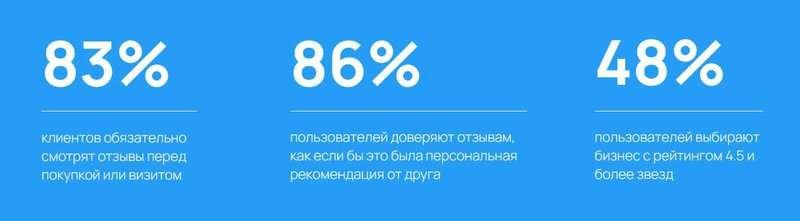
Reviews directly affect the search results in Google and Yandex.Maps. The more of them, the higher the positions, which means more customers and sales. But it is important not only to collect reviews, but also to work with them correctly!
🔹 We will help:
✔ Develop a strategy for collecting reviews
✔ Train staff to motivate customers to leave comments
✔ Set up a card so that it attracts new customers
🚀 Sign up for a free audit and learn how to improve your business's reputation this month!
Leave a request
Collecting reviews is not an accident, but a strategy. If you organize the process correctly, it will help your business grow, attract customers, and increase trust.
📌 Work with reviews, do not ignore negativity, simplify the process - and then customers themselves will want to share their impressions!
Frequently asked questions
No, this is prohibited by Google and Yandex rules.
Once — and if necessary, gently remind them in a couple of days.
Don't argue, don't make excuses, offer a solution to the problem.
Reply and politely ask them to add to the review.
Google and Yandex.Maps, social networks, newsletters, QR codes, personal requests.
No. It's better to work through them and show that your clients' opinions are important to you.

23 comments
Log in to leave a comment