




⛵ Jason and the Argonauts: The Quest for the Golden Fleece in Colchis
Jason is a hero of ancient Greek myth, and the Argonauts were his companions: around fifty men who set sail with him aboard the ship Argo in search of the Golden Fleece. They were bound for Colchis, an ancient land in what is now Western Georgia, where the Argo dropped anchor at the mouth of the river Phasis, today's Rioni near the modern city of Poti. The voyage was set in motion by King Pelias, who promised to return the throne of Iolcus to Jason in exchange for the Fleece, while secretly counting on his nephew never coming back.
In brief
- Jason, a Greek hero and the rightful heir to the throne of Iolcus.
- The Argonauts, around 50 companions aboard the ship Argo; the crew took its name from the vessel.
- The goal of the voyage, the Golden Fleece in Colchis (Western Georgia).
- Trials and the love of princess Medea helped win the Fleece.
⚓ Who the Argonauts Were, Explained Simply
The Argonauts were a band of heroes from ancient Greek myth who, led by Jason, set sail aboard the ship Argo in search of the Golden Fleece. The crew took its name straight from the ship: "Argonauts" means "those who sail on the Argo." There were around fifty of them, one for each oar, and they included the mightiest heroes of the age.
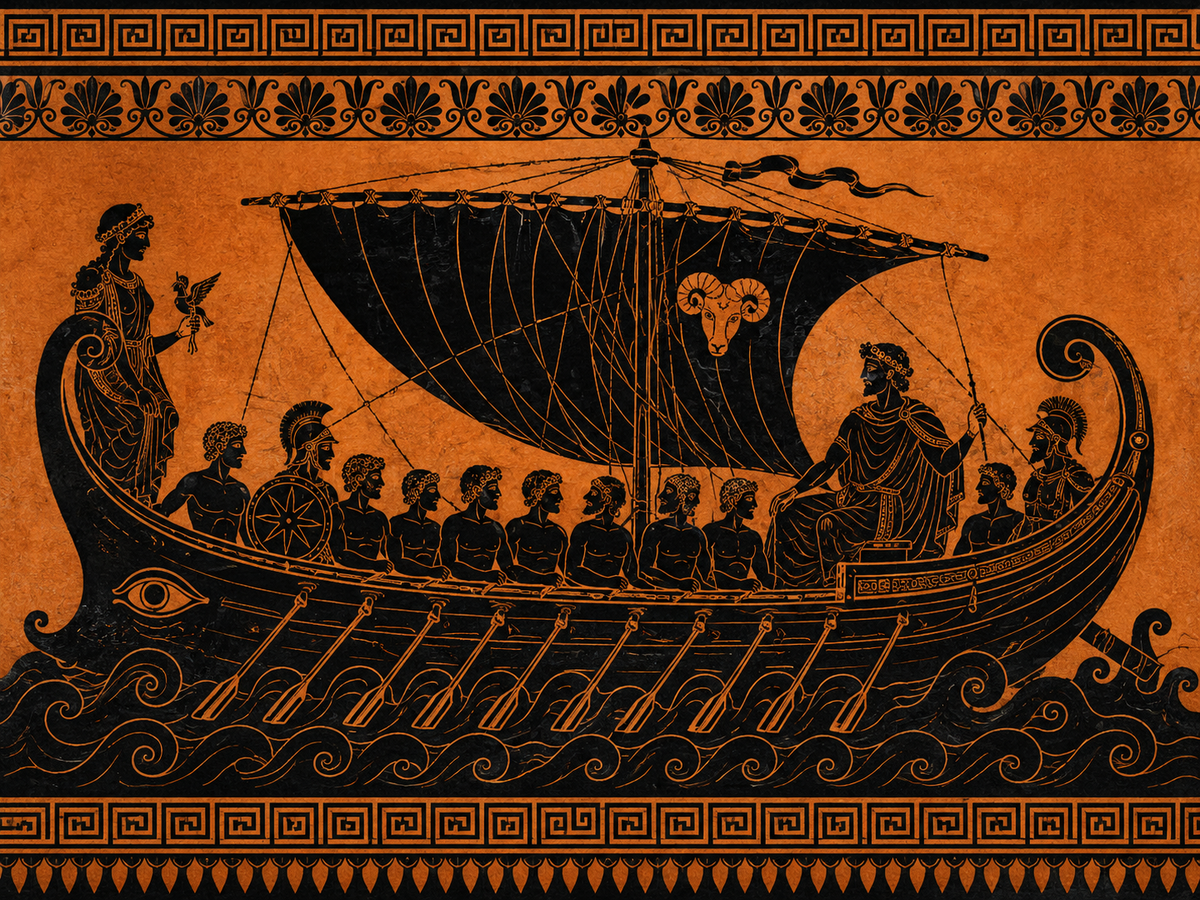
The voyage was not Jason's own idea but his uncle's. Pelias, king of Iolcus, promised to hand his nephew the throne if he brought back the Golden Fleece. The task sounded honourable, yet it was all but hopeless, for the Fleece was kept at the far edge of the world the Greeks knew, in Colchis. What the Golden Fleece actually is and why it is "golden" we explain in a separate article, so we will not dwell on it here.
👑 Jason: Who He Was and Why He Set Out for the Fleece
Jason was the rightful heir to the throne of Iolcus, a city in Thessaly near modern Volos. His father was King Aeson, but power in the city had been seized by Aeson's half-brother, Pelias. To keep their son safe from the usurper, his parents secretly handed the infant over to the wise centaur Chiron, tutor to many of the heroes of Greece. On the slopes of Mount Pelion Jason grew into a strong and well-trained warrior, watched over by the goddess Hera herself, who had no love for Pelias.
When he came of age, Jason set out for Iolcus to reclaim his father's throne. On the way he forded a raging river and lost one of his sandals in it, so that he came before Pelias shod on only one foot. Now the king had long been warned by a prophecy: beware a stranger wearing a single sandal. The moment he saw his nephew, Pelias understood who stood before him, yet he would not kill the heir openly. Instead he offered a bargain: I will give you back the throne if you bring the Golden Fleece from distant Colchis. The calculation was simple, for no one came back alive from such a journey.
🛶 The Ship Argo and Her Crew of Heroes
The ship for the voyage was built by a skilled craftsman named Argus, with the goddess Athena herself lending a hand. The Argo turned out to be a vessel like no other: light, fast, and large enough to seat fifty oarsmen. Its greatest marvel was a speaking beam: Athena had set into the prow a piece of sacred oak from Dodona, and it could talk, foretell the future, and give the crew advice.
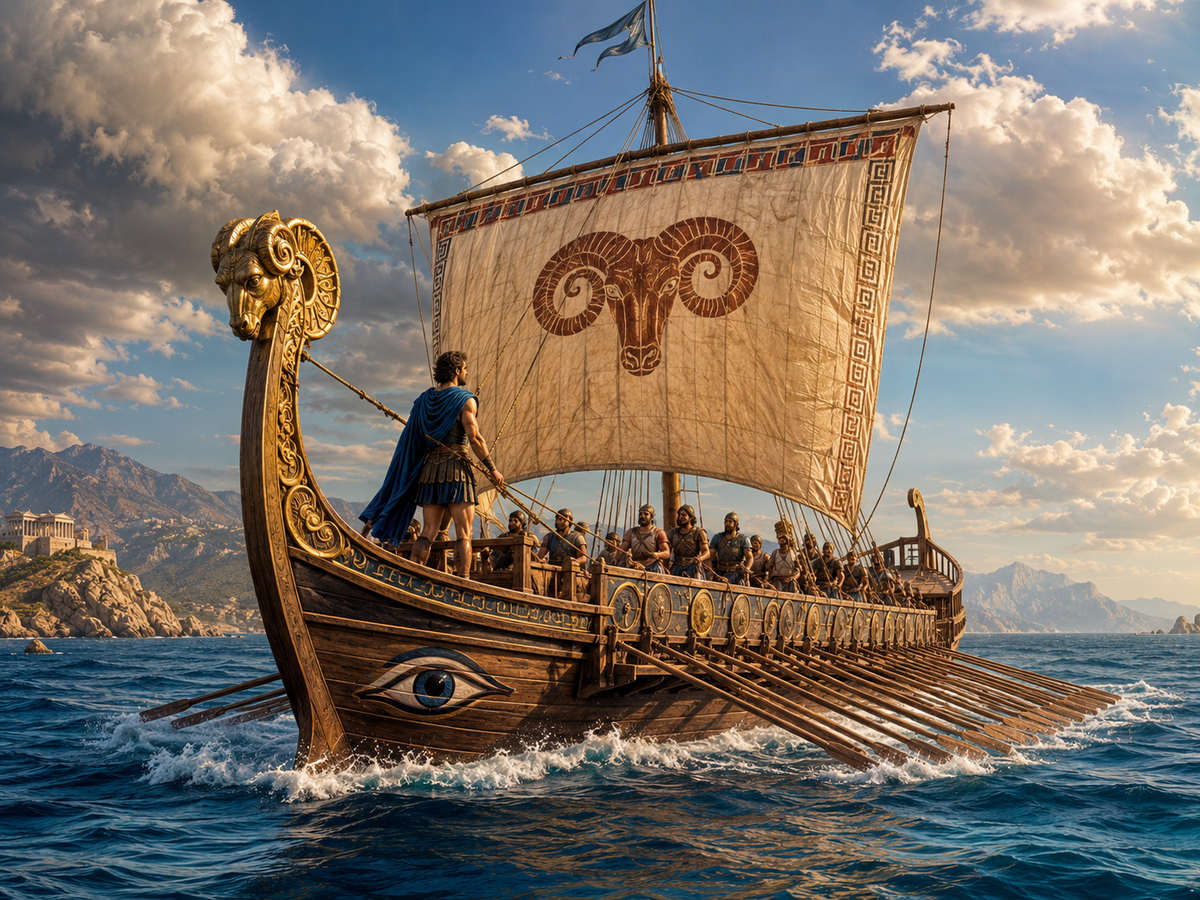
The flower of the Greek heroic age took their places at the oars of the Argo. There were around fifty men, one for each oar, and nearly every one of them was famous in his own right.
🦸 The Best-Known Argonauts
There is no point in listing the whole crew: the rosters differ slightly from one retelling to another. Still, a few heroes appear in almost every version, among them the strongman Heracles, the singer Orpheus, and the twin brothers known as the Dioscuri. Who was famous for what, and why each was needed on the voyage, is easiest to see in the table below.
| Hero | Known for | Role in the expedition |
|---|---|---|
| Jason | Leader of the expedition, heir to the throne of Iolcus | Captain and instigator of the voyage; won the Fleece with Medea's help |
| Heracles | The strongest hero of Greece | Rowed until he went ashore in Mysia to search for his lost friend Hylas |
| Orpheus | A legendary singer and musician | Set the rhythm for the rowers and calmed the waves with his song |
| Tiphys | An experienced seafarer | Helmsman of the Argo, steering the ship through dangerous waters |
| Lynceus | Renowned for his incredibly sharp eyesight | Scanned the way ahead and spotted dangers from afar |
| Castor and Polydeuces | The twin Dioscuri, fighters | Boxing and horsemanship, protecting the crew |
| Zetes and Calais | The winged sons of Boreas, the north wind | Drove off the Harpies that tormented the seer Phineus |
| Peleus and Telamon | Heroes, future fathers of Achilles and Ajax | Close-combat warriors |
🗺️ The Argonauts' Route: From Iolcus to Colchis
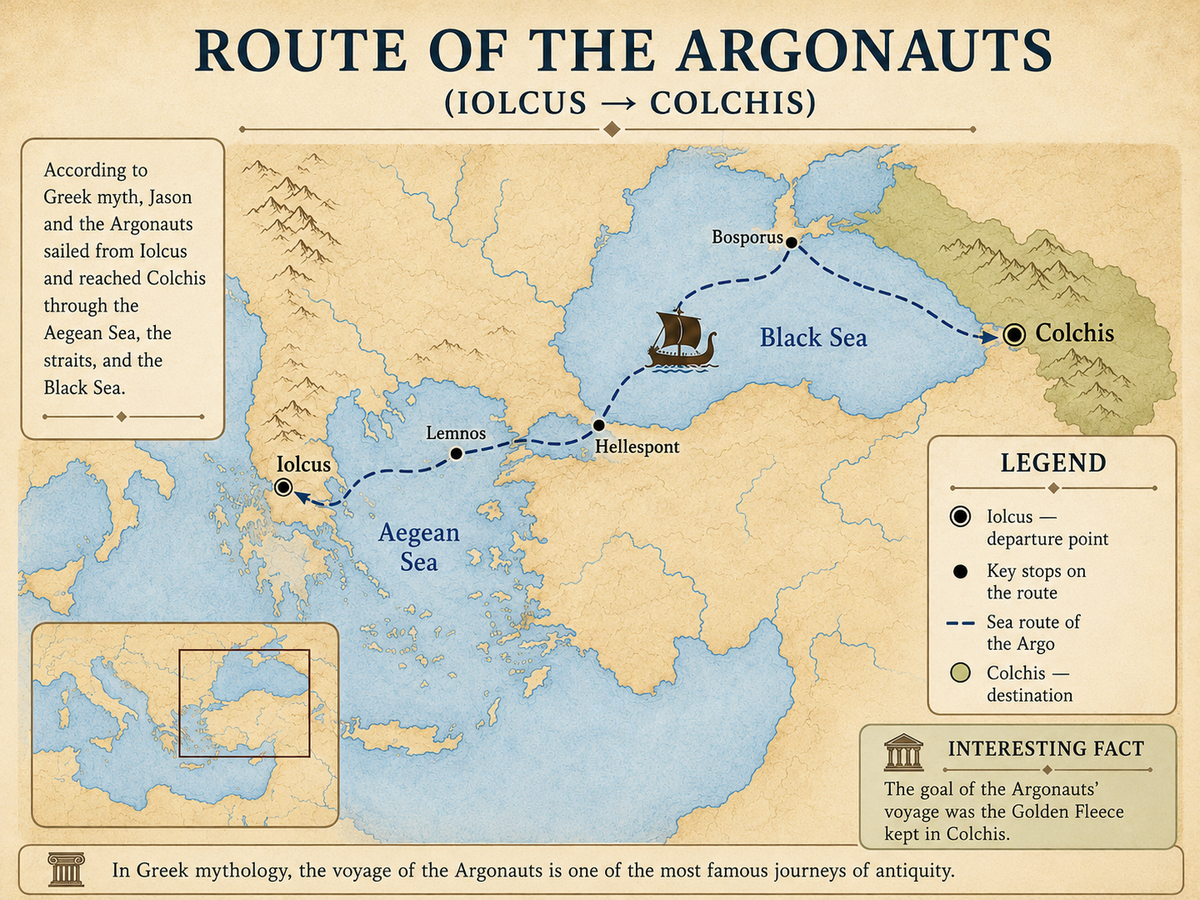
The journey from Iolcus to Colchis proved long and full of dangers. The Argo sailed around half of the world the Greeks knew, and at almost every stop a new trial awaited the heroes: an island inhabited only by women, robber kings, a blind seer, or rocks that crush ships. It is easy to follow the main stages of the expedition in order.
| Stage | Place | What happened |
|---|---|---|
| Departure | Iolcus (Thessaly) | The Argo puts to sea with some fifty heroes aboard |
| The island of women | Lemnos | The island is home to women alone; the Argonauts linger here for a long while |
| A battle by night | Cyzicus, land of the Doliones | After a warm welcome, a night storm drives the ship back, and in the dark the Argonauts fight their hosts by mistake; King Cyzicus is killed |
| The loss of Hylas | Mysia | A nymph draws the youth Hylas underwater; Heracles goes to search for him and falls behind |
| A boxing match | Land of the Bebryces | King Amycus forces the strangers to fight; Polydeuces beats him in a boxing duel |
| The blind seer | The palace of Phineus | The winged Zetes and Calais drive off the Harpies that tormented Phineus; in gratitude he points out the way ahead |
| The moving rocks | The Symplegades, the gateway to the Black Sea | The Argo darts between the clashing rocks (more in the fact below) |
| Arrival | The mouth of the Phasis, Colchis | The ship sails along the southern shore of the Black Sea and reaches the land of the Colchians |
💡 An interesting fact
The Symplegades were two rocks at the entrance to the Black Sea that clashed together and crushed anything trying to slip between them. On Phineus's advice, the Argonauts first sent a dove ahead: the bird flew through and lost only a few feathers from its tail. Then the rowers pulled hard at the oars and slipped through behind it, and the rocks managed to shear off only the very tip of the Argo's stern. After this passage the Symplegades froze in place forever and never moved again.
🔥 The Trials in Colchis: Bulls, Dragon's Teeth, and the Guardian Dragon
Jason came before King Aeëtes and asked him to hand over the Golden Fleece. The king could not openly refuse a guest, so he pretended to agree, but set a condition that was in truth impossible to meet. To win the Fleece, the hero had to accomplish several feats in a single day. Aeëtes owned a pair of monstrous bulls, a gift from Hephaestus, the smith god: with bronze feet and mouths that belched fire. These bulls had to be yoked to a plough, the field of Ares, the god of war, ploughed with them, and the furrows then sown not with grain but with dragon's teeth, from which armed warriors sprang up at once.
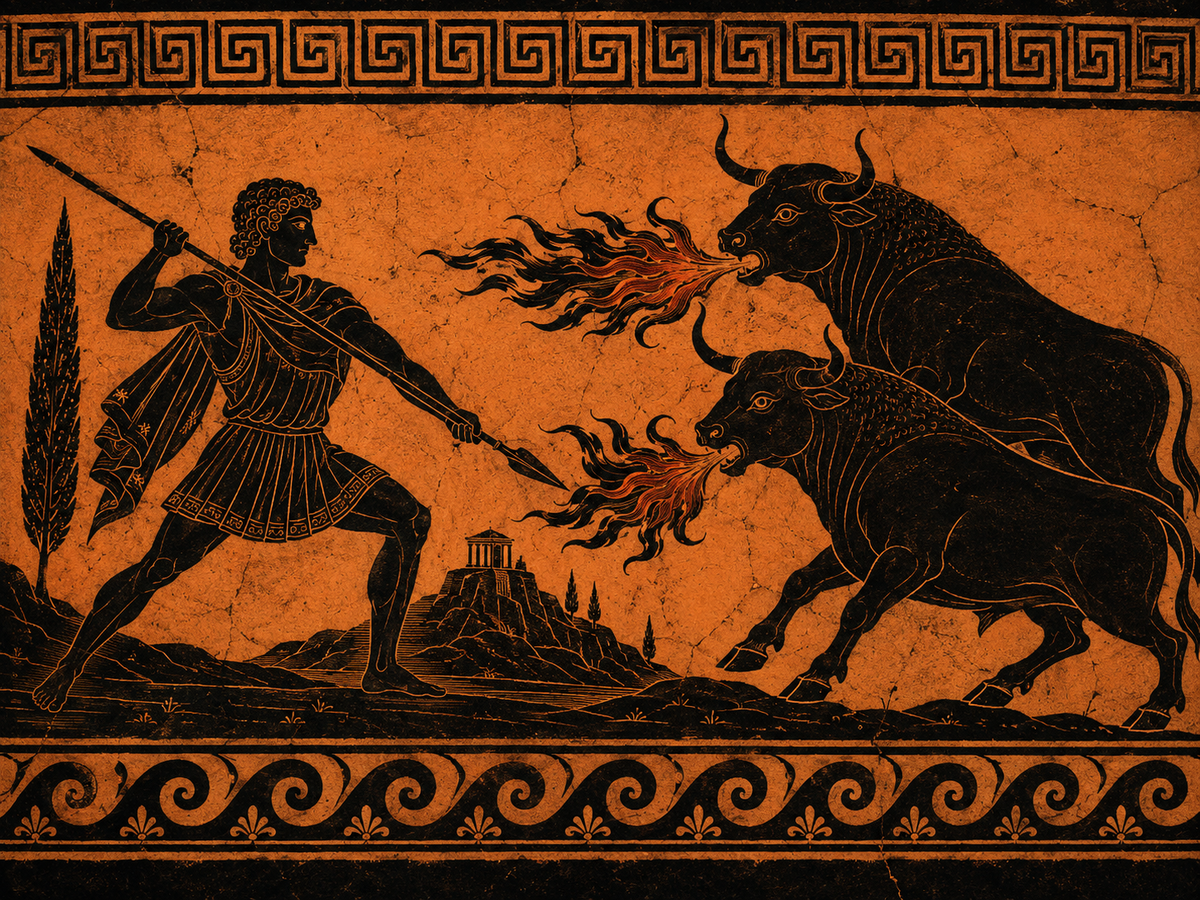
The Three Tasks of King Aeëtes (all in a single day)
-
1
Tame the bulls and plough the field
Yoke the bronze-footed, fire-breathing bulls to a plough and plough with them the field of Ares, the god of war.
-
2
Sow the field with dragon's teeth
Instead of grain, cast dragon's teeth into the fresh furrows.
-
3
Defeat the warriors that rise up
From the sown teeth armed warriors immediately spring up, and every one of them must be beaten.
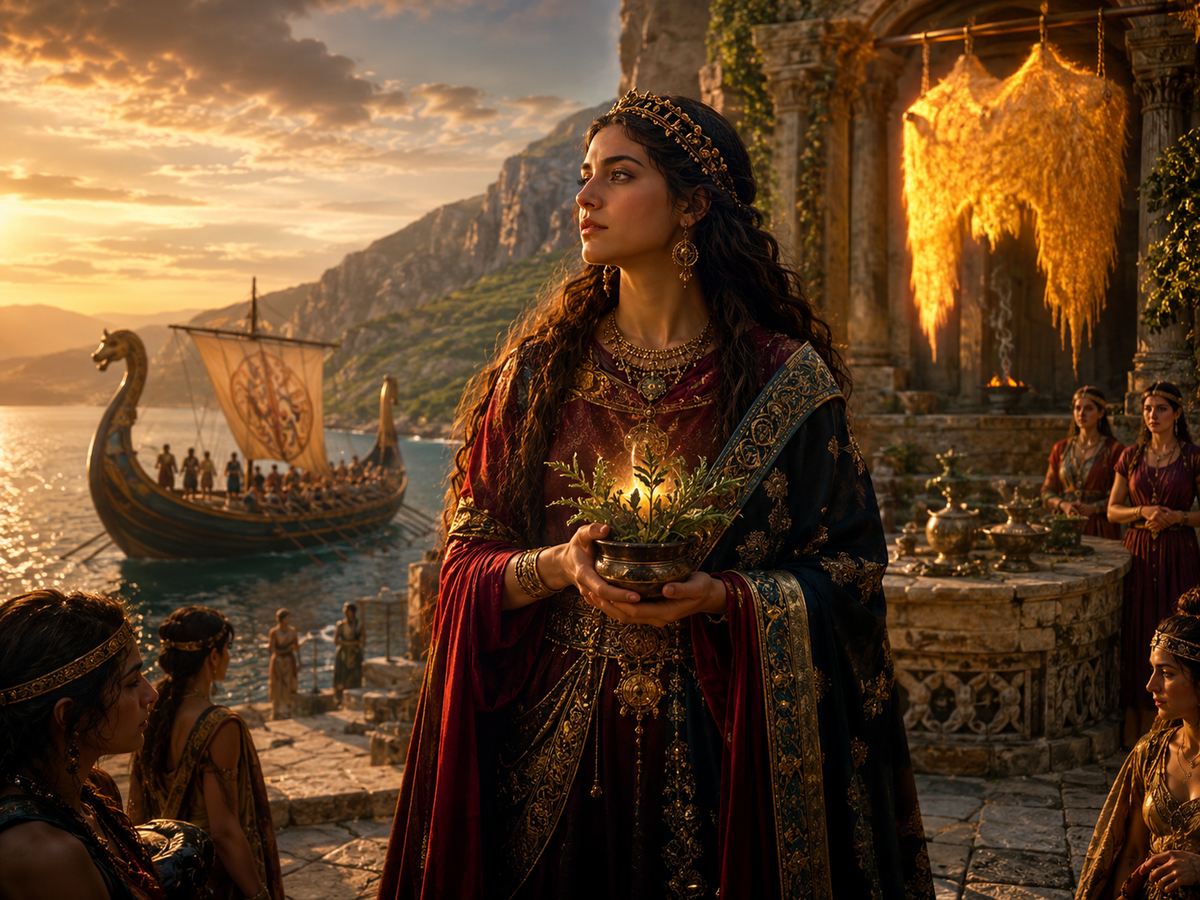
Jason could never have managed alone, but fortune smiled on him in the person of the king's daughter. Medea, a young sorceress, fell in love with the stranger, and not of her own will: the goddesses Hera and Athena watched over the hero, and at their request Aphrodite sent her son Eros, whose arrow pierced the princess's heart. In secret Medea gave Jason a magic ointment: he was to rub it on his body and his weapons to become invulnerable to fire and iron for a single day. She also taught him a trick against the warriors sprung from the dragon's teeth: to hurl a heavy stone into their midst. Unable to tell where the blow had come from, the warriors fell upon one another and cut themselves down.
Yet even after meeting every condition, Jason did not receive the Fleece: Aeëtes had no intention of giving it up. The treasure hung in a sacred grove, guarded by a dragon that never slept. Then Medea came to his aid once more: with her magic and a soft song she lulled the monster to sleep, Jason lifted the Golden Fleece from the tree, and the heroes hurried to the ship. What became of Medea afterwards, how her own fate unfolded, and why her name became one of the most tragic in all mythology, we tell in a separate article.
🌊 The Return and the Fate of Jason
Having taken the Fleece, Jason and Medea wasted not a moment and rushed to the Argo, and the ship at once put to sea. But Aeëtes, breaking his word, set off in pursuit of his daughter and the thieves of the treasure. To delay the pursuers, Medea took a cruel step bound up with the death of her younger brother, Apsyrtus. The various versions of the myth differ in their details, but they agree on one thing: this terrible price let the fugitives break away from the chase. It is with this deed that the dark side of the Colchian princess's story begins.

The journey home is described differently in the sources. In some versions the Argo sails up the Ister (as the Greeks called the Danube) and reaches the Adriatic through a chain of rivers; in others, the oldest, it sails along the very edge of the earth, across the river Ocean and the deserts of Libya. The way home proved no easier than the way to Colchis: along it the heroes are beset by the bronze giant Talos, who guarded the island of Crete, the singing Sirens, whose deadly voices Orpheus drowns out with his own song, and the sea monsters Scylla and Charybdis. In the end the Argo does return to Greece, and the Golden Fleece passes into Jason's hands.
For the hero himself, though, there was no happy ending. His later life brought Jason and Medea to Corinth, where their union ended in tragedy; that part of the myth, like the fate of Medea herself, we tell in a separate article. As for Jason, legend has it that his own ship was his undoing: grown old, he sat down to rest in the shade of the Argo, by then hauled up on shore, and the ship's loosened prow broke away and fell upon him. So ended, without glory, the life of the man who once led the most glorious expedition of ancient Greece.
🔍 Was the Expedition Real: What Lies Behind the Myth
The Argonauts are a myth, but an extraordinarily ancient one. It took shape long before the Trojan War: some of the expedition's members, such as Peleus and Telamon, are the fathers of the heroes of Troy, Achilles and Ajax. Homer already mentions the ship Argo as something widely known, while one of the earliest connected accounts of the voyage was left by the poet Pindar back in the 5th century BC. Behind the fairy-tale shell, scholars have long seen an echo of real events: the early voyages of the Greeks across the Black Sea and their ties with metal-rich Colchis.
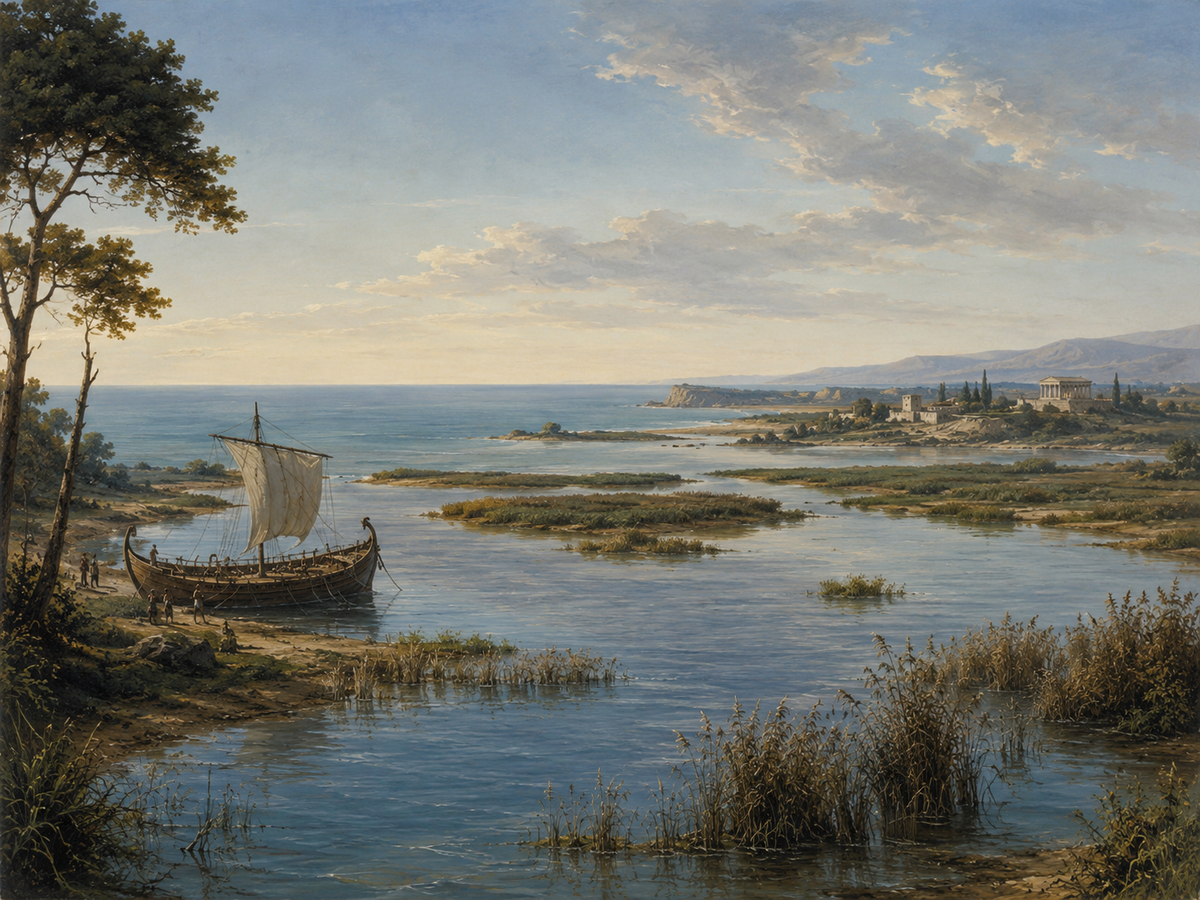
In historical times the eastern shore of the Black Sea was indeed settled by Greeks. On the lands of ancient Colchis, in what is now Western Georgia, Greek trading colonies arose: Phasis at the mouth of the river of the same name (today's Rioni near Poti), Dioscurias (modern Sukhumi), and Pityus (Pitsunda). Through them metals and the region's other riches flowed into the Greek world. For an ancient Greek, Colchis was the edge of the inhabited world, a distant, mysterious, and fabulously rich land that could be reached only by sea, after a perilous journey. It was from such real voyages and trade ties that the legend of the expedition for the Golden Fleece could have grown.
Ancient authors already tried to make out a real geography behind the myth. In his Geography, the Greek scholar Strabo explained the voyage of the Argonauts through genuine seafaring: in his view, it was the very wealth of Colchis and the long sea expeditions of the Greeks to the mouth of the Phasis that gave rise to the tale of Jason and the Golden Fleece.
Strabo, Geography (turn of the era), paraphrased.
How Reality Could Have Become a Myth
-
💰
A rich land at the edge of the world
Colchis was famed for its gold and metals, and it lay on the far eastern shore of the Black Sea.
-
🌊
A dangerous sea route
To get there, the Greeks had to pass through the narrow and treacherous Bosporus strait with its strong currents.
-
🗿
The birth of an image
The memory of the fearsome strait turned into the myth of the moving rocks, the Symplegades, that crush ships.
-
📜
A feat becomes an epic
Sailors' tales of a far voyage to a fabulously rich land gathered wonders and took shape as the heroic myth of the Argonauts.
What This Means
The myth of the Argonauts grew out of reality: out of the voyages of the ancient Greeks to the Georgian shore of the Black Sea and their acquaintance with rich Colchis. And why it was a fleece, and why it is "golden," is a separate story, closely tied to Georgia's mountain rivers.
❓ Why This Myth Is About Georgia and What to See Today
What matters most to us in this myth is that it unfolded on Georgian soil. Colchis, for whose sake the greatest heroes of Greece gathered, is a historical region in the west of modern Georgia. And that very mouth of the river Phasis, where the Argo dropped anchor, is the mouth of the Rioni near the modern city of Poti. So the final goal of the legendary expedition is a quite real place, one you can still visit today.
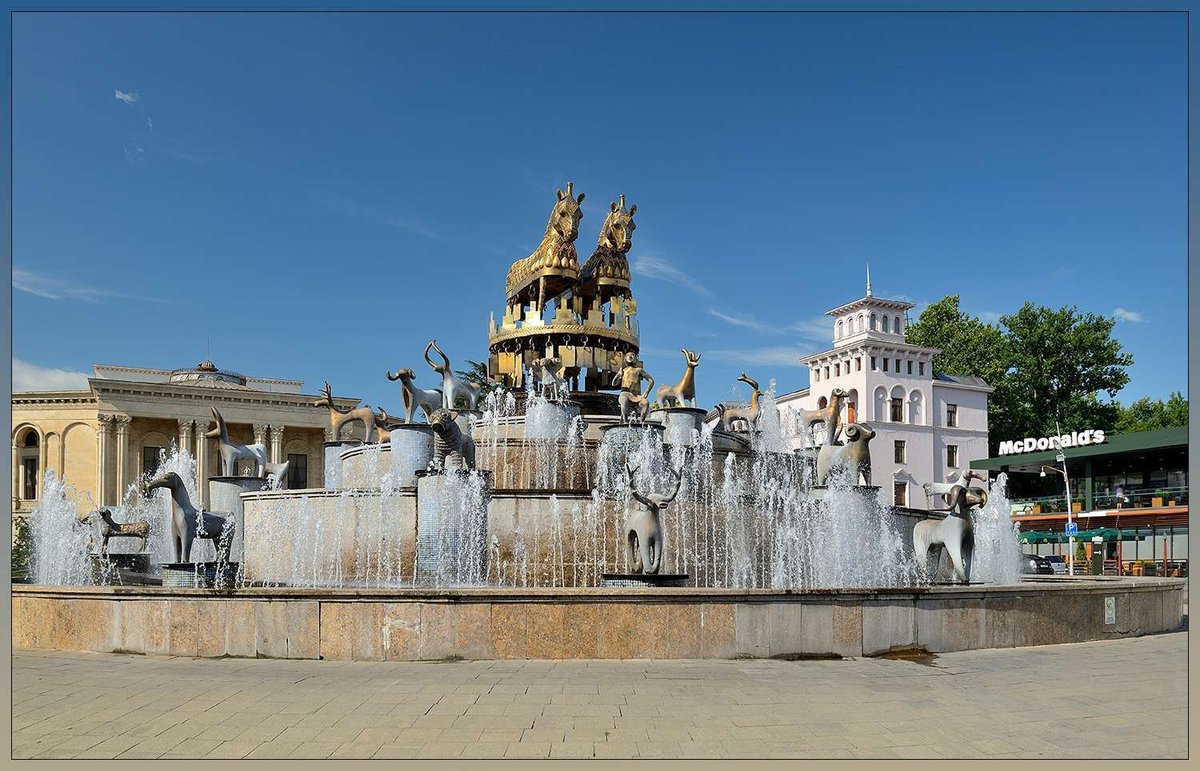
The memory of the Golden Fleece and the Argonauts is still alive in Georgia, and you can see its traces with your own eyes. In the centre of Kutaisi stands the Colchis Fountain, adorned with gilded figures of animals: these are enlarged copies of ancient Colchian artefacts that point straight back to the myth of the Golden Fleece.
In Poti, which grew up on the site of ancient Phasis, the maritime history of the region begins. Not far from Kutaisi lies Vani, where archaeologists found the richest golden treasures of ancient Colchis. And in Batumi, on Europe Square, the expedition was immortalised by the statue of Medea: the Colchian princess holds in her hands that very Golden Fleece.
👣 The Georgian trail
- The mouth of the river Phasis is the mouth of the Rioni near modern Poti.
- Colchis is the historical Western Georgia.
- The final point of the Argonauts' expedition, the Georgian coast of the Black Sea.
🧭 In the Footsteps of the Argonauts: a Route Across Western Georgia
If you would like to feel the myth of the Argonauts for yourself, you can map out a short route across Western Georgia through the places tied to the Golden Fleece. All the stops lie close to one another and are easy to combine into a single trip.
Poti
Georgia's sea gate, grown up on the site of ancient Phasis.
MythIt was here, at the mouth of the Phasis, that the Argo sailed in, having reached Colchis.
Kutaisi
The Colchis Fountain with its gilded figures right in the city centre.
MythThe sculptures echo the gold of ancient Colchis, the homeland of the Fleece.
Vani
An archaeological museum-reserve with golden finds from Colchis.
MythThe very wealth that may lie behind the legend of the Golden Fleece.
Batumi
The statue of Medea on Europe Square, the final note of the route.
MythThe princess holds in her hands that very Golden Fleece from the myth.
🎬 The Argonauts in Culture
The story of the expedition was retold by many ancient authors, but the fullest account to reach us is the poem Argonautica. It was written in the 3rd century BC by Apollonius of Rhodes, a learned man: he headed the famous Library of Alexandria, the greatest collection of books in the ancient world. It is largely thanks to his poem that we know the myth of the Argonauts in such detail.
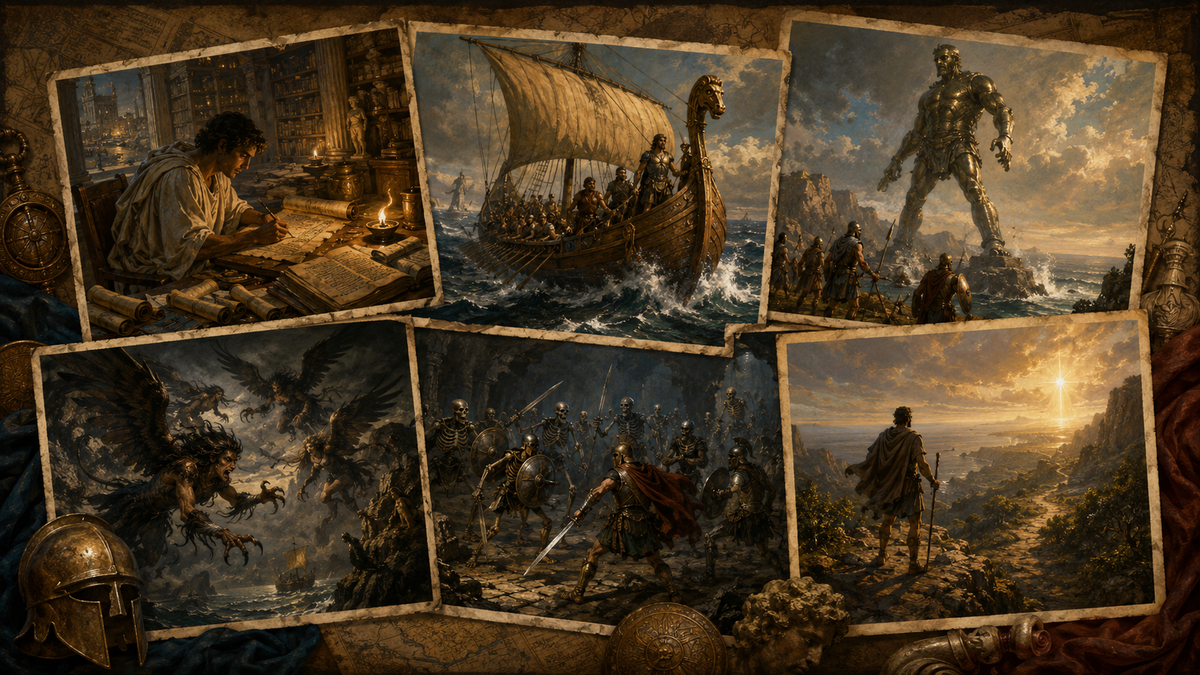
The cinema, too, did not pass the Argonauts by. The best-known screen version remains the 1963 film Jason and the Argonauts, made famous by the special effects of the master Ray Harryhausen, groundbreaking for their time. The bronze giant Talos, the winged Harpies, and the living skeleton warriors sprung from the dragon's teeth long set the standard for adventure cinema.
The word "argonaut" itself has long since gone beyond the myth. It is often used for a bold traveller or pioneer who sets out on a hard quest for a great goal. In this image there still lives the memory of the heroes who once dared to sail to the edge of the world for the Golden Fleece.
❓ Frequently Asked Questions about Jason and the Argonauts
💬 A Greek hero and the rightful heir to the throne of the city of Iolcus. To do away with his nephew, his usurping uncle Pelias sent him for the Fleece to distant Colchis.
💬 This was the name for Jason's companions: about fifty heroes who sailed off with him aboard the ship Argo. The crew took its name straight from the ship.
💬 To the eastern shore of the Black Sea, to Colchis, the territory of what is now Western Georgia. The Argo put in at the mouth of the river Phasis, today's Rioni near Poti.
💬 Pelias promised to give him the throne in exchange for the Fleece, but did not expect his nephew back: the road to Colchis was held to be deadly dangerous.
💬 About fifty, one for each oar of the Argo. The crew included celebrated heroes, among them Heracles, the singer Orpheus, and the brothers known as the Dioscuri.
💬 In a single day he had to tame fire-breathing bulls, plough a field with them, sow it with dragon's teeth, and cut down the warriors that rose from the earth.
💬 Medea, daughter of King Aeëtes and a sorceress, in love with the hero. She gave him an ointment of invulnerability, taught him a trick against the warriors, and lulled the guardian dragon to sleep.
💬 It is the west of modern Georgia: Imereti, Samegrelo, Svaneti, Racha-Lechkhumi, Guria, Adjara, and the neighbouring regions.
💬 Jason won the Fleece and fled Colchis together with Medea and the crew. After a long and dangerous journey back, the Argo returned home to Iolcus.
💬 The expedition itself is a legend, but a very ancient one, older than the Trojan War. Behind it lie the real ties of the ancient Greeks with rich Colchis.
📌 The Main Points in Brief
The voyage of the Argonauts is one of the central stories of ancient Greek mythology, and it is closely tied to Georgia in particular. The hero Jason gathered a crew of fifty celebrated warriors and set sail aboard the ship Argo for the Golden Fleece, bound for Colchis, an ancient land in the west of present-day Georgia. He was sent there by his uncle Pelias, who had seized another's throne and hoped his nephew would never return. In Colchis, King Aeëtes set Jason deadly trials, but the hero was helped by the king's daughter, the sorceress Medea: thanks to her he passed every task, lulled the dragon to sleep, and took the Fleece, and then fled with the crew back to Iolcus. Today the memory of this myth is kept by Georgian places: the Colchis Fountain in Kutaisi, the gold of ancient Colchis in Vani, and the statue of Medea in Batumi. And behind the tale of the Fleece, scholars see quite real voyages of the ancient Greeks to the rich Black Sea region.
💗 Read next
- The Golden Fleece: what this artefact is and why it is called golden.
- Medea: the full story of the Colchian princess and her fate
- The Kingdom of Colchis: what kind of country Colchis was and how it lived
- Prometheus and Amirani: the Georgian hero Amirani and his link to the myth of Prometheus
- The Colchis Lowland: the nature and history of the region where ancient Colchis lay.
- The Museum of Colchian Culture in Poti: where the memory of ancient Colchis is kept.
- The Rioni River: that very Phasis from the myth, the main river of Western Georgia.
🗣️ Now Over to You
The myth of the Argonauts has lived for almost three thousand years, and it speaks to each of us in its own way. Share your thoughts too:
- Have you been to Poti, Kutaisi, or Vani, and did you manage to feel the spirit of ancient Colchis there?
- What do you make of the idea that real Greek voyages lie behind the myth: do you believe it, or is it still pure legend for you?
- Which episode impresses you more, the passage between the moving rocks, the Symplegades, or the encounter with the sleepless dragon?
- And which of the Argonauts came to your mind? Perhaps we did not name your favourite hero.
Tell us in the comments, we would love to read your stories and opinions. ❤️

2 comments
Log in to leave a comment