




💡 Why There Is No Single Utility Bill in Georgia
💡 It's not one bill here, it's four or five
The single combined utility bill you're used to doesn't exist in Georgia. The market is split by provider and by region: electricity from one company, gas from another, water from a third, rubbish collection from the municipality. Each has its own account number, and you pay each one separately.

Someone arriving from Russia or Belarus usually expects one piece of paper with every line item and a total at the bottom. In Georgia, that piece of paper doesn't exist and never will.
Here, every utility lives on its own. Electricity comes from one company, gas from another, water from a third, and rubbish is billed by the municipality. Each has its own account number, its own bill, its own payment history. It's irritating at first, and then you get used to it, and eventually you even find the upside: go away for two months, switch off what you don't need, and pay only for what you actually used.
Here's who bills you for what, and what it all costs.
🔌 Who sends the bill

The first thing to nail down when you move in is the names of your providers. They differ by city.
Electricity. In Tbilisi that's Telasi, a company now also operating under the name Telmico, so don't be thrown if you see both. In the regions, Energo-Pro Georgia and local distribution networks.
Gas. In Tbilisi, household customers are served by Tbilisi Energy. In most of the rest of the country, SOCAR Georgia Gas and regional operators.
Water. In the capital, Georgian Water and Power, GWP for short. In Batumi and Adjara, Batumi Water. Elsewhere, municipal water utilities.
Rubbish. Billed as its own line item, with the rate set by the municipality.
Stairwell cleaning. Another separate line, and in Tbilisi it might be Tbilisi Cleaning or another company entirely.
Rates, though, are set for the whole country by a single body, the National Energy and Water Supply Regulatory Commission. So the price per kilowatt is the same in Tbilisi as in Kutaisi, it's just a different company sending you the bill.
⚡ Electricity, and the trick to the tiered rate

There's a detail here worth knowing, since it saves you money.
Electricity rates are split into three brackets based on usage: up to 101 kilowatt-hours a month, up to 301, and above 301. The more you use, the more each additional kilowatt-hour costs.
Being honest about the figures. Open sources disagree. One set puts the brackets at roughly 15, 19 and 23.5 tetri per kilowatt-hour. Another at roughly 18, 22 and 26.5. The gap between them looks suspiciously close to VAT, so one set is possibly quoted before tax and the other after. I can't confirm that for certain, so treat the lower figures as a baseline and the higher ones as what you might actually see on your bill.
What that means in practice. Crossing the 300 kilowatt-hour mark gets noticeably more expensive. A regular apartment without electric heating won't get anywhere near it, but if you're running convector heaters through winter, the bill will surprise you.
A rough example. A household of two using around 200 kilowatt-hours pays roughly 44 GEL a month.
🔥 Gas: where the winter shock comes from

This is where budgets actually get tested.
In summer, the gas bill is modest: the stove and hot water, if the boiler runs on gas. Come winter, if you're heating with gas, the picture changes.
By one account, a boiler heating a hundred-square-metre apartment with four radiators runs 160-180 GEL a month in winter. That's more than every other utility combined.
The gas rate as of 2026 sits around 55 tetri per cubic metre.
What this means when picking an apartment. Ask about the heating setup before you sign, not after. The gap between a gas boiler and electric heaters shows up hard in the winter bill, and both cost more than summer would have you believe.
A small detail about meter readings. Tbilisi Energy staff sometimes ask you to send a photo of your gas meter instead of having someone come by. Easier for everyone, and you don't have to wait around at home.
💧 Water: it comes down to the building
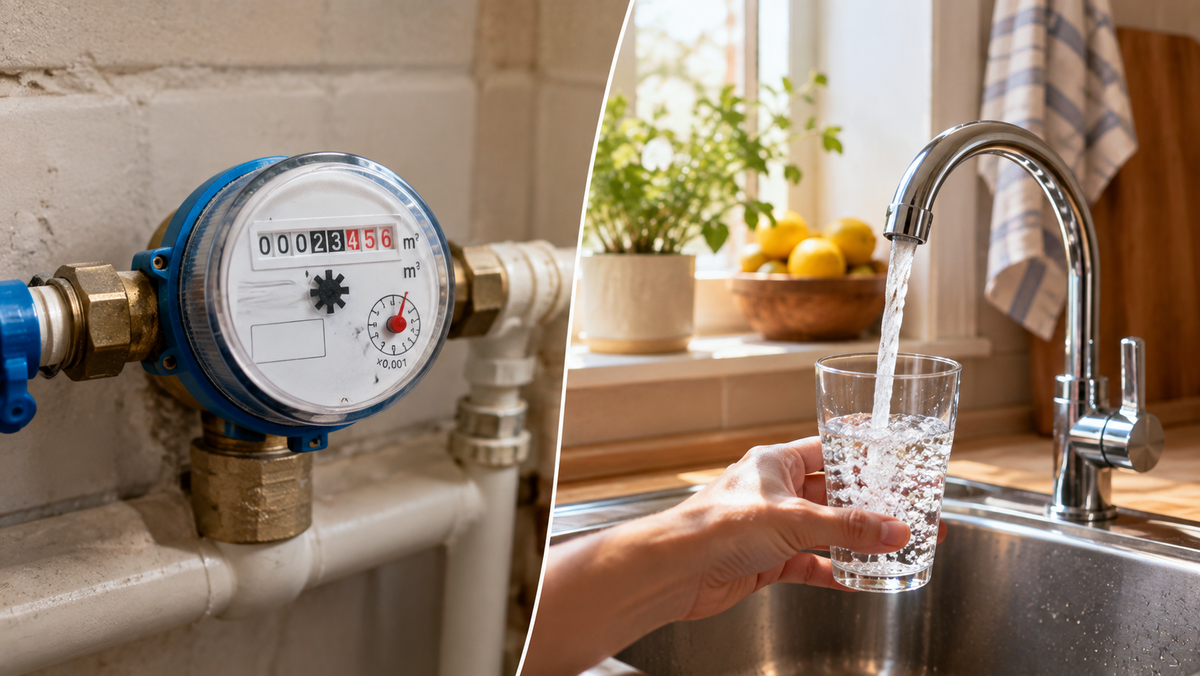
Here's an odd one: what you pay for water depends less on how much you use and more on which building you live in.
With a meter, you pay by usage, around 0.5 GEL per cubic metre at GWP's rate. Usually comes out low.
Without a meter, common in older buildings, you pay a flat amount per registered resident, around 4.5 GEL per person a month. Also cheap, but it has nothing to do with how much water you actually use.
Oddly enough, tenants in older buildings on the flat rate often come out ahead. So no meter isn't necessarily a downside.
🗑️ Rubbish and the stairwell: small line items, one surprise
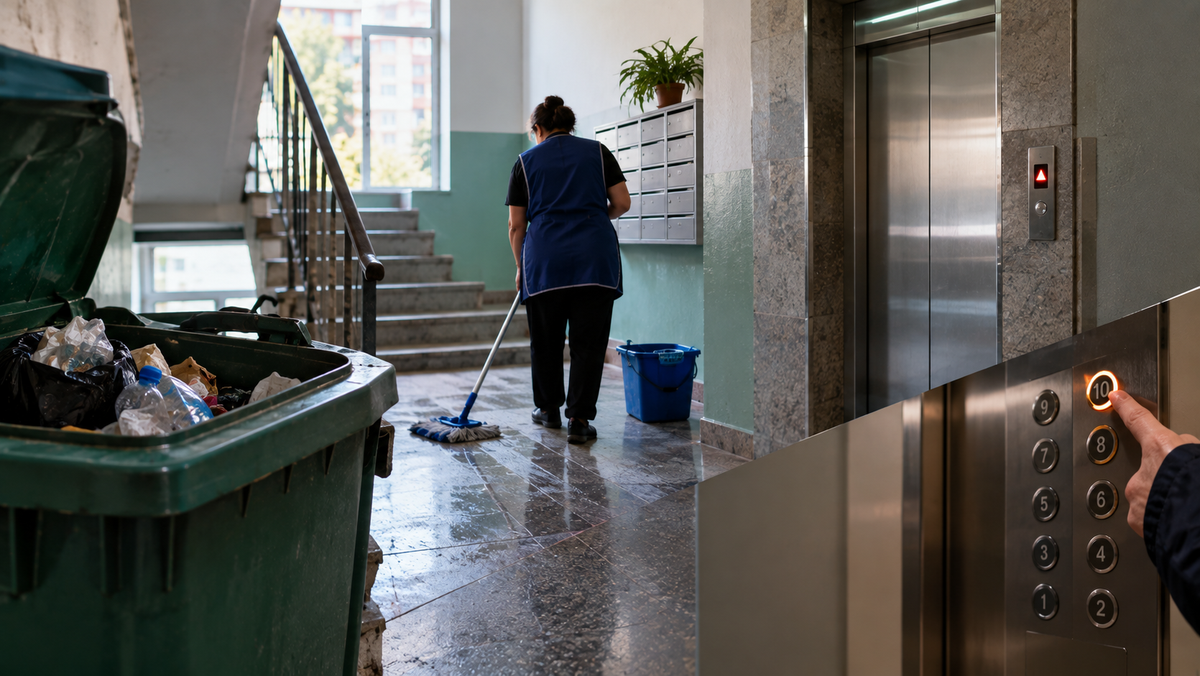
Two small charges worth knowing about separately.
Rubbish collection is billed per registered resident, around 2.5 GEL. A token amount.
Stairwell cleaning is billed separately, with the rate depending on the building. And here's a warning that circulates in expat communities: according to them, not paying this can get your electricity cut off. There's only one source for this claim, and it's not especially recent, so we couldn't confirm it officially. Given how small the amount is, though, it's easier to just pay it on time than to find out the hard way.
And a word on lifts. In Georgia, lift maintenance is usually not included in what the building management fee covers, and it's billed separately. For buildings above five floors, that's one more line to budget for.
🔑 What to ask when you move in

The important part happens right when you get the keys. Ask your landlord three things, and you won't run into trouble later.
Provider names. Who supplies the electricity, who supplies the gas, who supplies the water. Without these you won't find your account, not in a banking app, not at a terminal.
Account numbers. For each utility separately. Ask for them in writing, so you're not copying digits off a crumpled piece of paper.
Whether there's an outstanding balance. This one matters most. A debt is tied to the account, not the person, and sorting out someone else's unpaid bill becomes your problem. Ask to see the last few paid receipts, or screenshots from the app.
While you're at it, ask about heating too: gas boiler, electric heaters, or central. The answer shapes your winter budget.
What else is worth checking before signing a lease is covered in common mistakes with long-term rentals. For finding a place and what to look for, there's long-term rentals in Tbilisi and Batumi.
Photograph every meter the day you move in and send the photos to your landlord. Takes a minute, and it settles half of the disputes that come up later: six months on, nobody remembers what the readings were, but the bill still shows up in your name.
And don't judge the utilities by a summer bill. People rent in July, see forty GEL for everything, and feel great about it. Then December hits, the heating comes on, and the total jumps three or four times over. If you're renting in summer, ask the landlord what last January actually cost. A landlord who's being straight with you will tell you.
Living in Georgia? Tell us on Madloba what your utilities actually run in your city, in summer, in winter, and what turned out pricier than expected. Numbers like that are worth more than any rate table.
Information is current as of September 2026 and is meant as general guidance. Rates are set by Georgia's National Energy and Water Supply Regulatory Commission and get revised from time to time. The figures here are pulled from open sources and, for electricity in particular, don't fully agree with each other, likely due to VAT being included in some and not others. Check your provider's portal or your actual bill for current amounts.
❓ Frequently asked questions
💬 Because the market is split by provider and by region. Electricity, gas, water and rubbish are each handled by a different company, each with its own account number and its own bill. The one piece of paper with every line item and a total simply doesn't exist here.
💬 Ask your landlord when you move in. You'll need the company names and account numbers for each utility. Without them, you won't be able to find your account, not in a banking app, not at a terminal.
💬 A banking app, with a fee of around 0.5 GEL per transaction. If you don't have a card yet, yellow TBC Pay terminals work fine: enter the account number, feed in cash, take your receipt. There are also provider portals and Georgian Post, at a fee of around two per cent.
💬 The rate is tiered, three brackets: up to 101 kilowatt-hours, up to 301, and above. Figures in open sources differ by roughly the amount of VAT; use 18-26 tetri per kilowatt-hour as a range depending on usage. A household of two using around 200 kilowatt-hours pays roughly 44 GEL.
💬 Heating. By one account, a gas boiler in a hundred-square-metre apartment runs 160-180 GEL a month in winter, more than every other utility combined. Electric heaters push you into the top rate bracket too.
💬 Whether your building has a meter. With one, you pay by usage, around 0.5 GEL per cubic metre. Without one, you pay a flat rate per registered resident, around 4.5 GEL per person. The flat rate often works out cheaper.
💬 Around 2.5 GEL per registered resident. A token amount, but it's still its own line item that needs paying.
💬 That's what circulates in expat communities, but there's only one source for it and it's not especially recent, so we couldn't confirm it officially. The amount involved is small enough that paying on time beats finding out the hard way.
💬 A debt is tied to the account, not the person, so sorting it out falls to you. Before moving in, ask the landlord to show you the last few paid receipts or screenshots from the app.
💬 By one tenant's account of a studio in Batumi, March 2026: electricity 45 GEL, water 28, gas 22, rubbish 5, around a hundred total. In winter with heating that can multiply several times over; in summer without it, it drops noticeably.

0 comments
Log in to leave a comment