




⛪ Church of St. George in Kutaisi: From Armenian to Georgian
📋 What You Need to Know Before Your Visit
| 📍 Address | 6 Chanturia Street, Kutaisi, right by the Rioni River |
| 📅 Built in | 1725, originally as an Armenian church |
| 🔄 Since 1989 | operates as an Eastern Orthodox Georgian church |
| 🏷️ Officially called | Lower Church of Saint George |
| ⚠️ Don't confuse with | the Upper Church of Saint George near Bagrati Cathedral, of which only ruins remain |
🧭 What This Article Is About
The Lower Church of Saint George in Kutaisi, built in 1725 as an Armenian church and operating today as an Eastern Orthodox Georgian church. This article is ideal for those who want to understand the unique history of the building and what to look out for in its architecture.
⛪ A church with a double history
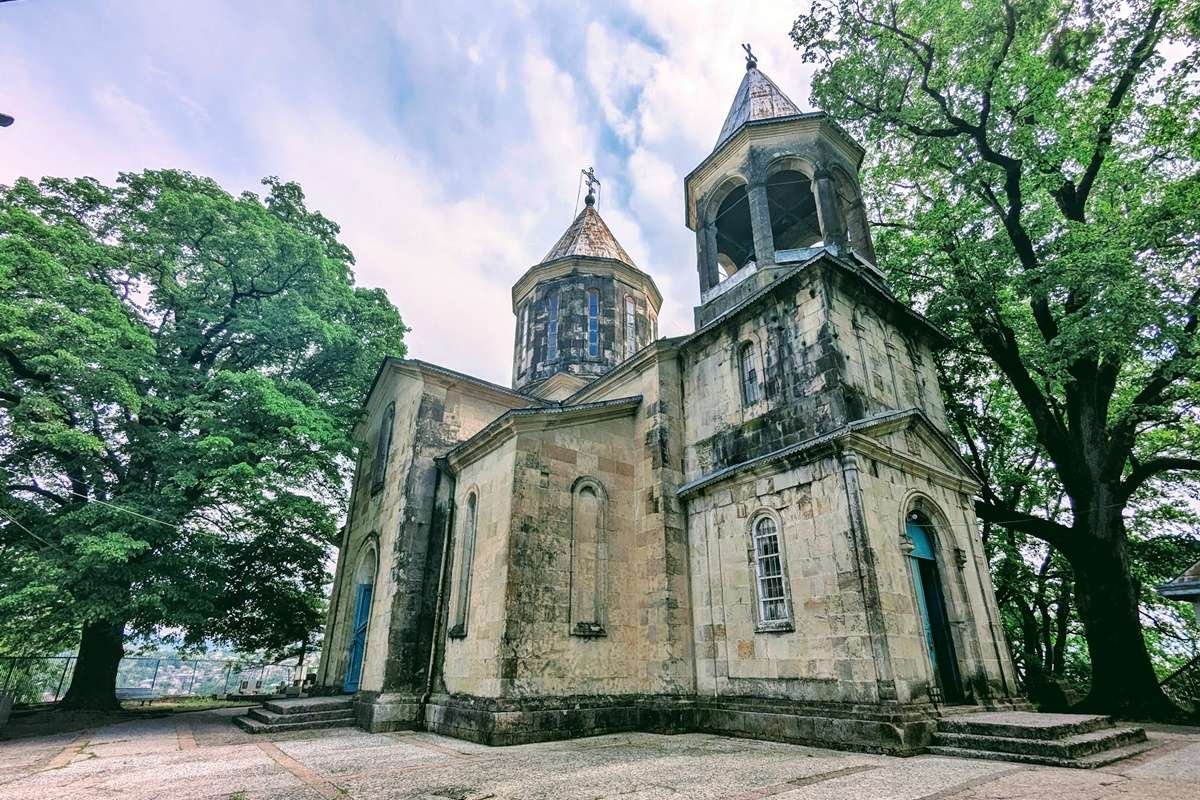
The Lower Church of St. George stands by the Rioni River, almost on the edge of Kutaisi's historic Jewish quarter.
The name "Lower" is no accident: it is called this way to distinguish it from the Upper Church of St. George, which once stood on a hill next to the Bagrati Cathedral, in the fortress's citadel, and today only ruins remain.
The Lower Church, unlike its namesake above, has been preserved in its entirety and continues to function.
🕊️ From an Armenian temple to a Georgian church
The church was built in 1725 and was originally Armenian, apparently the only Armenian church in Kutaisi.
Few details about its early history remain.
During the Soviet period, the building was likely closed and used for non-religious purposes, as was often the case with religious buildings of that time.
In 1989, the church was handed over to believers, not to the Armenian, but to the Georgian Orthodox community, and it has operated in this capacity ever since.
💡 Lifehack from the Editors
Be sure to examine both portals, the western and the southern: each features its own bas-relief depicting a scene where a rider strikes a monster with a spear. On the western portal, it's a classic motif with a serpent or dragon, while on the southern one, the image is more open to interpretation—take a close look and form your own opinion.
🏛️ Architecture: a tower reaching upwards
With its narrow, elongated drum and dome, as well as its restrained, low lower section, the church gives the impression of a building soaring upward.
The facades are richly decorated: the portals of the western and southern entrances are adorned with pilasters, cornices, and triangular arches.
Above the western entrance, in the tympanum of the arch, is a bas-relief depicting a scene of Saint George slaying a serpent or dragon with a spear, a classic iconographic motif.
Above the southern entrance, in a deep rectangular niche, is another bas-relief: a horseman slaying a human-like figure with a beast's head with a spear—possibly also Saint George and an equally unusual adversary.
Above both entrances are relief crosses, and the cross above the southern portal is enclosed in a pentagonal, ornamental frame.
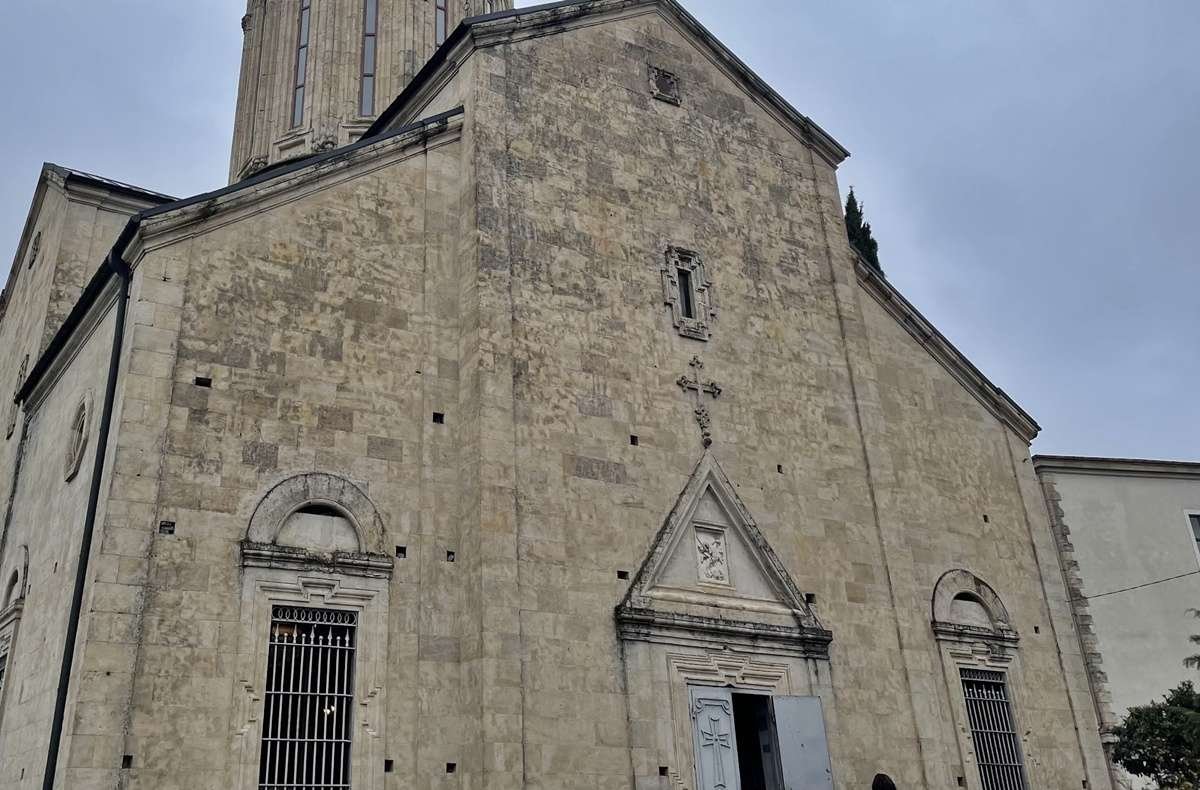
The facades are pierced by numerous windows of varying shapes: small octagonal ones, narrow oblong rectangular ones, and even one cross-shaped window, all decorated with relief frames.
Large windows with semicircular arches above are located on either side of the portals.
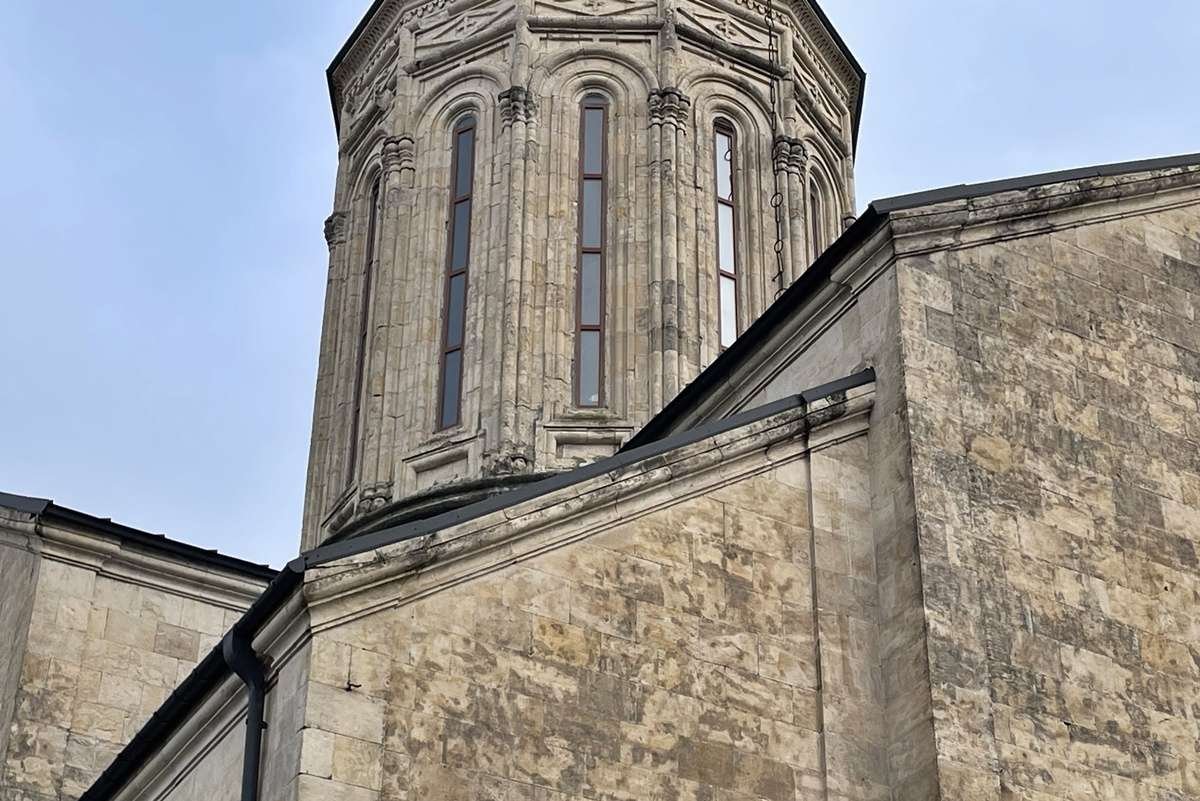
The church's drum is particularly ornate: twelve-sided, pierced by twelve narrow windows and adorned with a decorative cornice, a relief frieze of crosses inscribed within diamonds, and an arcaded band on triple semi-columns with decorative capitals.
👀 What can you see inside
The church's interior is also unusual for a Georgian church: there are no vestries on either side of the apse, and the eastern section's layout is more reminiscent of Russian Orthodox churches, with a deaconry and an altar. This is precisely why the altar partition is unusually long for the Georgian tradition; it extends from the south wall to the north wall along the entire eastern wall of the building. The columns inside the church are rectangular and cross-shaped, meaning their cross-section is shaped like a cross, with ornate bases and capitals.
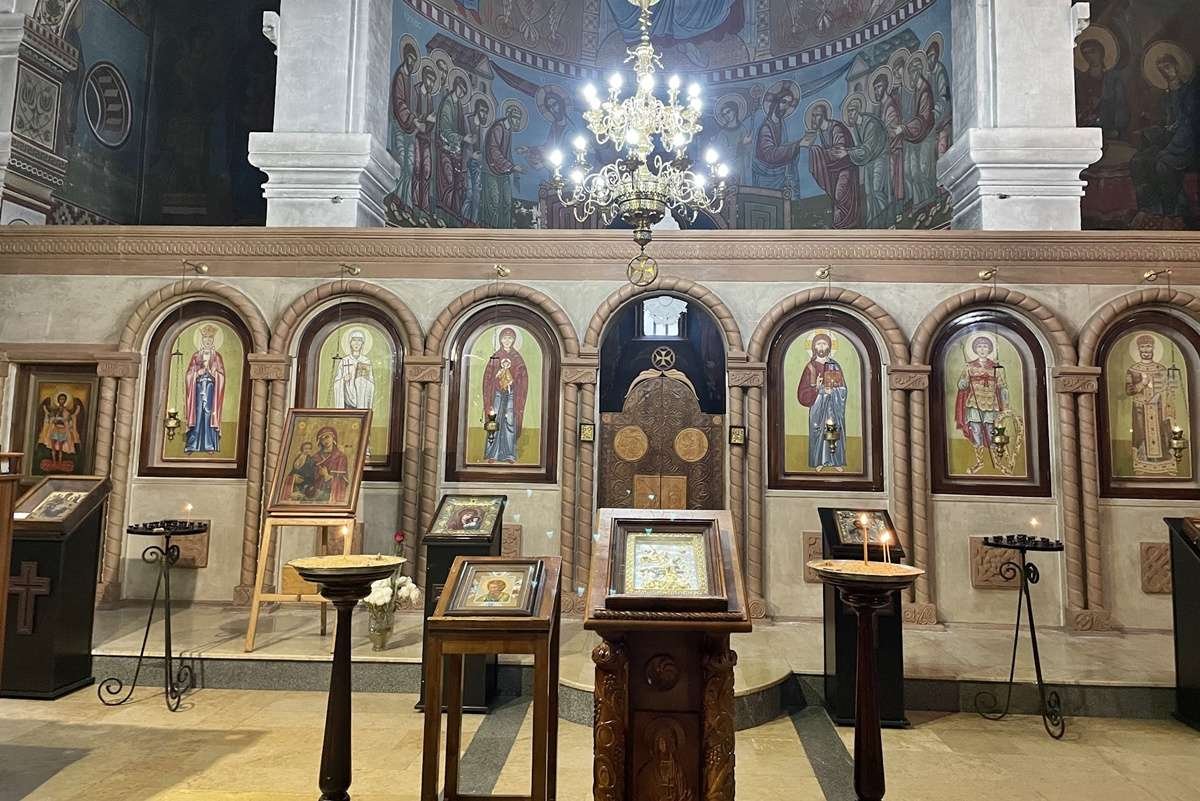
The only frescoes found are in the apse (and possibly in the deaconry and altar, but they're hard to see); the vaults and drum remain unpainted. However, the church walls are literally covered with icons, in several rows, one above the other. Directly above the entrance stands a modern, low wooden choir stall, and before entering the church grounds stands a small, two-tiered, six-bay belfry, also a modern structure.
🧭 Take a look around the neighborhood


ℹ️ The historical information is based on a detailed architectural description of the church and may not reflect the most recent changes to the interior design. Please inquire on-site to verify the current status.
💬 Tell Us
Did you notice the unusual white stone on the columns inside the church? Share in the comments how you think the bas-relief above the southern entrance should be interpreted!
📍 Impressions in a nutshell
The Lower Church of St. George is a rare example of a building that has survived the transition of religious communities: from an Armenian church built in 1725 to a functioning Georgian Orthodox church, with its unusual white stone and enigmatic bas-reliefs to boot.
🧡 Read More About Kutaisi
- ✝️ Protestant Church in Georgia: What It Is and How It Appeared
- 🌉 Bridges of Kutaisi: A Guide to the Crossings Over the Rioni
- 🏛️ Royal Residences of Imereti: Geguti Palace and the Palace of Solomon II
💾 Save this article to return to it before your trip to Kutaisi.
❓ Frequently asked questions about the Church of St. George in Kutaisi
💬 Unlike the Upper Church of St. George, which stood near the Bagrati Cathedral in the citadel and remains only in ruins, this church is located lower down, by the Rioni River, and has survived intact.
💬 Yes, it was built in 1725 as an Armenian church, likely the only one in Kutaisi. In 1989, it was transferred to the Georgian Orthodox community, and today it functions as such.
💬 Above the western entrance, St. George slaying a serpent or dragon with a spear—a classic scene. Above the southern entrance is a less obvious scene: a horseman slaying a beast-headed figure with a spear.
💬 The twelve-sided carved drum, the cross-shaped columns inside, and the white translucent stone used to construct the building, rare in Georgia.
💬 Yes, Bagrati Cathedral is nearby, along with the ruins of the Upper Church of St. George, as well as the historic Kutaisi Synagogue.
Read also

4 comments
Log in to leave a comment