




Bedia Cathedral in Abkhazia: Frescoes and Golden Chalice
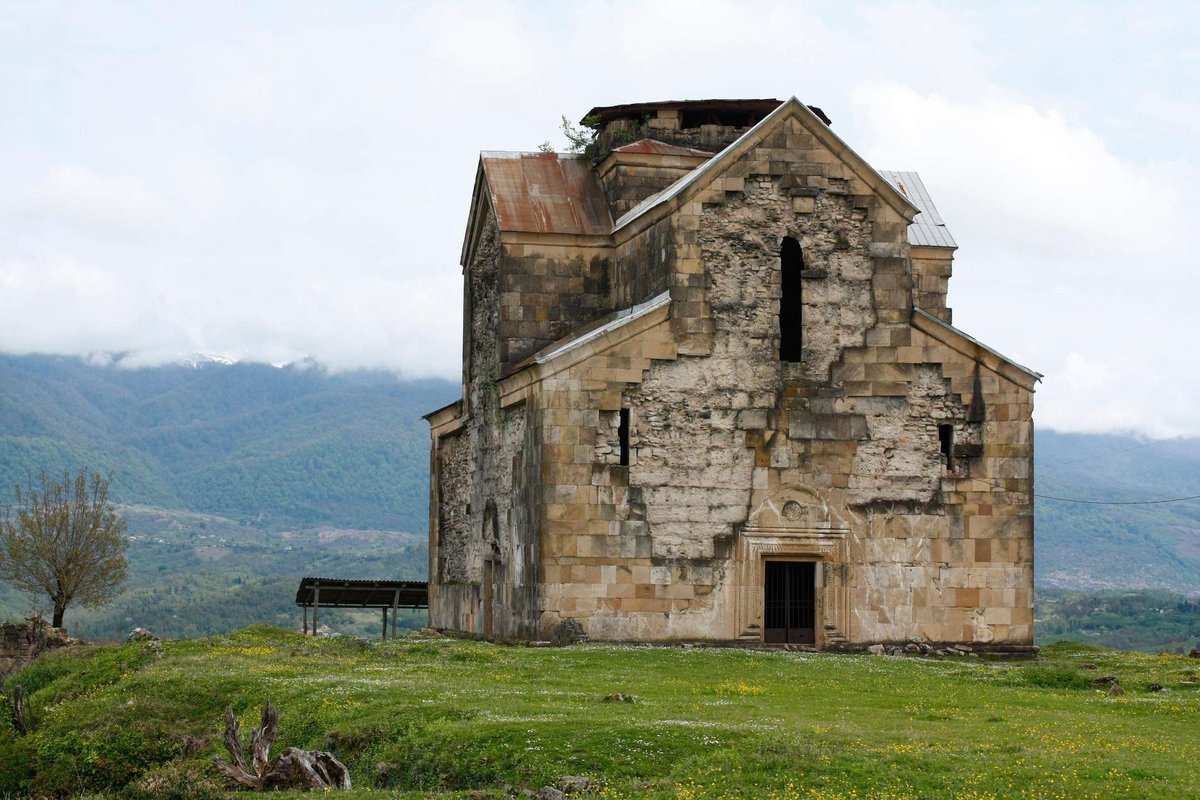
The Bedia Monastery Complex is located in Abkhazia, currently occupied by Russia, 25 km from the town of Ochamchire, in the center of the village of Bedia.
According to historical records, the Cathedral of the Mother of God was built by order of the first king of a united Georgia, Bagrat III Bagrationi (978-1014), who made it the episcopal center. Bagrat III himself and his mother, Gurandukht, are buried in this monastery. Three layers of frescoes have been preserved in the interior of the church, dating from the 10th-11th, 13th-14th, and 16th-17th centuries. Among them is a fresco on the eastern part of the southern wall, depicting the cathedral's founder, Bagrat III, holding a model of the church, and representatives of the Dadiani family. The Bedia Diocese was one of the most important ecclesiastical, cultural, and educational centers during the Middle Ages. To the east of the cathedral is the two-story palace of the Bedia metropolitans (built by order of Bedia Metropolitan Anton Zhuanisdze), and to the north, opposite the gate, is a bell tower (14th century). The Bedia Monastery was restored in the 13th-14th centuries.
The Bedia Monastery also owns a 14-cm-tall golden chalice—a church bowl made of pure gold. The chalice is 12.5 cm high; the diameter of the base for the chalice stand is lost. The chalice's outer surface is divided into 12 arched sections. Images of saints are placed under each arch. Jesus Christ and the Virgin Mary with Child are depicted under the opposite arches. On the top of the chalice is a single-line inscription in the Old Georgian alphabet—"asomtavruli"—from which we learn that the chalice was commissioned by Bagrat III and his mother, Gurandukht, who later donated it to the Bedia Monastery. The Bedia Chalice is kept in the Georgian State Museum of Art.

46 comments
Log in to leave a comment
Очень пригодились отзывы путешественников из рейтинга, где описаны лучшие ракурсы для фото, удобные маршруты обхода и моменты, когда свет на фасаде особенно красивый. Такие советы помогают не просто увидеть собор, а прочувствовать его атмосферу и понять, какие детали действительно заслуживают внимания.
После прогулки заглянул в тихий дворик неподалёку — спокойный уголок, где можно перевести дух и обдумать увиденное.
Как вы предпочитаете посещать такие духовные места: неспешной прогулкой с остановками, чтобы всё рассмотреть, или целенаправленно, чтобы сфокусироваться на главных деталях?
Особенный интерес для меня представляет что это- уникальный церковный артефакт, хранящийся в Бедийском монастыре. Он как нельзя лучше иллюстрирует мастерство своего автора и является частью традиций и истории данного места.
✅ Положительный момент статьи: Положительным моментом статьи является то, что она информативна и интересна для людей, которые интересуются историей и культурой Грузии и Абхазии. Статья описывает достопримечательность - Бедийский собор, который является важным церковным и культурным центром в Абхазии. В ней также упоминаются исторические факты и подробности о фресках, что делает ее еще более интересной и познавательной. Также стоит отметить, что статья не содержит политических оценок и комментариев, что может увеличить число читателей, заинтересованных в культурных достопримечательностях.
Несмотря на положительные и отрицательные моменты статьи, я благодарю автора на каталоге Мадлоба за интересную и полезную статью!!
Спасибо автору, за интересную статью о данном соборе!
Я окунуклась в историю того времени- историю , той, объединенной Грузии. Сейчас хочется, узнать более подробно о подвигах, достижениях Грузинского народа того времени.
Очень бы хотелось побывать в этом месте.