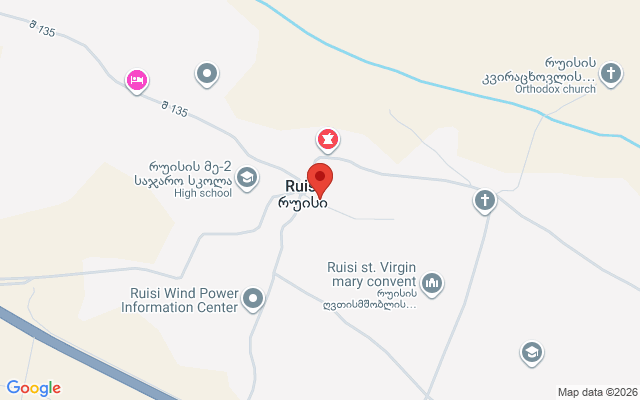




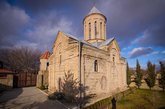


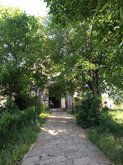

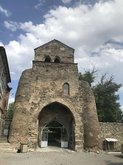


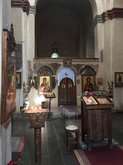

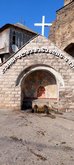

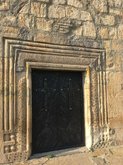

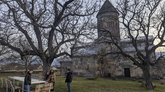

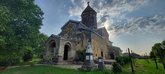

The Cathedral of the Mother of God stands in the centre of Ruisi village, Kareli Municipality, by the Gori-Khashuri highway, among the churches, cathedrals, monasteries and synagogues of the region. Built in the 8th-9th century, remodelled in the 11th century and rebuilt again in the 15th, it's a cross-in-square church with a tall dome and a horseshoe apse on the east, listed among Georgia's Immovable Cultural Monuments of National Significance.
For more on the cathedral's history, see the article on Ruisi Cathedral.
Ruisi holds a significant place in Georgian history: in 1055, the boy-king George II was crowned here, and in 1103 the cathedral became one of two locations for the landmark church council convened by King David IV (the other being the nearby Urbnisi cathedral). The Ruisi episcopal seat bore the title "Mroveli": one bishop, Leonti Mroveli, compiled a corpus of Georgian chronicles in the 11th century, a foundational source for the country's history. In 1695, King Alexander IV of Imereti, held prisoner here, was killed and buried at the cathedral.
The village of Ruisi also carries the memory of a tragic 20th-century event: in 1924, Bolshevik forces carried out the mass execution of 94 villagers, primarily from noble families, as part of suppressing the August Uprising against Soviet rule, an event known as the Ruisi Tragedy.
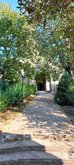
According to reviews, it's worth preparing for possible crowds. One visitor honestly notes that the atmosphere inside can be disrupted by noisy tour groups and a lack of quiet seating, especially at peak times. Around the church spreads a large grassy field, good for walking and photos, including with children.