




Schvilo Castle: Film Location for Sherekilebi
The answer to the question: what to see in Georgia? Skhvilo Castle, located near the village of Kvemo Chala in the Shida Kartli region, Kaspi Municipality, is undoubtedly Skhvilo Castle.
History
The castle was first mentioned in chronicles in the 10th century. In the 17th century, the residence of a family bearing the name Zedginidze-Amilakhvari was located on this site. This family is also associated with the history of a 14th-century prison.
Since the 17th century, Skhvilo Castle has been frequently mentioned in various historical sources. In 1629, some time after the death of Shah Abbas, Teimuraz I attempted to renounce his allegiance to Iran.
For this, the ruler Simon II, who was imprisoned in the Skhvilo prison-fortress, was forced to be executed. The severed head of Simon II was brought to the feet of King Zurab Eristavi, who had killed him. In 1632, after ascending the throne, Rostom attempted to lure Teimuraz's supporters into his entourage. His primary target was Yotam Amilakhvari. His attempts were unsuccessful, and Rostom stormed the castle.
During these battles, the structure suffered colossal damage.
The Skhvilo Fortress remained significant in the 18th century. Georgians sought refuge within the castle walls during battles with Lek, Ottoman, and Qizilbash warriors. This usually helped them defeat their enemies.
The fortress also served as a rallying point for revolutionary-minded peasants from 1905 to 1907. However, in the 19th century, Skhvilo lost its fortification significance.
Architecture
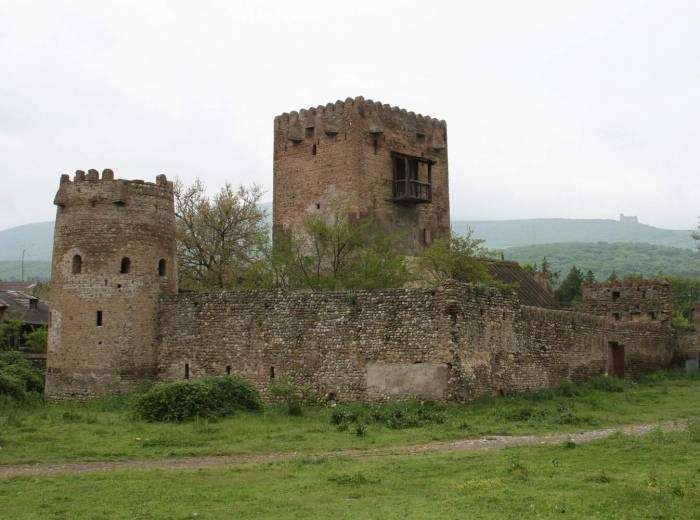
Skhvilo Castle comprises a wall, a main and secondary tower, a church, a reservoir, as well as houses suitable for habitation and outbuildings for farming.
The castle itself is built of cobblestones, protected externally by a very thick, high, crenellated wall, upon which seven more abutments were built. The top of the wall was intended for observation, containing loopholes, openings in the walls, and places for soldiers.
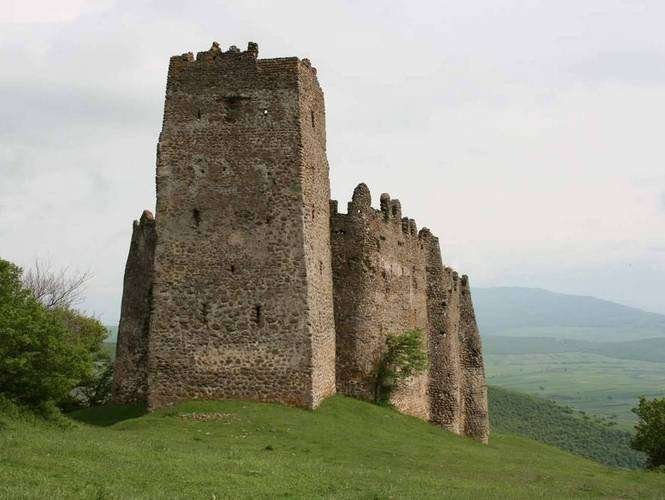
The wall on the north side is occupied by a five-story tower, known as the main tower. A unique entrance to the structure is located six meters above ground level, on the first floor of the tower. The fourth floor served as a connecting wall, and was therefore covered with a vault constructed of stones. The remaining floors had wooden roofs. Each tower tier contained several loopholes.
On its fifth level, a balcony projected from wood, with a wide opening offering a view of the entire courtyard. A relatively small tower stood on the southern side of the enclosure, its lower section sealed off. Entrance was from the courtyard, two meters above ground level. A stone canopy covered the first and second levels, and timber covered the roofs of the three floors above.
A door to the balcony opened from the second and fifth floors. Unfortunately, the balconies have not survived to this day.
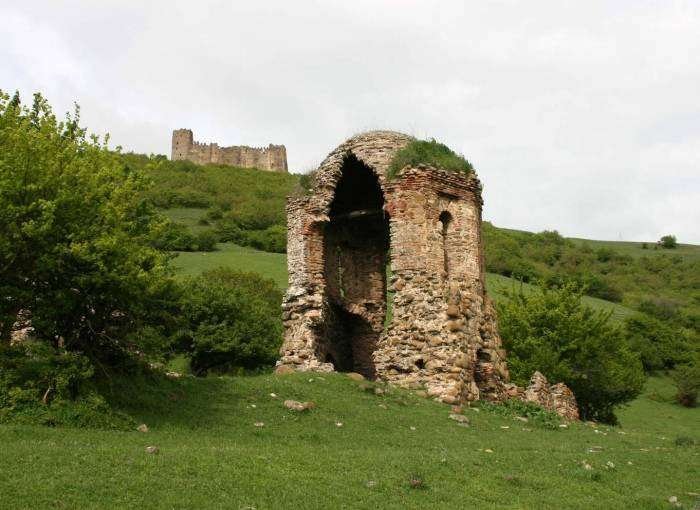
The Church of Skhvilo is a two-story structure located in the southeastern part of the courtyard. Initially, it was a single-story building, but over time, a second church was added. However, both churches were rebuilt several times.
The Church of St. George was located below and is built of bluestone.
The church was built by Zedgenidze during the reign of Alexander I, as evidenced by the inscription "Asomtavruli" (meaning "in capital") on the building's western façade.
The apse of the church was semicircular. The upper church was dedicated to St. Theodore. It was built using cobblestone. The apse was trapezoidal. The ruins of a once three-story residential building were discovered within the castle walls in the courtyard to the west.
Similar three-story buildings also stood in the eastern and northern parts of the courtyard. The buildings used for farming were covered with awnings, and their entrance was usually 5-6 meters above ground level.
The central part of the courtyard was occupied by a fireplace, open to all four directions. A two- or three-story structure likely also stood in this area. A vaulted water reservoir stood near the castle wall to the west, and a ceramic water supply led from the north to it.
Skhvilo Castle is a monument of vital historical and cultural significance in Georgia. Its surroundings make it equally recognizable. The castle is perched on a hill, offering stunning views of the Kartli Valley. Furthermore, the Skhvilo Fortress and surrounding grounds were used as the setting for the film "Sherekilebi," a celebrated Georgian film.
So, if you're still unsure what to watch during your trip to Georgia, consider watching this wonderful film: see Georgia's picturesque landscapes and landmarks, and be inspired to travel.
Photo source: travelgeorgia.ru

32 comments
Log in to leave a comment
Особенно ценно, что рейтинг помогает понять архитектуру и значение крепости — здесь есть мощные стены с бойницами, главная пятиэтажная башня, остатки церкви и водохранилища, а сам комплекс расположен на возвышении, откуда открываются захватывающие виды на долину Картли.
Советы от местных и отзывы туристов помогают заранее спланировать посещение: как добраться до замка из села Квемо‑Чала, на что обратить внимание при прогулке по руинам и где лучше остановиться для пикника или фото‑остановки после экскурсии.
После прогулки по Схвило я зашёл в маленькое кафе у дороги и попробовал местные блюда под бокал грузинского вина — атмосфера здесь действительно особенная.
Кто бы вы взяли с собой в такую экскурсию: друга‑историка, который расскажет о баталиях прошлого, или фотографа, чтобы поймать лучшие кадры древних стен?