




🏰 The Cave Monastery of Vardzia in Javakheti: Five Phases of Building, Frescoes and Life Inside the Rock
🏰 Vardzia: What to Know Before You Go
A monastic complex cut into a monolithic cliff on the eastern spur of the Erusheti range, in Javakheti, on the left bank of the Mtkvari. It was built over half a century under George III and his daughter Tamar, conceived as a fortress and ending up a city-monastery.
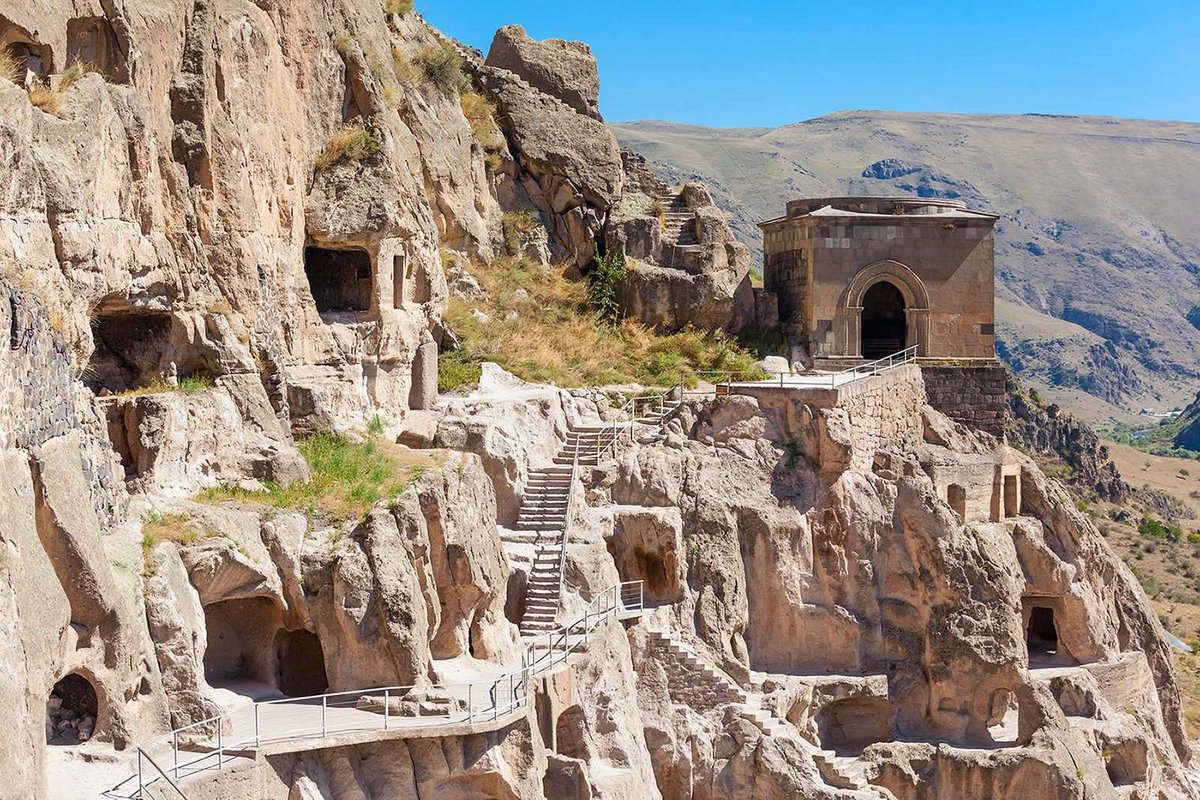
Vardzia is a monastic complex hewn into a monolithic cliff on the eastern spur of the Erusheti range, in Javakheti, on the left bank of the Mtkvari, at 1,300 metres above sea level. The uppermost cave sits at 1,462 metres.
The place is well known but usually described in passing. In fact Vardzia has a detailed building history in five phases, the names of its patrons and its painter are recorded, and inside are wine cellars, an aqueduct and a chamber known as Tamar's room.
🏗️ Five phases: who built what
Vardzia did not appear all at once, and each phase belongs to a particular ruler.
The first, under George III (1156-1184). The first cells and a church were cut. The original idea was a fortress.
The second (1184-1185), under Tamar. A hall-type Church of the Dormition with a gallery was built. It was painted by the artist Giorgi at the expense of Rati Surameli, eristavi of Kartli. It was under Tamar that the purpose changed: from a fortress the complex became a fortified monastery.
The third (1185-1203). Service rooms, cells, defensive works and irrigation systems were completed. By 1205 the half-century of building was over.
The fourth, after the earthquake of 1283. Beka Jaqeli (1285-1306), ruler of Samtskhe, ordered a two-storey bell tower with carved ornament.
The fifth, under Atabeg Ivane. The large refectory was cut.
The complex divides into two parts: the rock village of Anauri of the tenth to twelfth centuries, and the monastery proper. The paintings in the church at Anauri date from the sixteenth century, several hundred years later than the main ones.
🏠 How the city inside the rock was arranged
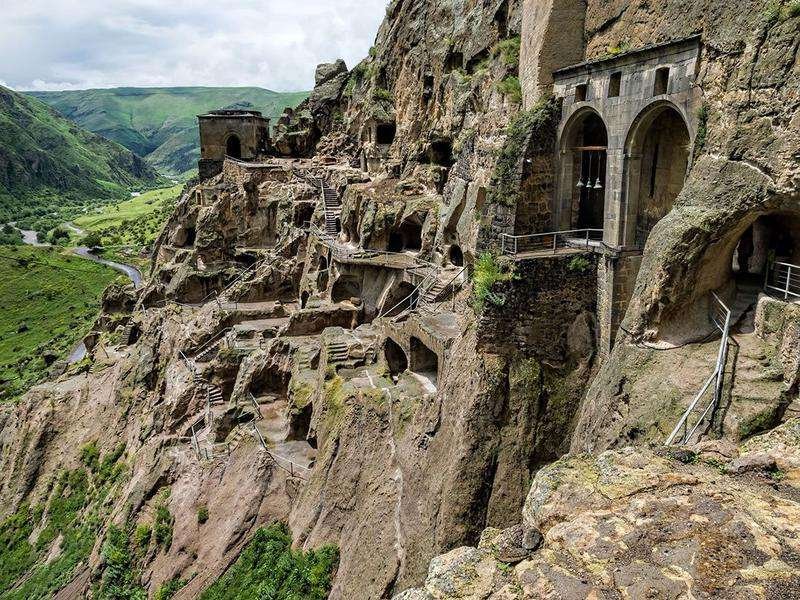
This is the most interesting part, and it is usually left out.
The complex runs about a kilometre along the river, and the caves reach several dozen metres into the rock. Sources disagree on the number of levels: both eight and thirteen are cited. The total number of caves is estimated at six hundred, while the surviving chambers of the monastery number around 420. The difference lies in what is being counted: every hewn cavity, or the rooms the community actually used.
The cells have two, three or four rooms, with a vestibule, a living room and a store. Wide niches cut into the walls served as benches, smaller ones held crockery, books and lamps. The layout of an ordinary dwelling, only in stone.
They made a great deal of wine here. The complex holds 25 marani, wine cellars, with 185 kvevri. For a monastery that is industrial scale: nobody keeps that many vessels for their own use.
Water came from a natural spring deep in the rock behind the main church, along conduits totalling three and a half kilometres. This is the site's great feat of engineering: a city inside a cliff that depended on no outside source, and could therefore withstand a siege.
The eastern part survives best, with 242 rock chambers. Among them are a hall measuring eight by five and a half metres, a council hall, Tamar's chamber and a room for rest. The refectory is in the western part, and rooms used as refuges in the centre. Twelve chapels are spread across the complex.
🎨 The frescoes and who appears in them
In the twelfth-century Church of the Dormition the images of the ktetors, the patrons of the building, survive: George III, Queen Tamar and Rati Surameli. Tamar's portrait here is one of the few made in her lifetime, and some visitors come specifically for it.
Alongside them are scenes from the New Testament.
✍️ Ioane Shavteli and the Hymn to the Virgin of Vardzia
Ioane Shavteli worked at Vardzia, and his career explains what this monastery meant to the state.
Shavteli headed the community and at the same time held high office at the royal court: he was first deputy to the mtsignobartukhutsesi, in effect deputy head of government. The abbot of a remote cave monastery sat in the country's senior leadership.
The Hymn to the Virgin of Vardzia is his, and it survives to this day. It is not merely a literary monument but evidence that Vardzia was a centre of power and culture rather than a refuge.
⚔️ What happened afterwards
The half-century of building ended in the early thirteenth century, and the story then runs downhill.
Vardzia had no artificial defences. The cliff itself served as the wall, and the city was securely hidden from outside eyes. That is precisely why the earthquake of 1283 was so devastating: the outer rock collapsed, more than two thirds of the complex was destroyed, and what remained lay exposed. The site lost its principal protection.
In 1551 the army of the Iranian Shah Tahmasp I, known in Georgian sources as Tamaz, arrived. The icon of the Virgin, gold and steel doors and a great many ornaments were carried off.
In 1578 the Ottomans took the monastery. Many monks were killed, the survivors scattered, and the house stood empty.
Under Soviet rule the site first served as a tourist base, and in 1938 Vardzia was given the status of a museum reserve. In 1989, with the blessing of Catholicos-Patriarch Ilia II, services resumed, and by 1999 monastic life was re-established.
Today Vardzia is both a museum reserve and a working monastery, which is why part of the complex is closed to visitors.
🗺️ What to see nearby
Vardzia is almost never visited on its own: a whole string of sites stands along the Mtkvari valley, all within half an hour's drive.
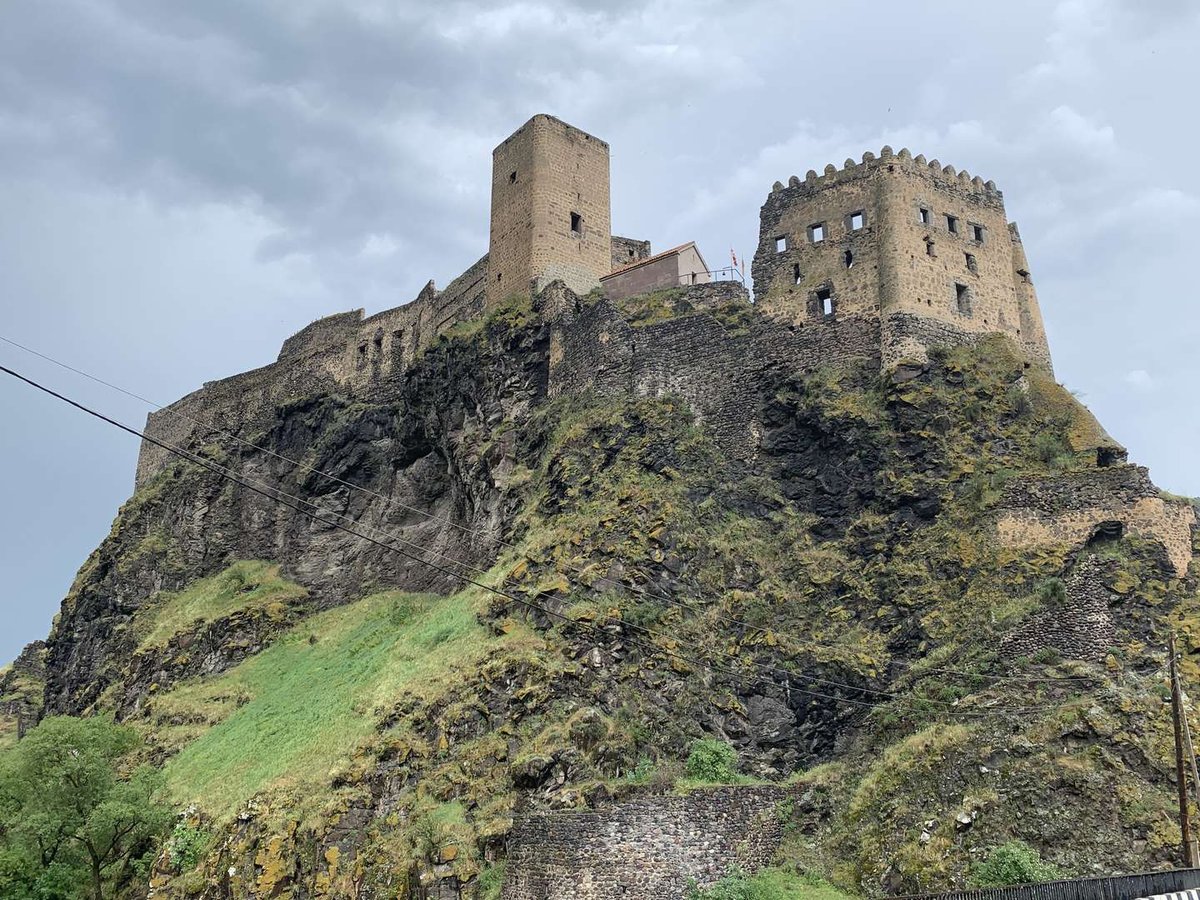
Khertvisi Fortress, one of the oldest and best preserved fortresses of medieval Georgia. It stands where two rivers meet, about eleven kilometres to the north. Together with Vardzia it sits on the UNESCO tentative list.
Tmogvi Fortress on the bank of the Mtkvari, with the foundations of ancient settlements visible from it. About three kilometres away.
Vanis Kvabebi, a cave monastery in the cliffs two kilometres from Vardzia. Quiet and almost deserted, which after crowded Vardzia is a noticeable contrast.
🚗 Getting there
The nearest town is Aspindza, thirty kilometres from Vardzia. The main base is Akhaltsikhe, about an hour away. Borjomi is some seventy kilometres to the north, Tbilisi about four hours.
Public transport does reach Vardzia, but rarely and with a change at Akhaltsikhe. Most people come by car or on a tour: the standard day trip from Tbilisi takes in Borjomi, Rabati and Vardzia.
The road from Akhaltsikhe follows the Mtkvari and is worth the drive in itself, so allow time for stops at Khertvisi and Tmogvi.
🧭 Where to stay and what is nearby
You can sleep right by Vardzia: there are guesthouses and small hotels in the area. Akhaltsikhe offers a wider choice.
Been to Vardzia? Leave a review on Madloba: tell us how long the walk through the caves took, whether you took a guide, and whether you managed to see Tamar's chamber.
Information is current as of August 2026. Ticket prices, opening hours and access to individual chambers all change, so check the current conditions before you travel.
❓ Frequently asked questions
💬 In Georgia, Samtskhe-Javakheti region, the historical province of Javakheti, on the left bank of the Mtkvari, thirty kilometres from Aspindza. The complex is cut into the cliff on the eastern spur of the Erusheti range at 1,300 metres, with the upper caves reaching 1,462 metres.
💬 Rates are set by the Agency of Protected Areas and revised periodically, so the current figure is best checked on their website or at the ticket office. Tickets are bought on site, and the shuttle to the caves is paid for separately. Discounts apply for schoolchildren and students.
💬 George III began the work in 1156 and his daughter Tamar continued it. The main construction ran to 1203 and the whole was finished by 1205. The bell tower under Beka Jaqeli and the refectory under Atabeg Ivane came later.
💬 Around 420 chambers of the monastery survive, 242 of them in the better preserved eastern part. The total number of hewn caves, including those destroyed, is estimated at around six hundred.
💬 Yes, and in significant quantity. The complex holds 25 wine cellars with 185 kvevri. For a monastery that is industrial scale; nobody keeps that many vessels for their own use.
💬 From a natural spring deep in the rock behind the main church. It ran along conduits totalling three and a half kilometres, so the city depended on no outside source and could withstand a siege.
💬 The cliff itself served as the wall: the city was cut inside it and invisible from outside. That is exactly why the earthquake of 1283 was so devastating, exposing the complex and stripping away its defence.
💬 In the twelfth-century Church of the Dormition the ktetors are depicted: George III, Queen Tamar and Rati Surameli. The painting was executed by the artist Giorgi at Rati Surameli's expense. Tamar's portrait here is one of the few made in her lifetime. The paintings at Anauri church date from the sixteenth century.
💬 Since 2007 it has been on the tentative list of World Heritage, not the inscribed list. The phrase "UNESCO site" is common but inaccurate.
💬 About an hour by car from Akhaltsikhe, thirty kilometres from Aspindza, roughly four hours from Tbilisi. Public transport is infrequent and requires a change, so most people drive or join a tour, usually the Borjomi, Rabati and Vardzia combination.

31 comments
Log in to leave a comment
Мадлоба делится советами от месхетинцев: май–октябрь без жары, скромная одежда в монастырскую зону, фото без вспышки. Отзывы подсказали тайные туннели, FAQ — билет 10 лари, с детьми ок. Планирую повторить с ночёвкой у реки!
А вы бродили по Вардзии — что круче, фрески Тамары или виды на Кура? Расскажите! 🤔
Этот уникальный пещерный комплекс в южной Грузии поражает своей грандиозностью и сложностью. Вардзия была построена в XII веке во времена правления царицы Тамары и служила как монастырь, так и укрепленный город.
Прогуливаясь по этим древним туннелям и залам, невозможно не восхищаться мастерством и упорством тех, кто создал этот удивительный город в скалах. Каждая комната, каждая ниша рассказывают свою историю, и находясь там, чувствуешь себя частью этого далекого прошлого. Вардзия — это место, которое стоит посетить, чтобы ощутить дух древности и прикоснуться к истории Грузии.