




Sultan Ezid Temple in Tbilisi: faith, history, and how to get there
🕍 Active temple · ⏱️ 30–60 min · 📍 60 Viktor Kupradze St, Tbilisi
🕍 What you need to know before visiting
| 📍 Address | 60 Viktor Kupradze St, Tbilisi |
| 🕐 Opening hours | Mon–Sun: 09:00–20:00 |
| 💰 Admission | free |
| 📅 Opening | June 16, 2015 — on land allocated by the Government of Georgia |
| 📞 Phone | +995 322 23 62 25 |
🧭 Who is this article for
The Sultan Ezid Temple is the only Yezidi sanctuary in Georgia and one of the few in the world. Yezidi believers come here, but tourists interested in rare religions and multiethnic Tbilisi can also visit the temple freely. This article is for those who want to understand who the Yezidis are, what this place is, and how to get there.
🕊️ One of the few in the world
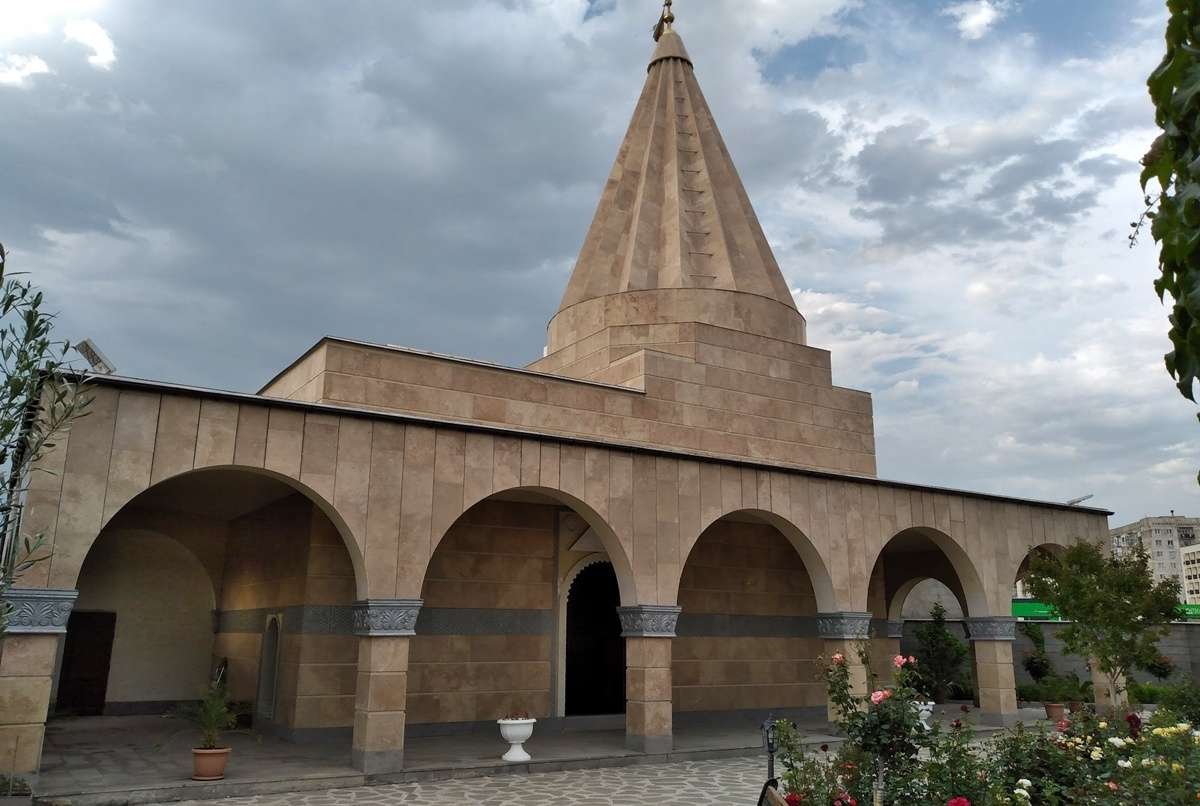
On June 16, 2015, the "Quba Sultan Ezid" temple opened in Tbilisi — at that time, it was the second Yezidi temple outside Iraq in the entire world. The first one appeared in the Armenian village of Aknalich in 2012. In Iraq, the homeland of the Yezidis, the main holy temple is Lalish in Kurdistan. It was modeled after Lalish that the Tbilisi temple was built.
The land for construction was allocated by the Government of Georgia in 2009. Construction began in 2012 at the initiative of the "House of Yezidis of Georgia" — funded by local businessmen. The financing came entirely from the community; the state only provided the land.

🏛️ What the temple looks like
The Tbilisi temple is modeled after Lalish — this is noticeable at first glance. It shares the same characteristic features: a single cone-shaped spire tower pointing upwards, and bare outer walls made of light stone without any molding or decor. This appearance is intentional: in Yezidism, simplicity of form reflects the purity of faith.
Surrounding the temple is a well-kept garden with trees, blooming bushes, and neatly trimmed lawns. On the territory stands a separate pyramidal glass building: this is where courses on Yezidi religion and history are held, as well as Georgian and Kurdish language classes. A small hill opens up a view of a part of Tbilisi — a view that is not mainstream, but very atmospheric.
Inside, it is no less interesting than outside. The interior design includes sacred Yezidi motifs and images of Malak Taus — the Peacock Angel, the central figure of the Yezidi faith.

🦚 Who are the Yezidis and why their religion is unique
The Yezidis are a Kurdish-speaking ethno-religious group, one of the oldest in the Middle East. They consider their religion — Yezidism — to be monotheistic: there is one God (Xwede), who created the world and handed it over to the care of seven angels (the Seven Mysteries, heft sirr).
The three main figures — Malak Taus (the Peacock Angel), Sheikh Adi ibn Musafir, and Sultan Ezid — form a sacred triad. The Tbilisi temple is named after the third one: Sultan Ezid is considered the patron protector of the Yezidi people in earthly life. The word "Ezid" goes back to the Persian izad — "deity."
The religion shows traces of Zoroastrianism, Sufism, Christianity, and Judaism. During prayer, Yezidis face the Sun. One does not convert to Yezidism — one can only be born into it.
Why they were called "devil worshippers"
This is one of the most painful misunderstandings in the history of religions. In the Quran, Malak Taus shares a name associated by others with Shaitan — the same word Arabs use to designate Satan. This led to centuries of accusations of "devil worship," which Yezidis categorically reject. It was this accusation that became the pretext for 74 genocides throughout the history of these people, including the mass extermination by ISIS militants in Iraq in 2014.

📜 How the Yezidis ended up in Tbilisi
Isolated Yezidi tribes appeared in the South Caucasus back in the 18th century. In the 1770s, the King of Georgia, Erekle II, tried to establish diplomatic contact with them.
Mass migration occurred at the turn of the 19th–20th centuries: Yezidis fled persecution by the Ottoman Empire from the regions of Van, Kars, and Bayazet. By the end of 1918, large communities ended up in Tiflis: they settled in Zemel, Didube, Sololaki, Meydan, and other neighborhoods, trying to stay close to their compatriots.
According to the 1989 census, there were more than 30,000 Yezidis in Georgia. After the collapse of the USSR, most left for Russia, Germany, and the USA. According to the 2014 census, about 12,000 remained, with more than 90% living in Tbilisi. Around 2015, refugees from Sinjar, Iraq, also arrived in the city, escaping ISIS.
Notably, Yezidism was officially recognized in Georgia only in 2011 — four years before the temple opened.

The temple staff gladly talk to visitors — do not miss this opportunity. If you are lucky enough to talk to a Pir (a spiritual mentor), it is an entirely different conversation, completely unlike a standard tour guide story. Come without rushing and set aside some time for a conversation. The glass pyramidal building nearby is often missed — but classes are held there and you can sometimes find out the schedule of community events. It is better to ask for permission before taking pictures inside: sometimes they allow it, sometimes they do not.
🗺️ How to get there
1️⃣ By public transport — the stop is a two-minute walk from the temple. Check the current routes via an app or ask locals — the area is served by several bus routes.
2️⃣ By taxi (Bolt / Yandex) — say "60 Kupradze St" or "Sultan Ezid Temple". Coordinates: 41.7096, 44.8716. About 10–15 minutes from the center.
3️⃣ On foot from "300 Aragveli" metro station — about 15–20 minutes through residential areas.
💬 What those who have been here say
"I liked that there are no crowds of tourists here and you can stand quietly and think. And also the view from the hill over the city — of course, it's not the most mainstream, but it is very atmospheric. If you want to see Tbilisi outside of standard routes, drop by here. The road is simple, and the impressions feel like a journey into another era."
"My time spent in conversation with Mr. Pir Dima and the locals was very valuable."
"An excellent depiction of the Yezidi culture."
"This is an ancient religious site, dating back 7000 years."
"Ezidis temple is located in Tbilisi. It was amazing experience to be there and to listen to them. Yezidis are religious minorities in the world. I would recommend to visit their temple, to get information about very rare culture."
🏁 Why go here
The Sultan Ezid Temple is a place that falls outside any standard itinerary around Tbilisi. It is an active temple of a living community, one of the few in the world, built on the model of sacred Lalish. Behind its walls lies the history of a people who survived 74 genocides and preserved their religion and language. There are no crowds here. Instead, there is an opportunity to talk, learn something that is not written in guidebooks, and leave with a different perspective on multiethnic Tbilisi.
Save the article or share it with those traveling to Georgia.
ℹ️ The temple is active, admission is free. The schedule and working hours may change during religious holidays. Photography inside is subject to permission from the staff. Information is current at the time of publication.
Have you been to the Sultan Ezid Temple? Did you manage to talk to the staff or find out something unexpected? Or maybe you heard about the Yezidis for the first time and this place became a discovery? Tell us — we read all the comments ❤️
❓ Frequently Asked Questions
💬 Sultan Ezid is one of the three manifestations of the one God in Yezidism, along with the Peacock Angel (Malak Taus) and Sheikh Adi. He is considered the patron protector of the Yezidi people in earthly life. The name goes back to the Persian word izad — "deity."
💬 Yezidism is a monotheistic religion with seven holy angels. It contains traces of Zoroastrianism, Sufism, Christianity, and Judaism. The main symbol is the Peacock Angel (Malak Taus). Yezidis pray facing the Sun. One cannot convert to Yezidism — one can only be born a Yezidi. The religion is transmitted mainly orally through sacred singers known as Qawwals.
💬 The head angel, Malak Taus, is called Shaitan in Arabic — the same word that means "Satan" in the Quran. This caused a centuries-old misconception that Yezidis themselves consider offensive and false. Because of this accusation, the people survived 74 genocides in their history, the latest being carried out by ISIS militants in 2014.
💬 A large Yezidi diaspora appeared in Georgia in the late 19th and early 20th centuries, fleeing persecution by the Ottoman Empire. According to the 1989 census, over 30,000 Yezidis lived in Georgia. After 2009, the Georgian government allocated land for a temple, which opened in 2015.
💬 Not always. According to visitor feedback, it is better to ask the staff for permission to take photos in advance. Outside and in the courtyard, you can take photos freely.
💬 The temple is open to everyone. The staff warmly welcome guests and share the history of their religion. The only restriction: you cannot become a Yezidi — it is a closed ethno-religious group that does not accept converts.
💬 A few. The main one is Lalish in Iraqi Kurdistan, which is the holiest site of Yezidism. The Tbilisi temple opened in 2015 as the second Yezidi temple outside Iraq. Later, a large temple called Quba Mêrê Dîvanê opened in Aknalich, Armenia (2019). There are small community sanctuaries in Russia and several European countries.

2 comments
Log in to leave a comment
أحببت تفاصيل المكان، ولفت انتباهي أن التذاكر مجانية، مما جعلني أتعجب من الشغف وراء هذا المعبد، الذي يُعتبر واحداً من القليل جداً في العالم. هل يمكن أن تعني مثل هذه المواقع في عصرنا هذا شيئاً أكثر من مجرد الصور الجميلة والمنشورات على إنستغرام؟ كيف يمكنني احترام تلك التقاليد الغنية أثناء زيارتي؟