




⛪ Antiokhia: the Ancient Church of St Stephen in Mtskheta, Location and History
⛪ What to Know About Antiokhia
A small but ancient church in the south-eastern part of Mtskheta, near where the Aragvi and Mtkvari rivers meet. Officially the Church of St Stephen the Protomartyr, better known as Antiokhia. Built at the turn of the 4th-5th centuries by a Greek architect.

In Mtskheta, where the Aragvi and Mtkvari rivers meet, between that famous view of Svetitskhoveli and Jvari Monastery, stands a small, almost unnoticed church that locals call Antiokhia. Its official name is longer, the Church of St Stephen the Protomartyr, but the name "Antiokhia" has stuck so firmly that many travellers never learn the official one.
This church is one of the oldest in Mtskheta, a contemporary of the era when this small town was still the capital of Iberia, the first Georgian state. It stands in a courtyard separated from Svetitskhoveli by residential blocks, away from the noise of the main tourist routes, which gives it exactly the quiet that visitors so often mention.
🗺️ Antiokhia on the Map
Directions in Google Maps📜 History: King Archil and a Greek Architect

According to the Georgian chronicle "Kartlis Tskhovreba", the church was built by King Archil I at the turn of the 4th-5th centuries. Archil was the great-grandson of King Mirian, the first ruler of Georgia to accept Christianity, and the grandfather of the great King Vakhtang Gorgasali. Tradition holds that the church was raised in thanksgiving after the Persians were driven out.
The architect was a Greek named Aurelius Acolius, known from a Greek inscription found at the church's threshold. The stone slab bearing that inscription is now kept in the Mtskheta Archaeological Museum. This detail is one reason Antiokhia is considered an early example of Byzantine influence in Iberia.
🏛️ Architecture: From a Three-Nave Basilica to a Hall Church
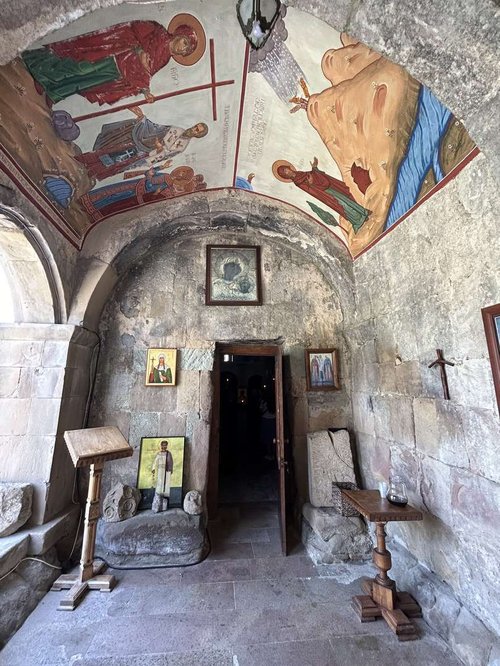
The church's appearance has changed considerably over time. It began as a three-nave basilica, and today's hall church took shape from its northern nave. The building is elongated and rectangular, with an apse to the east, its interior structured as a single simple nave.
In 736, during the Arab invasion of Georgia, the church was burned. It underwent major repairs in the 15th-18th centuries, which altered its original appearance almost entirely. The entrance gate was likely added at that time, while the gate's second storey came even later, in the 16th-18th centuries. Three of the church's walls and the gate are built of smooth sandstone blocks, while the later southern wall and the defensive tower are built of rubble, cobblestone and brick.
During the Soviet period, the church was abandoned once again. In the 1990s, after Georgia regained independence, a Georgian bank funded the restoration of the church and its grounds, and artist Irakli Tsintsinadze decorated the walls with new frescoes.
🕊️ Today: an Active Convent and a Quiet Courtyard
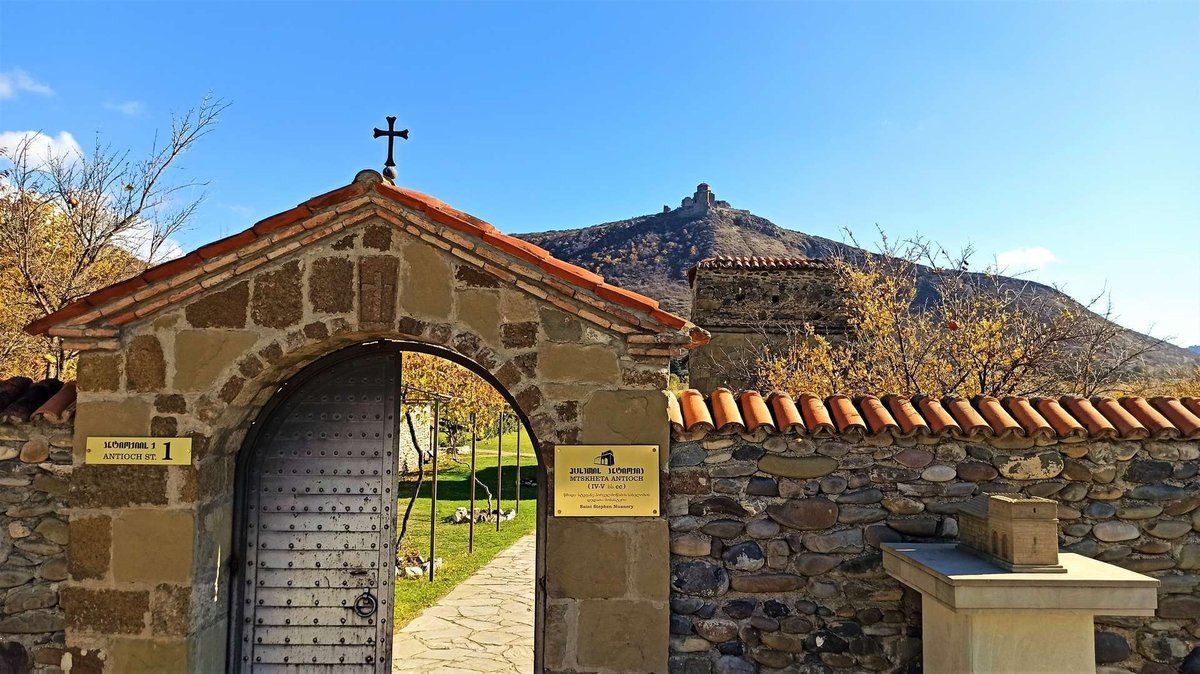
Today Antiokhia is an active women's convent dedicated to St Stephen. A small vineyard and pomegranate trees have been planted in the church courtyard, and a model of the church stands near the monastery entrance. Visitors often describe the place as unusually quiet and serene, somewhere time itself seems to slow down, in contrast to the crowds elsewhere.
The church sits just 500 metres from the main tourist routes, yet compared to the scale of the crowds at Svetitskhoveli, it's almost always quiet here, and for many, that's exactly what makes it worth the detour. According to the official catalogue listing, the church is open daily, from 9:30am to 5pm.
📌 Before You Go
Have you visited Antiokhia? Tell us whether you managed to step inside the church, whether you saw the modern frescoes, and whether you truly felt the quiet other visitors describe.
Information is current as of July 2026. Opening hours and the convent's internal rules can change, check before you go.
❓Frequently Asked Questions
💬 A small, ancient church, officially the Church of St Stephen the Protomartyr, built at the turn of the 4th-5th centuries by King Archil I. Today it's an active women's convent.
💬 King Archil I, great-grandson of King Mirian and grandfather of King Vakhtang Gorgasali, in thanksgiving after the Persians were driven out. The architect was a Greek named Aurelius Acolius.
💬 In the south-eastern part of Mtskheta, near where the Aragvi and Mtkvari rivers meet, about 500 metres from Svetitskhoveli, a ten-minute walk.
💬 It began as a three-nave basilica, and today it's a hall church formed from the northern nave, with an apse to the east. The complex also includes an entrance gate and a defensive tower.
💬 Yes, it's an active women's convent dedicated to St Stephen. The church is open daily, from 9:30am to 5pm.
💬 The church stands off the tourist paths, behind residential blocks, so it sees far fewer visitors than the much larger Svetitskhoveli. In the 1990s, artist Irakli Tsintsinadze painted new frescoes on the restored walls.

4 comments
Log in to leave a comment
I still can’t shake off that feeling. The architect was Greek, and it was fascinating to see how different styles intertwine there, like threads in a grand tapestry. It got me thinking about the stories we carry, the lives we build based on bricks and mortar.
Just curious though, do you think visiting a place like this changes the way you see your own home?