




🕳️ Caves of Imereti: 8 Underground Worlds from Prometheus to Dzudzuana
🕳️ What to Know About Imereti's Caves
Imereti is Georgia's main cave region. More than a dozen karst caves are hidden in the limestone ridges around Kutaisi and Tskaltubo, from the vast, developed Prometheus Cave with its underground river to Dzudzuana, where archaeologists found the world's oldest dyed flax fibres.

Georgia is usually pictured as mountains, sea and wine, but under the limestone ridges of Imereti lies an entire underground world. This part of the country, the hills and plateaus around Kutaisi, Tskaltubo, Tkibuli and Chiatura, became Georgia's main cave region: dozens of karst cavities, carved by water through soft limestone over millions of years.
Karst forms where water dissolves limestone over centuries, leaving cavities, galleries and halls with dripstone formations. In Imereti everything lined up for this: thick limestone beds, abundant rivers, a humid climate. Some caves are developed for tourists and receive thousands of visitors, others are known only to scientists, and a few remain barely explored. The full list with photos and coordinates is gathered in the natural attractions section of Imereti.
🗺️ Eight Caves: by Type of Visit
Open a group to jump to a cave.
🚶 Developed for tourists 4
🦴 Archaeological 1
🔦 Wild and minor 3
🗺️ Imereti's Caves on the Map
Open in Google Maps🚶 Prometheus Cave: an Underground River and a Boat Route
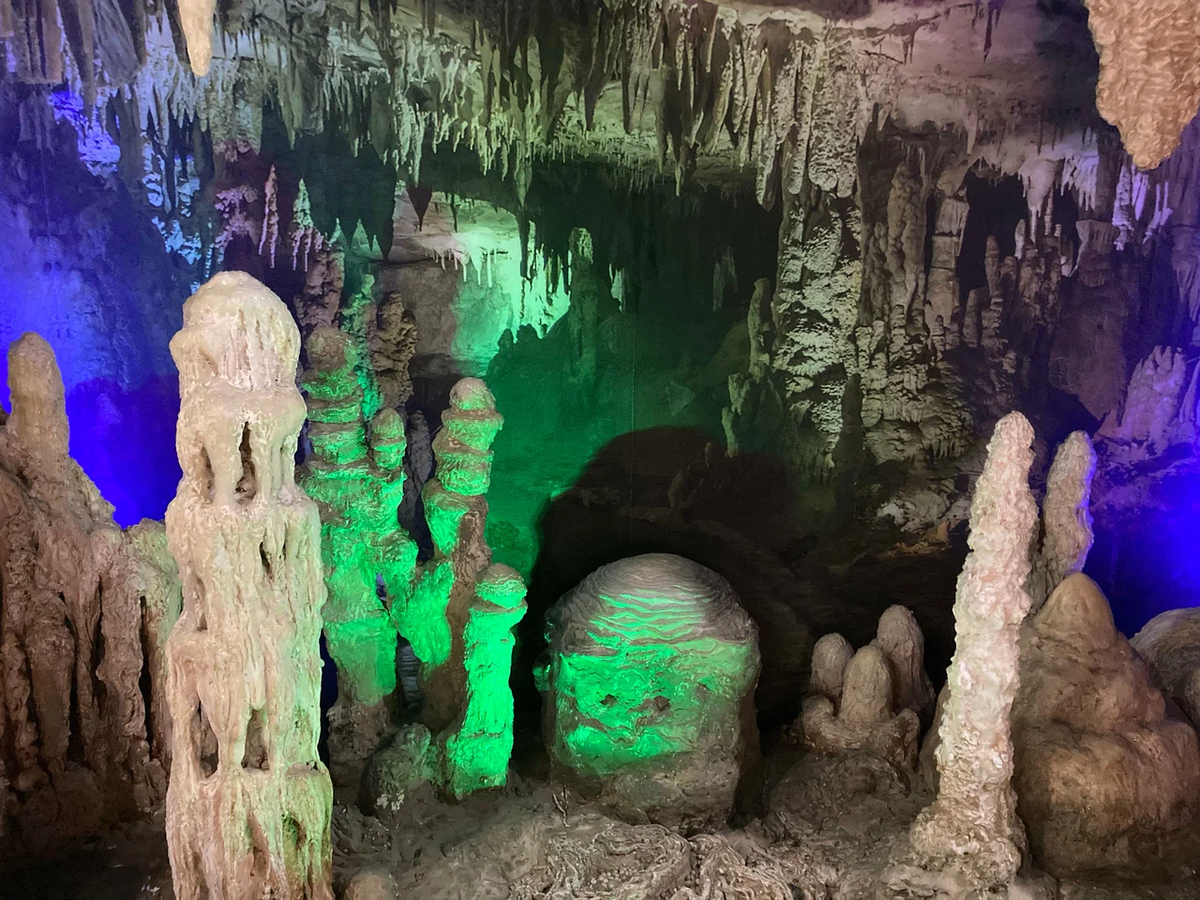
Prometheus Cave in the village of Kumistavi, about 20 km from Kutaisi, was discovered by a group of Georgian speleologists on 15 July 1983. It is Georgia's largest and most visited cave. Development for tourists began as early as 1985, but work stopped after the collapse of the Soviet Union and resumed only in 2007: the cave finally opened to visitors on 26 May 2011. The name was coined in 2010, tying the cave to the legend of Prometheus, chained to the cliffs of the Caucasus.
The cave's total length is estimated at about 11 km, with roughly 1,800 metres developed for visitors across six of its 22 halls. The route passes through a series of halls with columns of stalactites and stalagmites, dripstone curtains and stone cascades, lit and accompanied by music. At the end, visitors can take an optional boat ride along the underground river; a walking exit is also available. The temperature inside stays around 14°C year-round at very high humidity, so even in summer it's worth bringing a jacket and non-slip shoes.
Visits are only possible with a scheduled guided tour, offered in Georgian, English and Russian. The cave pairs naturally with Sataplia: both lie north-west of Kutaisi, close to each other. Note that Monday is a day off at both Prometheus and Sataplia.
🦕 Sataplia: a Cave, Dinosaur Footprints and a Glass Deck
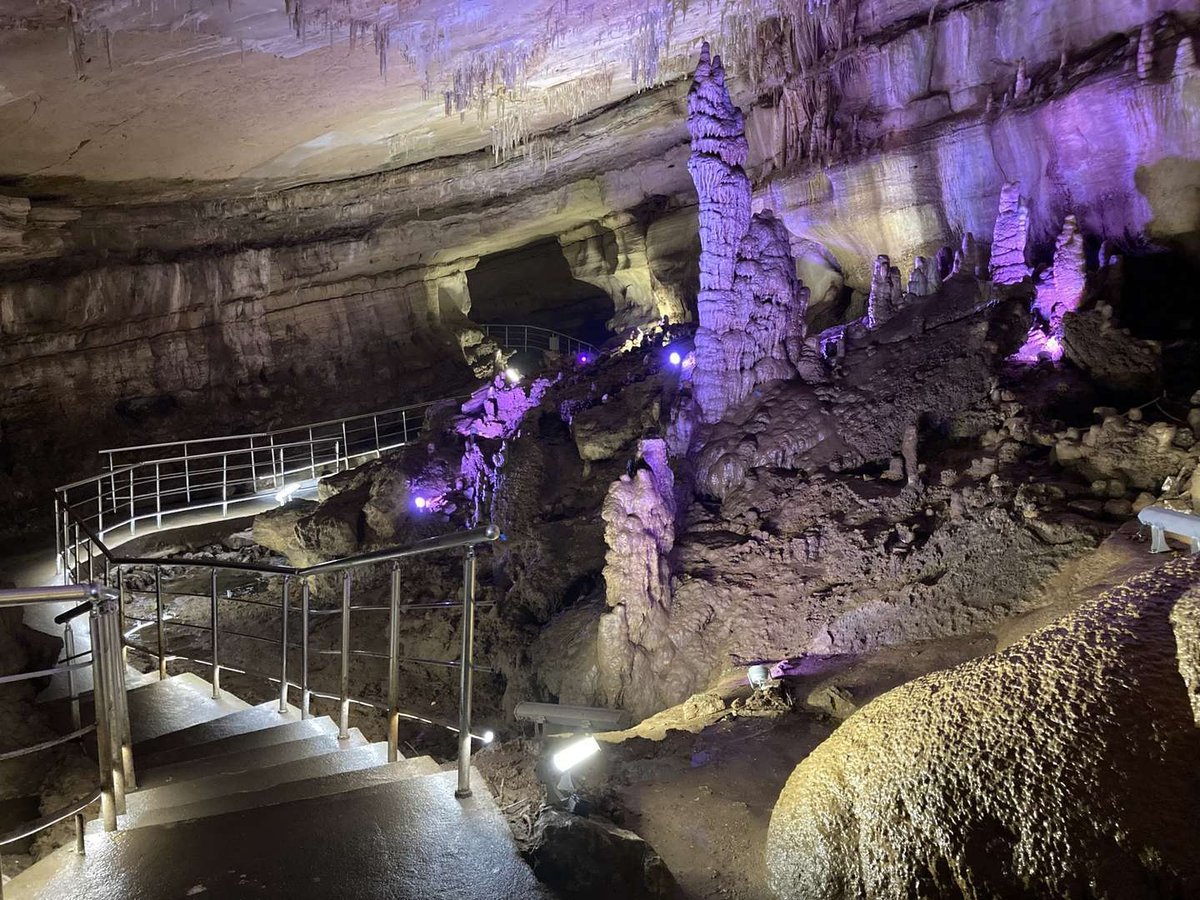
Sataplia, a reserve about 10 km from Kutaisi, brings together several reasons to visit in one place: a karst cave, dinosaur footprints, and a panoramic observation deck. The name translates from Georgian as "place of honey," a reference to the wild bees that once lived on the mountain's slopes. The reserve was established in 1935 to protect the dinosaur footprints, discovered in 1933 by local teacher and naturalist Petre Chabukiani.
Sataplia's main scientific value lies in its fossilised dinosaur footprints, about 120 million years old, from the Cretaceous period. It is one of the few places in the world where the tracks of both herbivorous and carnivorous dinosaurs survive side by side, though separated by thousands of years: the lower layer, left by a raptor (tracks about 30 cm long), the upper layer, by a plant-eating dinosaur (about 48 cm). The prints are now protected inside a purpose-built pavilion. These footprints are exactly why anyone searching for dinosaur footprints in Georgia ends up at Sataplia first. The karst cave itself is compact, about 300 metres, with a small underground stream and dripstone formations, and the route ends at a glass observation deck cantilevered over the Colchic forest below.
The cave's modest size makes Sataplia an ideal pairing with Prometheus: in a single day you can see the scale of a major cave system, genuine dinosaur tracks, and a view from above. Like Prometheus, Sataplia is closed on Mondays.
🕳️ Tsutskhvati: Thirteen Tiers Above a River

Tsutskhvati is perhaps the most unusual cave in the region. It isn't a single cavity but a vertical complex of thirteen tiers cut into a limestone cliff above a river in Tkibuli municipality, about 25 km from Kutaisi. Locals call it Maghara. The lowest tier is flooded, the upper tiers are linked by passages, and part of the complex is still under archaeological study.
The cave's value goes beyond geology. Its layers have yielded the bones of more than forty animal species, including cave bear, and in the so-called Bronze Cave on the fifth tier, a Neanderthal child's tooth about 50,000 years old. Tsutskhvati's sediments hold a record of climate change spanning roughly 140,000 years, while the upper tiers have produced cult objects and traces of feudal-era fortifications, stone walls, staircases, fragments of qvevri jars. Excavations have continued here since the 1970s, and an international archaeological expedition has worked at the site since 2016.
Part of the complex is open to visitors, but the terrain is more demanding than the developed Prometheus Cave: sturdy footwear, a headlamp and caution are all needed, and the lower tiers require wading through water. Where Prometheus impresses with the scale of its halls, Tsutskhvati offers the atmosphere of a genuine multi-tier labyrinth.
💧 Navenakhevi: Dripstone Formations and an Underground Hall

Navenakhevi is a developed cave in the village of the same name, Terjola municipality, about 40 km from Kutaisi. It runs about 250 metres, and the route passes through four halls rich in dripstone formations. Around the thirtieth metre the cave splits in two, but there is no way through, a massive stalagnate column blocks the passage.
The cave was first studied in the 1930s by Professor Levan Maruashvili, and only opened to the wider public in the 1980s. Navenakhevi is smaller and quieter than Prometheus, with noticeably fewer visitors, making it a good choice for anyone who wants to see karst formations without the crowds. It pairs naturally with Tsutskhvati, both caves lie in the same part of the region east of Kutaisi, just a few kilometres apart.
🦴 Dzudzuana: Where the World's Oldest Flax Was Found

Dzudzuana, near the village of Mghvimevi in Chiatura municipality, is famous not for its halls or formations but for what lay in its ground. In 2009, the journal Science reported the discovery here of wild flax fibres about 30,000 years old, some spun, dyed and knotted. It is the world's oldest known evidence of people spinning and dyeing thread, long before the advent of agriculture.
The dyes preserved shades of black, grey, pink and turquoise. Threads like these could have been used to haft stone tools, weave baskets, or sew clothing. Alongside the fibres, the cave's layers yielded Stone Age tools, plant pollen and animal bones, including cave bear, bison and tur, evidence that the cave was inhabited intermittently over tens of thousands of years. Dzudzuana itself runs about 175 metres, with a stream running through it, but as a tourist site it remains modest: there is no lit, developed route here. Its value lies in its history rather than its decoration, and it speaks most to those interested in archaeology and the origins of human technology.
🔦 Wild and Minor Caves: Mandaeti, Mujireti, Bzvani and Akaki Tsereteli
Beyond the developed and well-known sites, Imereti holds caves that see almost no tourists and have no infrastructure at all.

Mandaeti lies in Tkibuli district, in the same karst zone as Tsutskhvati. Mujireti is a little-known cave in the central part of the region. Bzvani lies in south-western Imereti, near Vani. The Akaki Tsereteli Cave sits in the northern part of the region and is named after the classic Georgian writer.
All four are wild caves: no tours run here, and there are no paths or lighting. Visit only with experience, proper gear (headlamp, helmet, sturdy boots), and ideally a local guide. Undeveloped underground spaces carry real risks: collapses, narrow passages, and no way to orient yourself once inside.
🏔️ How Imereti's Caves Formed
Every cave in the region is karst in origin. They formed where flowing water dissolved limestone over centuries, a soft rock that gives way easily to water carrying dissolved carbon dioxide. Rain and underground streams slowly widened cracks into galleries, halls and entire multi-tier systems like Tsutskhvati.

Dripstone formations, stalactites hanging from the ceiling, stalagmites rising from the floor, and columns where the two have joined, form from drops of water carrying dissolved calcite. Each drop leaves a microscopic layer of mineral, which is why large stalactites take millennia to grow. That's exactly why caves ask visitors not to touch anything: oil from hands halts the growth of these formations.
Imereti's karst matters to science too: its caves preserve the bones of extinct animals, ancient pollen and traces of human presence. Finds like those at Tsutskhvati and Dzudzuana help reconstruct the region's climate and life over tens of thousands of years. For more on Georgia's karst phenomena, see the countrywide overview of Georgia's mysterious caves, which covers caves across the whole country, not only Imereti.
🚗 How to Tour Imereti's Caves
📌 Before Your Visit
Have you been to the caves of Imereti? Tell us which one you visited, what impressed you most, and whether you took the boat ride along the underground river at Prometheus. Your experience helps others who are only just planning their trip underground.
Information is current as of June 2026. Opening hours for developed caves, entrance fees and route access change seasonally, check before you go.
❓ Frequently asked questions
💬 The regional catalogue lists eight caves: Prometheus, Sataplia, Navenakhevi, Tsutskhvati, Dzudzuana, Mandaeti, Mujireti, Bzvani and the Akaki Tsereteli Cave. Four are developed for tourists, one is known mainly for its archaeology, the rest remain wild.
💬 Prometheus Cave (Kumistavi) near Kutaisi, Georgia's largest developed cave, with lit halls and a boat route along an underground river. It's the country's most visited underground site.
💬 At Sataplia Reserve, about 10 km from Kutaisi. A protected pavilion there preserves footprints about 120 million years old, left by both herbivorous and carnivorous dinosaurs. Nearby is a karst cave and a glass observation deck.
💬 Yes, at the end of the main route there's a short separate section with an underground river you can ride by boat. It's optional, a walking exit is also available.
💬 Developed caves stay around 14°C year-round. In summer that's a pleasant coolness, but bring a jacket, the difference from the heat outside can feel sharp.
💬 Dzudzuana yielded dyed flax fibres about 30,000 years old, the world's oldest known evidence of spinning and dyeing thread. It's one of the most important Palaeolithic sites in the Caucasus, though modest as a tourist destination.
💬 Mandaeti, Mujireti, Bzvani and the Akaki Tsereteli Cave are undeveloped: no paths, lighting or markings. Go only with experience, proper gear (headlamp, helmet) and a local guide. Alone and unprepared, it's genuinely dangerous.
💬 Yes. Prometheus and Sataplia lie close together north-west of Kutaisi and combine easily into one day. Tsutskhvati and Navenakhevi lie further east and pair well as a separate route.

36 comments
Log in to leave a comment