


🗣️ How to Translate Into Georgian: Apps, Voice and Camera
🗣️ The task picks the tool, not the app-store rating
Chatting with a taxi driver, working out a menu, writing to a landlord and translating a document are four different jobs, and the best tool differs for each. There is no single "most accurate" Georgian translator.
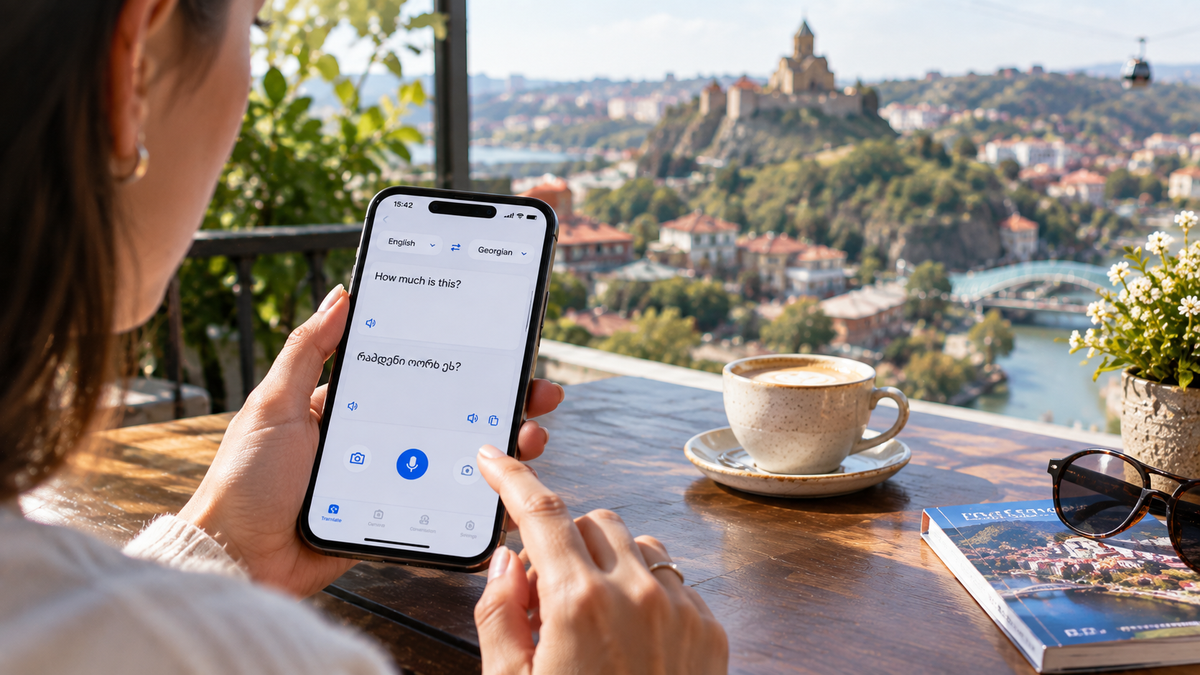
Georgian is built in a way that makes it genuinely hard for machines. It is not Slavic and not Indo-European at all, it has its own script, its own grammar, and a verb system where a single form can carry information about several participants in the action at once.
The practical upshot is simple: translators handle Georgian worse than you're used to. They will usually get you the gist, but producing Georgian text that does not read strangely is a different matter.
Here is what actually works, for which situations, and where a machine will reliably let you down.
📱 Which services actually support Georgian
Start with the basics, since this is usually where the disappointment happens.
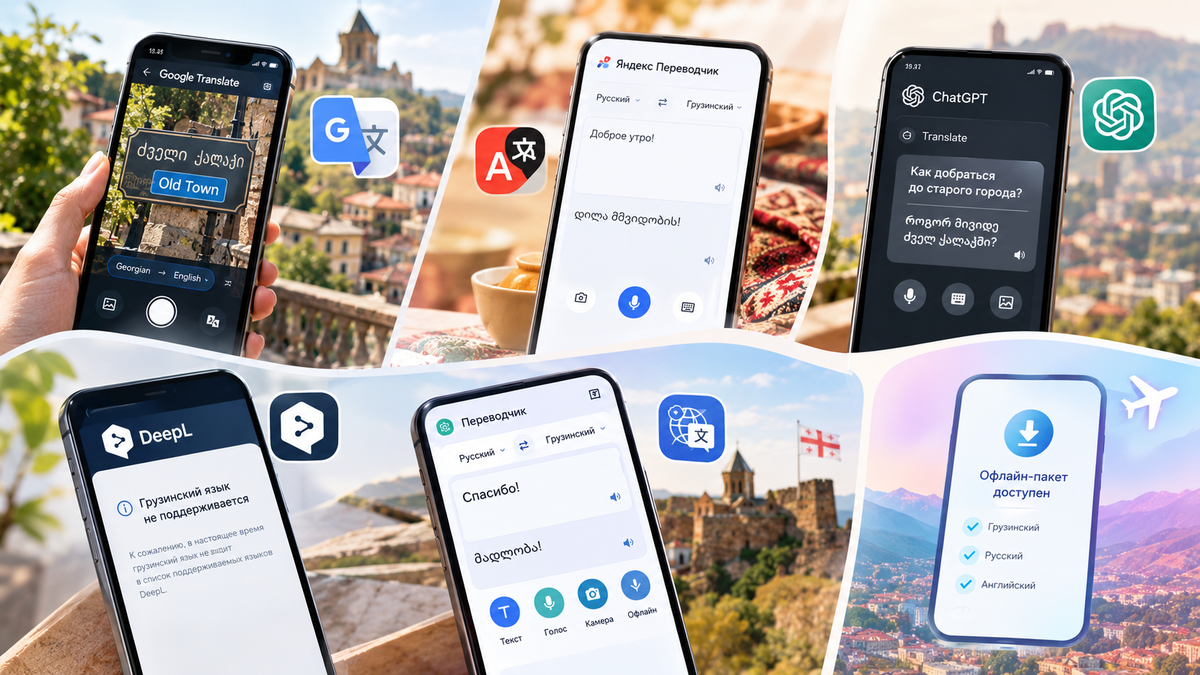
Google Translate remains the main tool. In 2026 it runs on the local Gemini Nano model, supports over 130 languages, and translates text in augmented reality: point the camera at a sign, and the translation overlays the original in real time, accounting for perspective and lighting. Voice input has learned to handle accents and background noise, and dialogue mode now figures out who is speaking which language without anyone tapping the microphone.
Yandex Translate supports Georgian and includes both voice and photo translation. For Russian speakers it is the obvious second option, and on some phrasing it actually outperforms Google.
ChatGPT Translate launched in early 2026 as OpenAI's dedicated tool: around a hundred languages, text and voice, limited offline mode once language packs are downloaded. For connected text and correspondence, AI models generally produce more natural results than classic translators.
DeepL does not support Georgian. Worth knowing before you rely on it: if you're used to DeepL for European languages, you will need a different tool here.
Dedicated apps. App stores carry standalone Georgian-Russian and Georgian-English translators with offline packs, voice input and a camera. Quality varies, but the offline mode on some of these can be more reliable than the big players.
🎤 Voice translation: where it works, where it breaks
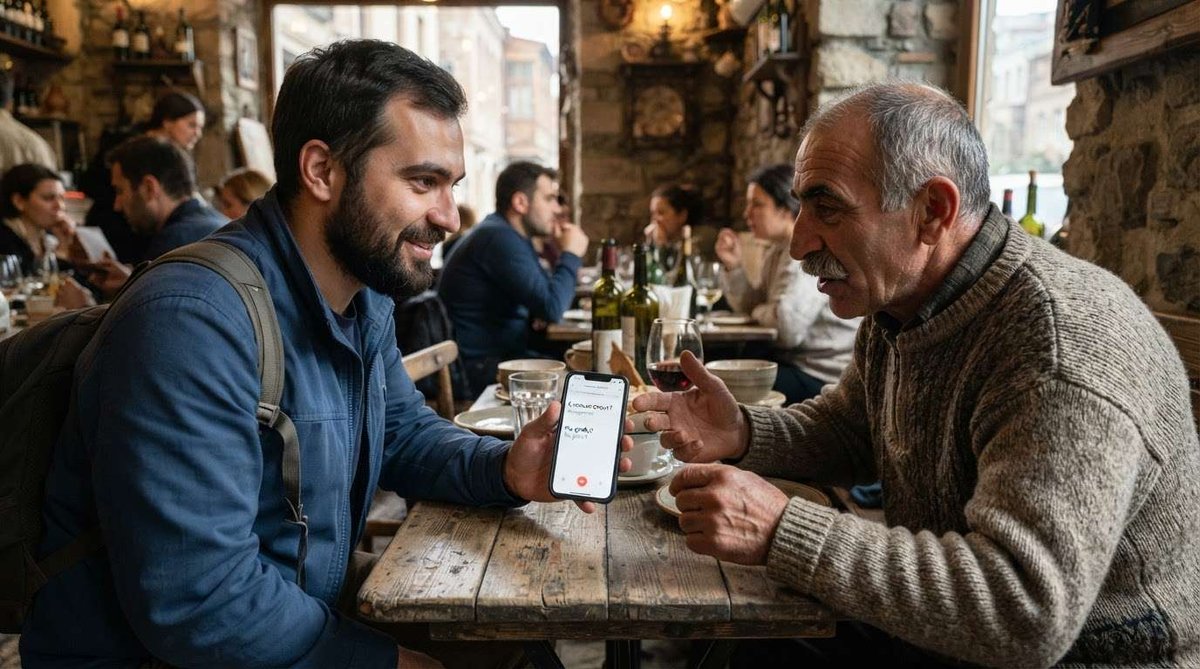
The most tempting feature, and the most overrated one.
Where it works well. Short everyday phrases: "how much is this," "where's the nearest pharmacy," "can I get the bill." Dialogue mode, where the phone sits between you and figures out the language on its own, suits this well.
Where it starts breaking down. Georgian phonetics are genuinely hard to recognise: the language has sounds that don't exist in English, including a set of ejective consonants. If the other person speaks fast, has a regional accent, or you're somewhere loud, recognition slips, and you get a translation of something that wasn't quite said.
A practical habit. Don't rely on voice in one direction only. Show the other person the screen with the translated text; they'll immediately spot it if the app got something wrong.
And to be honest about pace. A conversation run through a translator is slow. Fine for a quick question on the street, not for a half-hour chat.
The camera: the most practical use case
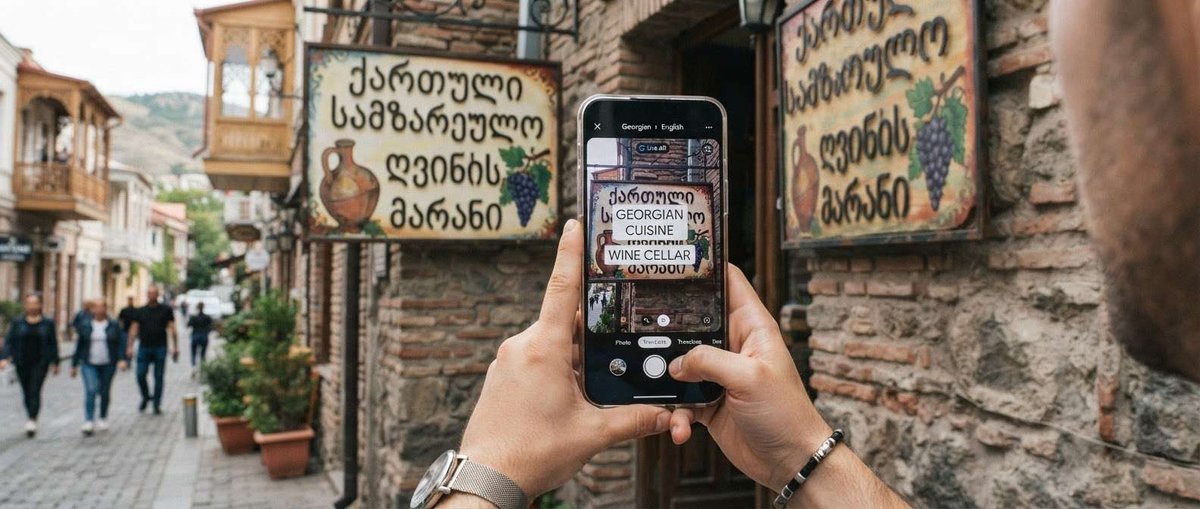
This is where machine translation genuinely earns its keep, and here's why.
The Georgian alphabet is unfamiliar. Unlike, say, Polish, where the letters are at least recognisable and you could type a word manually, you can't even copy a Georgian sign by hand. The camera solves that problem outright.
Menus, price tags, labels, signposts. All short phrases without complicated grammar, and they translate predictably.
AR mode overlays the translation directly on the original text in real time. It works smoothly on menus and signs, less so on dense blocks of text.
Where the limits are. Handwriting is recognised poorly. Decorative fonts on restaurant signage, likewise. Small print on packaging needs good light and a steady hand.
A tip. If the live overlay comes out nonsensical, take a plain photo and translate it from your gallery instead: a static image reads more accurately than a moving camera feed.
⚠️ Why Georgian is genuinely hard for machines

The section most translator round-ups skip, and the one that explains everything else.
The language is isolated by origin. Georgian belongs to the Kartvelian family, with no proven relation to Slavic or Indo-European languages at all. For machine learning, that means fewer parallel texts to train on and no related language to lean on.
The verb is built unfamiliarly. A single verb form can encode information about several participants in the action at once. A Russian or English sentence doesn't map onto Georgian word for word, and the reverse is just as true.
There's simply less training data. Georgian has a few million speakers. There is orders of magnitude less text online in it than in English or Russian, and models are trained on correspondingly less of it.
What that means in practice.
Translation out of Georgian is usually more understandable than the other direction: you get the gist even when the phrasing is off.
Translation into Georgian more often comes out unnatural. A native speaker will understand it, but they'll hear the machine in it.
Check anything important with a round trip. Translate the phrase into Georgian, paste the result back in, and see what comes out in your own language. It's a blunt method, but it catches the blunt mistakes.
✉️ A special case: Georgian texts in the Latin alphabet
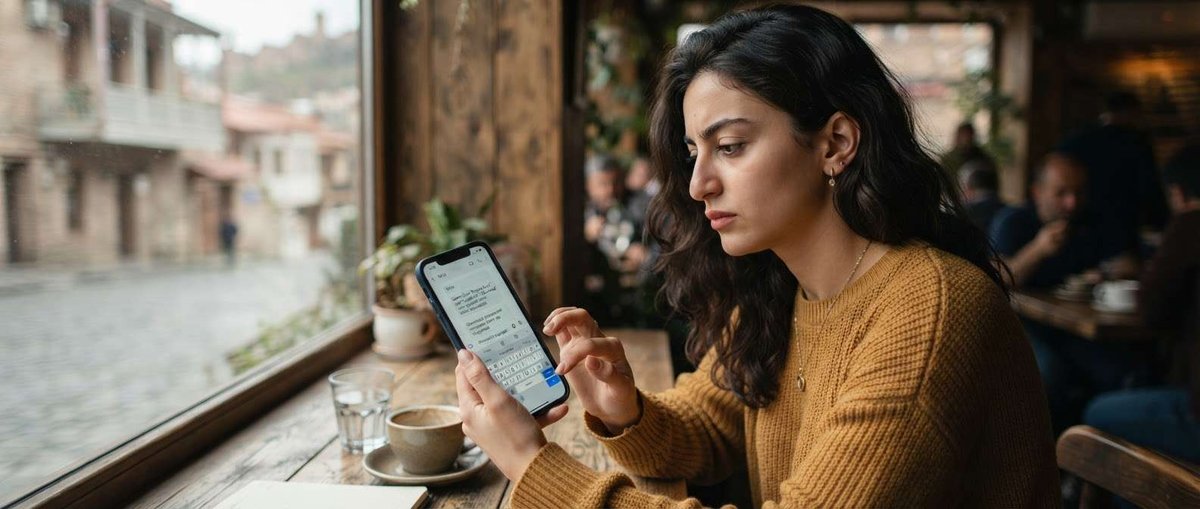
Something almost everyone runs into, and it stumps ordinary translators completely.
Georgians often write in messaging apps using the Latin alphabet, not in English, but Georgian words spelled out with Latin letters. "Gamarjoba, rogora khar" is neither English nor a Russian-style transliteration.
Why the translator fails. It sees Latin letters, tries to guess the language, and usually guesses wrong. To get a real translation, the text first needs to be converted back into the Georgian alphabet.
How to actually do that is covered in a separate piece: how to translate Georgian texts written in the Latin alphabet.
🗣️ When you don't need a translator at all
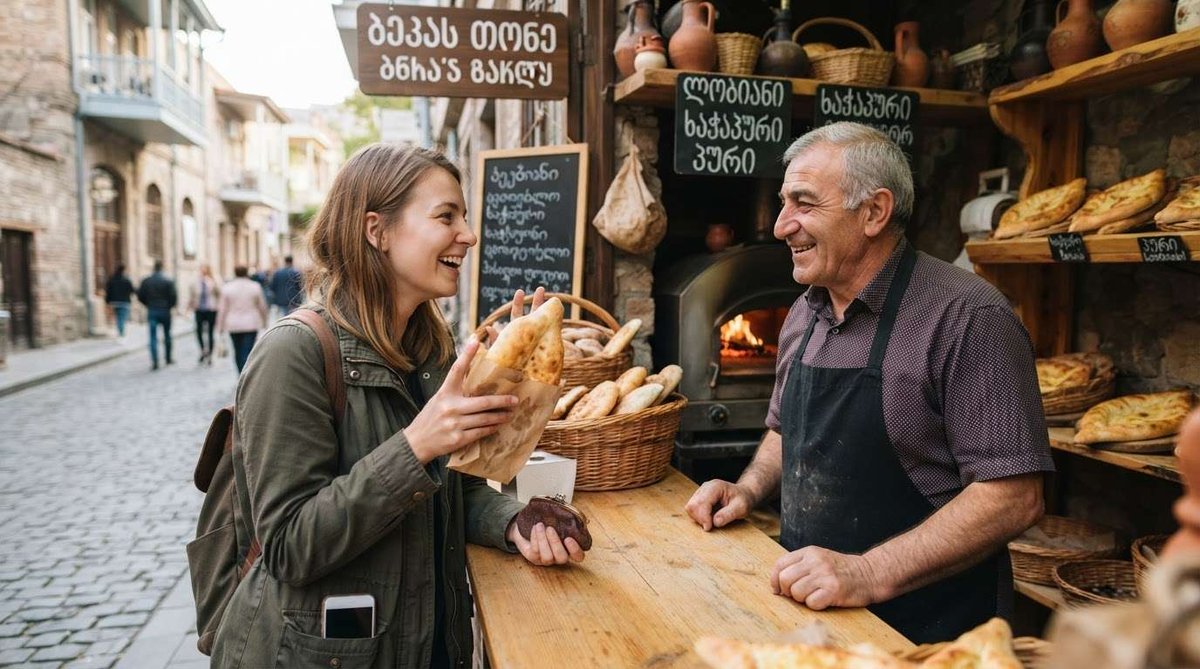
Counterintuitively, in half of everyday situations you don't need to reach for your phone.
A handful of basic phrases covers more than you'd expect. "Gamarjoba" (hello), "madloba" (thank you), "didi madloba" (thank you very much), "ki" (yes), "ara" (no), numbers up to ten. That set closes out most short interactions, and how people respond to you shifts noticeably: attempting a few words of Georgian is appreciated here.
A minimal set is collected in 12 words and phrases every traveller should know, and a fuller one in the beginner's phrasebook.
On the alphabet. Learning the thirty-three letters is easier than it sounds, and it makes a real difference: you start reading street signs and shop names without a camera at all. Covered in the Georgian alphabet.
And on what sits behind the words. Why "gamarjoba" is not simply "hello," and why "genatsvale" doesn't translate into a single word, is covered in the uniqueness of the Georgian language.
📄 When you need a human translator
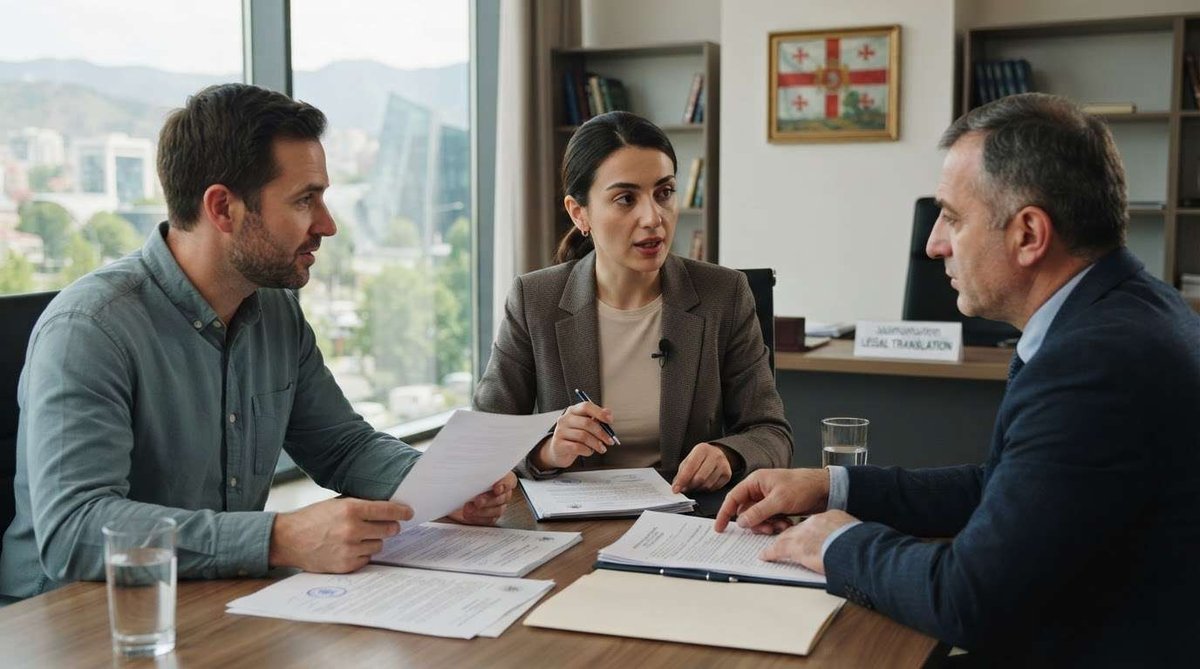
Some tasks rule an app out entirely.
Documents. Certificates, diplomas, official records, lease and sale agreements. For anything going to an official body, you need a professional translation, often notarised.
Legal matters. Meeting with a lawyer, signing a contract, dealing with government agencies.
Medical visits. Describing symptoms, understanding a diagnosis. Here the cost of a mistranslation is too high. How to find a doctor who speaks your language is covered separately.
Business negotiations, where exact wording matters.
Translation agencies with addresses and contact details are collected in the directory: translation agencies in Tbilisi, translation agencies in Batumi and translation agencies in Kutaisi.
Download the Georgian offline pack before you travel. Signal drops out in the mountains, and that's exactly where you'll need a translator most: in Tbilisi and Batumi someone will likely speak Russian or English with you, in a Svan or Tush village that's no longer a given.
And carry two apps, not one. When a phrase comes out looking nonsensical, run it through a second service. Where they disagree tells you exactly where the machine got confused, and where they agree gives you some confidence the translation is at least close.
Used a translator in Georgia? Leave a review on Madloba: tell us which app pulled through, where it let you down, and which phrases you ended up learning by heart.
Information is current as of September 2026. Translator features update frequently: supported languages, offline availability and recognition quality all shift with app versions. Check current capabilities in the app itself before you travel.
❓Frequently Asked Questions
💬 There isn't a single best one; it depends on the task. Google Translate, with its dialogue mode and AR overlay, works well for conversation and the camera. Yandex Translate is a solid option if you're already in its ecosystem. For connected text and correspondence, AI-based models tend to produce better results.
💬 No. This trips up a lot of people used to it for European languages: Georgian isn't on DeepL's list, and you'll need a different tool here.
💬 Yes, and it's the most practical use case there is. The Georgian alphabet is unfamiliar, and you couldn't type a word off a sign by hand anyway, so the camera solves the problem outright. Handwritten and decorative text is recognised less reliably.
💬 Good on short, everyday phrases. It slips on fast speech, accents, or noisy places: Georgian has sounds that don't exist in English. Show the other person the screen with the text so they can spot a mistake right away.
💬 Yes, if you download the language pack in advance. Offline quality is usually lower than online, and some features may not be available. Worth downloading before you travel, especially if you're heading into the mountains.
💬 Georgian belongs to the Kartvelian family and isn't related to English, Russian, or other European languages. Its verb system is built unfamiliarly, and there's far less training text available for it than for English. Translating out of Georgian is usually easier to follow than translating into it.
💬 With a round trip: paste the translated Georgian back into the translator and see what comes back in your own language. It's a blunt method, but it catches the blunt mistakes. For anything important, run the text through two different services.
💬 Because Georgians often write in messaging apps using Latin letters for Georgian words, not English. The translator sees Latin script and guesses the wrong language. That text needs to be converted back into the Georgian alphabet first.
💬 No. Anything going to an official body needs a professional translation, often notarised. The same goes for contracts, legal matters, and talking to a doctor, situations where the cost of a mistake is too high.

0 comments
Log in to leave a comment