




Tbilisi Metro: A Complete Guide to the Tbilisi Metro
Tbilisi Metro is a key part of the transport system of Georgia’s capital, providing fast and convenient travel across the city and helping residents and tourists easily reach different districts.
The history of the Tbilisi Metro began in the Soviet era, and since then this popular mode of transport has been updated and modernized many times.
History of Tbilisi’s Underground Railway
The story of Georgia’s first and only metro system is filled with important milestones and achievements that played a key role in the development of the country—and its capital in particular.
1952 — The idea of construction: the beginning
The idea of building a metro in Tbilisi emerged in 1952, when the city faced growing transport challenges and the need for an efficient public transit system.
1954 — Design and preparation
Work on the metro project began in 1954. It included studying geological conditions and creating a master construction plan.
1957 — Construction begins
Building the metro was a complex technical and engineering undertaking that required major effort and resources, but the first construction works started as early as 1957.
1966 — Opening of the first line
On January 11, 1966, the first line of the Tbilisi Metro was officially opened. It included six stations: Didube, Elektrodepo, Vagzlis Moedani (Station Square), Marjanishvili, Rustaveli, and Tavisuplebis Moedani (Freedom Square).
1979 — Opening of the Blue Line
On April 15, 1979, the Blue Line (the Saburtalo Line) opened with three stations: Sadguris Moedani 2 (Station Square 2), Teknikuri Universit'et'i (Technical University), and Delisi. The new branch expanded the metro network and improved transport connections to the western districts of Georgia’s capital.
1985 — Further expansion
By 1985, the Tbilisi Metro network had grown to 19 stations. The opening of new stations, such as Vazha-Pshavela, supported the continued development and improvement of the city’s transport system.
2000s — Modernization and renewal
In the 2000s, a large-scale modernization program began: rolling stock and station infrastructure were upgraded, and modern safety systems were introduced—making the metro more comfortable and reliable for passengers.
2018 — Opening of “Universiteti” station
A new station, Universiteti, became part of the Blue Line and opened in 2018. It expanded transport options and improved access to educational institutions.
The future — Expansion plans
The city plans further expansion of the metro network, including building new stations and introducing innovative technologies to improve passenger service and increase capacity.
How to use the Tbilisi Metro
Fare and payment options
A single ride on the Tbilisi Metro costs 1 lari (about 30 cents). You can pay for your trip using mobile apps, contactless bank cards, or a Metromoney plastic card. The Metromoney card can be purchased at the metro ticket office for 2 lari and topped up at ticket offices and vending machines at stations.
The Metromoney card can also be used on other types of public transport in the city, such as buses and the funicular. Please note that if you pay with a Metromoney card, you can make free transfers within 1 hour on the metro or buses.
Discounts and free travel are available for students, pensioners, and other eligible groups.
Tbilisi Metro map
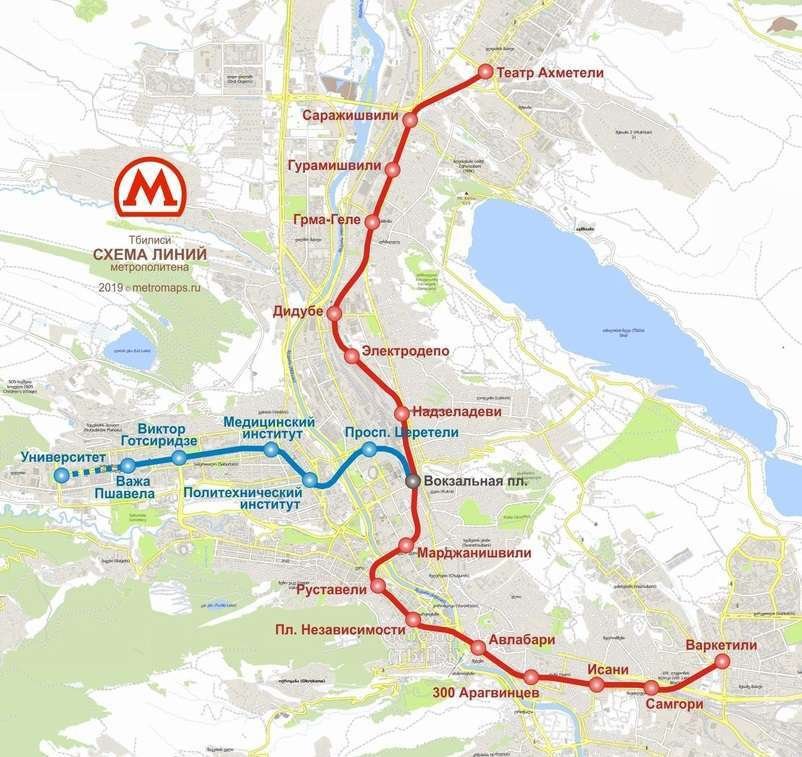
Main lines and stations
The Tbilisi Metro consists of two main lines:
- Red Line (Akhmeteli–Varketili) — the first and longest line. It runs through the city center and connects the northern and southern districts.
- Blue Line (Saburtalo Line) — a newer line serving the western districts of Tbilisi.
Infrastructure and amenities
Transfer station
There is only one transfer hub in the Tbilisi Metro — Sadguris Moedani. The transfer stations here are equipped with everything needed for passenger convenience: elevators, escalators, information boards, and multilingual navigation signage.
Navigation and passenger information
At stations and on trains, stops are regularly announced in two languages — Georgian and English. Listen carefully to the announcements and follow the signs so you don’t miss your station.
Passenger facilities
Special attention is paid to safety: stations and trains are equipped with CCTV cameras, and security staff are on duty on the platforms. In addition, some stations offer waiting areas with free Wi-Fi, and you can charge your mobile devices.
Tourist tips for using the Tbilisi Metro
The Tbilisi Metro is not only a convenient way for locals to get around—it’s also a great option for tourists to reach the city’s main attractions quickly and affordably.
Here are a few practical tips to make your metro rides as comfortable as possible:
- Plan your route in advance
Before you set off, check the metro map and plan your route. This will help you avoid confusion and save time. Metro maps are available at stations and online. - Buying and topping up a Metromoney card
To use the metro, you’ll need a Metromoney card. You can buy it at ticket offices in stations and top it up at vending machines. The card also works on city buses and the funicular. - Use navigation apps
For convenience, use mobile apps that show metro routes and provide information about nearby stations. This is especially helpful if you don’t speak Georgian. - Explore the most famous stations
Some Tbilisi Metro stations are true works of art. For example, Rustaveli is decorated with mosaics and marble columns, while Marjanishvili stands out for its architectural design. Stop by to enjoy their beauty! - Pay attention to operating hours
The Tbilisi Metro runs from 6:00 to 00:00. Keep this in mind when planning your trips, especially if you need to get back to your hotel late in the evening. - Follow signs and announcements
At stations and on trains, stops are regularly announced in two languages—Georgian and English. Listen carefully and follow the signs so you don’t miss your station. - Follow basic etiquette
As in any public transport, there are simple rules to follow: give up your seat to elderly passengers and people with children, don’t block walkways, and keep an eye on your belongings. - Use transfers wisely
If your route requires a transfer, familiarize yourself in advance with Sadguris Moedani (Station Square), which connects the two metro lines. Listen to announcements so you can switch lines quickly. - Explore the areas around stations
Many stations are close to interesting places. For example, from Freedom Square you can quickly reach the Old Town, and Rustaveli station is near Rustaveli Avenue, known for its shops and theaters. - Be prepared for crowds
During rush hours (morning and evening), the metro can get crowded—especially at central stations like Rustaveli, Tavisuplebis Moedani (Freedom Square), and Sadguris Moedani (Station Square), which many people use to transfer between lines. If you’d rather avoid crowds, plan your trips for less busy times.
By following these tips, you’ll be able to use the Tbilisi Metro easily and comfortably—and enjoy everything the city has to offer.
Safety tips for using the Tbilisi Metro
Safety is a key aspect of using public transport, and the Tbilisi Metro is no exception. Below are practical tips to help you feel safe and comfortable during your trips.
Keep an eye on your belongings
- Personal items: Keep bags, backpacks, and other belongings close to you—especially in crowded trains and at busy stations.
- Valuables: Try not to openly display valuables such as smartphones, wallets, or jewelry to avoid attracting unwanted attention.
Follow instructions and rules
- Announcements: Listen carefully to announcements and follow instructions from metro staff—especially in unexpected situations.
- Signs and directions: Pay attention to station signs and directional boards to navigate safely and avoid restricted or hazardous areas.
Be careful on escalators
- Adults: Hold the handrail and stand on the right so others can pass on the left.
- Children: Make sure children hold the handrail or your hand to prevent injuries.
Avoid overcrowded trains
- Rush hours: If possible, avoid traveling during peak times (8:00–10:00 in the morning and 17:00–19:00 in the evening), when trains can be very crowded.
- Off-peak: If a train is packed, wait for the next one—it may be less crowded.
Stay alert on platforms
- Safety line: Do not cross the safety line on the platform to avoid the risk of falling onto the tracks.
- Boarding and exiting: Let passengers exit the train first before you enter. This reduces crowding and speeds up boarding.
Know where the exits and emergency exits are
- Evacuation plan: Check the evacuation plan at the station and locate the nearest emergency exits.
- Emergencies: In an emergency, stay calm and follow metro staff instructions.
Use official entrances and exits only
- Official access points: Use only official metro entrances and exits to reduce risk and stay safe.
- Well-lit areas: Stick to well-lit areas and avoid dark, isolated places.
Report suspicious objects or people
- Suspicious items: If you notice something suspicious, do not touch it—report it immediately to metro staff or security.
- Suspicious behavior: If someone is acting suspiciously, inform metro staff or the police.
Keep children under close supervision
- Supervision: Keep children close, especially in crowded areas and on escalators.
- Instructions: Explain basic metro rules to children and tell them what to do if they get separated from you.
Notice CCTV cameras
- Security: CCTV cameras are installed in stations and trains for your safety and can be helpful if an incident occurs.
By following these simple but important tips, you can ensure a safer and more comfortable experience on the Tbilisi Metro.
Architectural highlights and interesting facts about the stations
Tbilisi Metro stations are known not only for their practicality, but also for their distinctive architecture and artistic design. Many of them are true works of art that reflect Georgia’s cultural and historical heritage.
Rustaveli Station
- Architecture: Named after the famous Georgian poet Shota Rustaveli, this station impresses with its grandeur. Mosaics, marble columns, and high vaults create a monumental atmosphere.
- Decor: Wall mosaics depict scenes from Shota Rustaveli’s life as well as key events from Georgian history—turning the station into a real underground museum.
- Depth: The deepest station in the Tbilisi Metro, at 60 meters.
- Historical significance: Opened in 1966, it is one of the oldest stations in the network, and its design reflects the spirit of the Soviet era in which it was built.
Marjanishvili Station
- Design: Decorated with bright mosaics and bas-reliefs showing scenes from Georgian history and culture. The interior feels theatrical and grand.
- Special features: The station often hosts exhibitions and art installations, making it a popular venue for cultural events.
- Location: Situated in the city center near the Kote Marjanishvili Theatre, which makes it especially popular among theater lovers.
Freedom Square Station (Tavisuplebis Moedani)
- Architecture: The station features marble and granite, along with decorative elements symbolizing freedom and independence.
- Surroundings: Located beneath Freedom Square—the heart of the city. From here, it’s easy to reach the Old Town and many of Tbilisi’s main attractions.
Avlabari Station
- City views: Located near the high bank of the Kura River, offering scenic views of the Old Town and the Holy Trinity Cathedral (Sameba).
- Historic district: Avlabari is one of Tbilisi’s oldest and most atmospheric neighborhoods, full of historic buildings and cozy cafés.
Technical University Station (Teknikuri Universiteti)
- Modern design: A good example of a contemporary approach to metro architecture. Modern materials and technologies were used, and passenger-friendly elevators and escalators were installed.
- Location: Serves one of Georgia’s largest universities—the Georgian Technical University. Thousands of students and staff use it daily.
- Innovation: The station often hosts exhibitions and presentations of new technologies, making it a hub of progress and innovation.
University Station (Universiteti)
- Latest technologies: Opened in 2018, this station stands out for its modern design and up-to-date technologies aimed at passenger comfort.
- Aesthetics: Decorated with artistic panels and light installations, making it one of the most visually appealing stations in the Tbilisi Metro.
Vazha-Pshavela Station
- Cultural heritage: Named after the renowned Georgian writer and poet Vazha-Pshavela, with design elements that highlight Georgia’s literary legacy.
- Architecture: Traditional Georgian ornaments and motifs give the station a distinctive local character.
Akhmeteli Theatre Station (Teatr Akhmeteli)
- Terminal station: A terminal on the Red Line and an important transport hub for residents of the northern districts.
- Shopping nearby: Large shopping centers and markets are located close to the station, making it a popular stop for shopping.
Delisi Station
- Green surroundings: Located in an area with parks and green spaces—great for walks and relaxation.
- Sports facilities: Several sports complexes are nearby, including the Mikheil Meskhi Stadium.
Tbilisi Metro’s architectural landmarks make it not only an efficient way to get around, but also an important cultural attraction worth exploring and appreciating.
Modern improvements to Tbilisi’s underground transport
Rolling stock upgrades
In recent years, the Tbilisi Metro has introduced new modern trains equipped with air conditioning, comfortable seating, and automated control systems. Existing trains are undergoing major overhauls and upgrades to meet today’s comfort and safety standards.
Innovative technologies
The introduction of automatic train control systems and infrastructure condition monitoring helps improve accuracy and operational safety. Metro stations are equipped with modern information displays and public announcement systems that inform passengers about train arrival times and other important updates.
Station modernization
Many metro stations have been renovated and modernized: interiors have been refreshed, and lighting and ventilation systems have been improved. As part of a broader accessibility program, stations are being fitted with elevators and ramps for passengers with reduced mobility and parents with strollers.
Safety systems
All stations and trains are equipped with modern CCTV systems, ensuring a high level of passenger safety. The metro has also implemented access control and additional security systems to help prevent incidents and respond quickly to potential emergency situations.
Energy efficiency
The Tbilisi Metro is adopting energy-saving technologies such as LED lighting and energy recuperation systems, helping reduce electricity costs and minimize environmental impact.
Electronic payment systems
Cashless payment options—such as Metromoney—allow passengers to pay quickly and conveniently using cards and mobile apps. These electronic payment systems are integrated with city buses and the funicular, making transfers easier and trips more seamless. In addition, if you pay with a Metromoney card, you can make free transfers within 1 hour on the metro or buses.
Infrastructure development
In the coming years, new metro lines and stations are planned to improve transport links to more remote parts of the city. Near some stations, new parking areas and park-and-ride facilities are also being created, making public transport more convenient for commuters.
Improving passenger service
The Tbilisi Metro continues to modernize to provide passengers with greater comfort, safety, and efficiency. Recent improvements cover multiple aspects of infrastructure, technology, and customer service.
Rolling stock upgrades
Innovative technologies
Station modernization
Safety systems
Energy efficiency
Electronic payment systems
Infrastructure development
Passenger service improvements
These modern upgrades make the Tbilisi Metro more comfortable, safe, and efficient, providing a high level of service for both residents and visitors.
Tbilisi Metro is not only a vital part of the city’s transport system, but also an important element of daily urban life. Thanks to continuous modernization and improvements, it remains a convenient and safe way to get around. Its rich history and architectural landmarks make metro rides both interesting and educational. Enjoy the comfort and discover new sides of Georgia’s capital with the Tbilisi Metro.

0 comments
Log in to leave a comment